A commercial interior rarely has the same acoustic requirements from one end of the building to the other. A corporate office, retail showroom, theatre, studio, boardroom, reception area, or large commercial building can all have very different combinations of hard surfaces, occupancy levels, ceiling heights, and background noise.
That makes acoustic specification less about finding one acoustic product for an entire project and more about understanding what each part of the space requires. Some areas may need wall absorption, some may need a conventional acoustic ceiling, while others may need suspended treatment that works without closing off an exposed ceiling.
The acoustic products mix also has to work visually and practically. Ceiling services, lighting, HVAC, partitions, furniture, and maintenance access can all influence which acoustic approach is realistic. A technically suitable product still needs to fit the actual architectural and MEP conditions of the project.
Amazone By Furnitech is one example of a supplier with experience across this type of work. We have been involved in ceiling and acoustic applications for more than two decades, with projects ranging from commercial offices, retail stores, studios, auditoriums, showrooms, multiplex, theatres, public buildings, and institutional projects. We also have more than 1,500 commercial clients who have used our panels and ceiling products.
Watch the Space Before Choosing the Acoustic Products
The first useful exercise is to look at the surfaces available for treatment. In a furnished corporate office, the ceiling may provide a large continuous absorption area, while selected walls can receive additional treatment. In a retail showroom, excessive wall treatment may interfere with displays, making the ceiling more important. A theatre or studio may have more specific requirements, while a reception or large commercial lobby may need acoustic treatment without making the space feel enclosed.
Ceiling construction is another important distinction. A standard suspended ceiling provides a continuous horizontal surface for acoustic tiles, while an exposed or visually open ceiling may be better suited to suspended acoustic products. These are different ceiling strategies and should not be treated as products that are automatically combined with acoustic ceiling tiles.
This is where the overall project drawing becomes useful. Reviewing reflected ceiling plans, wall elevations, furniture layouts and service locations before selecting acoustic products can prevent the common mistake of choosing products first and trying to make them fit later.
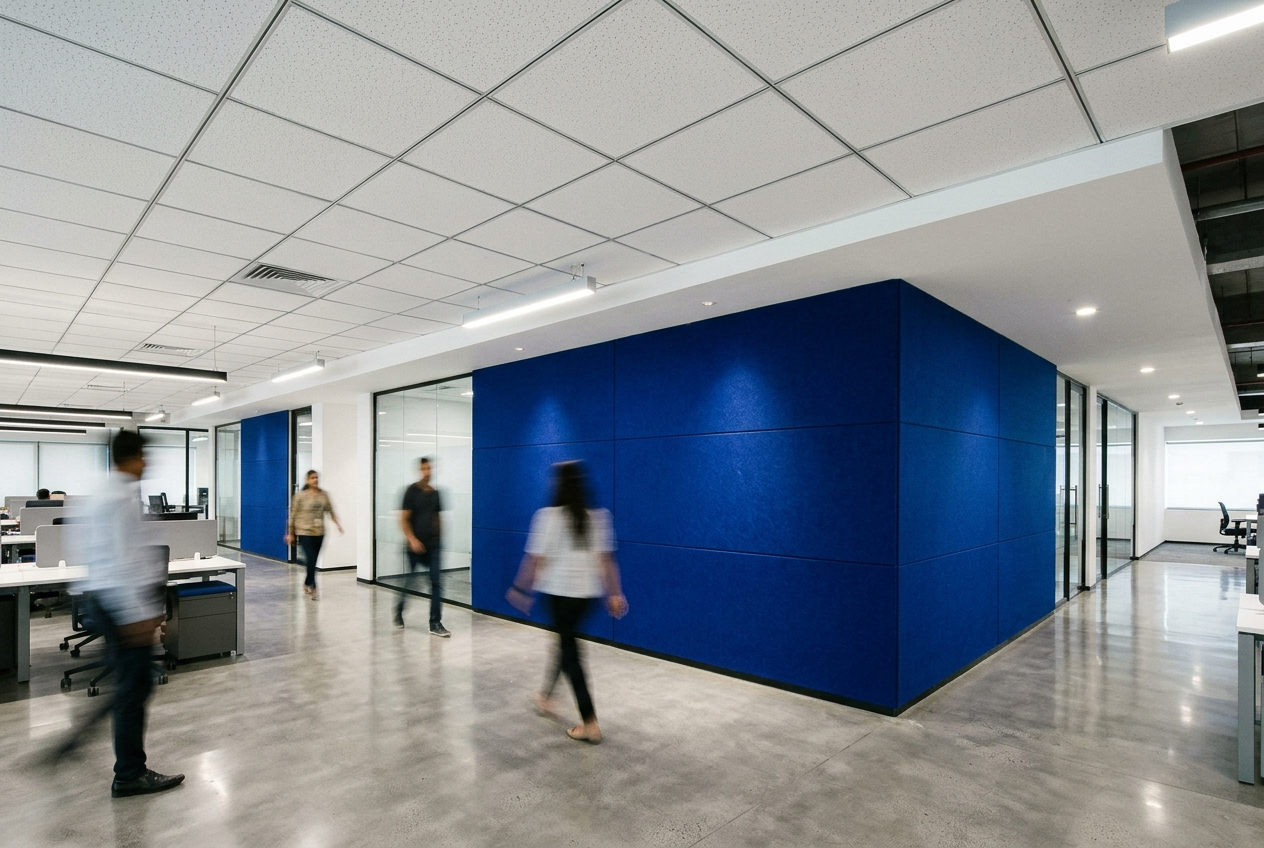
Polyester fibre acoustic panels are lightweight, design-flexible panels that can be installed on walls or suspended in customised configurations. They suit corporate offices, boardrooms, reception areas, retail showrooms and other commercial spaces where colour, shape or branding needs to be part of the acoustic design.
Amazone By Furnitech’s polyester fibre panels are available in 9 mm and 12 mm thicknesses, with NRC up to 0.70 and 0.85 respectively. Standard panels measure 2440 x 1220 mm and are available in multiple colours, while CNC-cut PET panel services allow customised patterns, curves, lettering and other designs. This makes them useful when acoustic treatment needs to follow a specific interior concept rather than simply cover a wall.
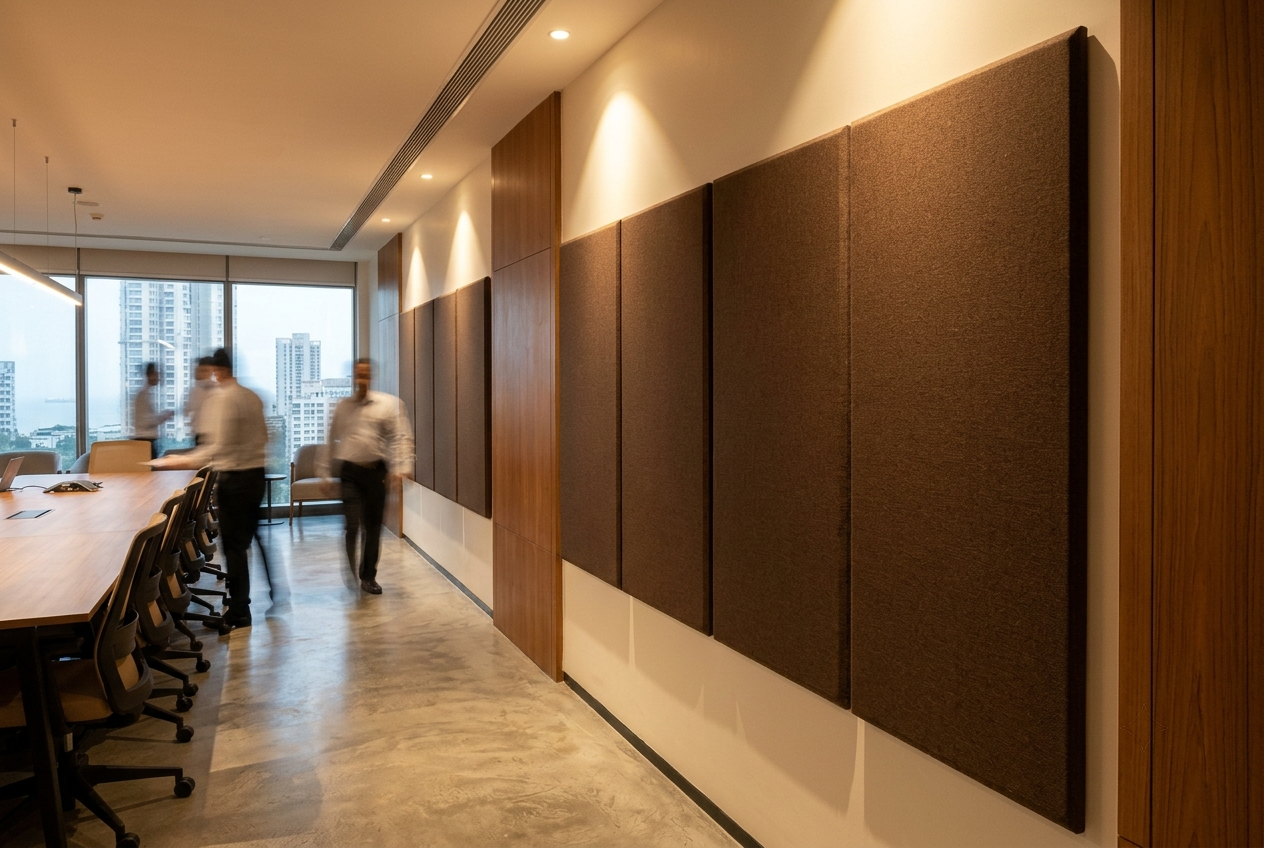
Fabric-wrapped acoustic panels are generally considered when a project needs stronger wall absorption along with a softer finished appearance. They can be useful in boardrooms, corporate offices, theatres, studios, reception areas and other commercial interiors where speech intelligibility and reverberation control are important, particularly when a larger proportion of wall treatment can be accommodated.
Amazone By Furnitech’s fabric-wrapped acoustic panels use a fibreglass acoustic core with a jute fabric finish. The panels are 25 mm thick, offer NRC up to 0.95 and are available in multiple size formats. The fabric finish allows designers to coordinate the acoustic treatment with the surrounding interior rather than leaving the acoustic core visually exposed.
White fibre glass wool acoustic ceiling tiles are suited to projects where acoustic treatment needs to form part of a conventional suspended ceiling. They work well in corporate offices, boardrooms, commercial buildings, retail areas and other interiors where a continuous ceiling surface, easy maintenance and integration with ceiling services are priorities.
Amazone By Furnitech offers white fibre glass wool ceiling tiles in Square, Tegular and Microlook edge profiles, with 15 and 20 mm thickness options and NRC up to 0.90. Available formats are 600 x 600, 1200 x 300 and 1200 x 600 mm. For projects designed around a T-grid ceiling, these tiles provide an acoustic ceiling solution without requiring a separate suspended feature system.
Black fibre glass wool acoustic ceiling tiles serve a different architectural purpose from conventional white tiles. They can be considered where the ceiling is intended to visually recede, particularly in theatres, studios, experience centres, selected retail environments and contemporary commercial interiors with exposed services or dark ceiling schemes.
Amazone By Furnitech’s black fibre glass wool acoustic ceiling tiles include 600 x 600 and 1200 x 600 mm formats in 15 and 20 mm thicknesses, with NRC up to 0.95. The darker finish can become part of the ceiling design while retaining the acoustic function of a ceiling tile, particularly where lighting, exposed services and the ceiling structure are intended to remain visually understated.
Mineral fibre ceiling tiles are a familiar option for commercial projects that need a conventional suspended ceiling with acoustic treatment. They can suit offices, corporate buildings, retail interiors, commercial facilities, reception areas and other spaces where a standard grid ceiling needs to accommodate lighting and building services.
Amazone By Furnitech’s mineral fibre ceiling tiles include Square, Tegular and Microlook edges, multiple surface textures and formats such as 595 x 595, 1195 x 295 and 1195 x 595 mm, with thicknesses from 12 to 20 mm. For the 16 mm variant, it offers an NRC of up to 0.60, an STC of 25 dB, an ASTM E84 Class A fire classification, thermal conductivity of 0.055 W/m·K, and light reflectance of 90.21%. These figures are based on testing conducted by SGS and ARAI.
Acoustic ceiling clouds are suspended elements used when the existing ceiling should remain visible or when a continuous acoustic ceiling is not suitable. They work well in large corporate interiors, reception areas, showrooms, retail environments and other commercial spaces where an open ceiling volume is part of the design.
Amazone By Furnitech’s acoustic ceiling clouds use fibreglass and polyester fibre and are available in circles, hexagons, rectangles, squares, waves and curves. Standard options include 600, 900 and 1200 mm diameter formats, along with rectangular configurations, with NRC up to 0.95. Amazone By Furnitech also offers custom acoustic ceiling clouds that can be CNC-cut or hand-cut into project-specific shapes and colours, giving designers greater control over both acoustics and the ceiling’s visual character.
Acoustic baffles are vertically suspended elements that provide absorption while retaining a visually open ceiling. They are particularly useful in large commercial interiors, open-plan offices, showrooms, retail floors and other spaces where a conventional continuous ceiling is not part of the design.
Amazone By Furnitech’s standard acoustic baffles use high-density fibreglass wool and measures 2400 x 300 x 30 mm, with NRC up to 0.90. Acoustic baffles can also be customised in size, shape and colour, allowing the suspension layout to coordinate with lighting, services and the geometry of the space. For larger or exposed commercial ceilings, this can be more suitable than introducing a conventional ceiling-tile system.
Perforated gypsum acoustic boards are useful when acoustic treatment needs to remain visually close to a conventional gypsum surface. They can suit corporate offices, commercial buildings, boardrooms, reception areas and other interiors where walls or ceilings need to maintain an integrated architectural appearance.
Amazone By Furnitech’s perforated acoustic gypsum boards measure 2400 x 1200 x 12 mm, with NRC up to 0.60. They can be used on walls or ceilings, while perforated gypsum ceiling tiles are available in 595 x 595 x 12 mm formats for grid-based applications. The board format is useful where larger continuous surfaces need acoustic treatment without introducing a visibly different material.
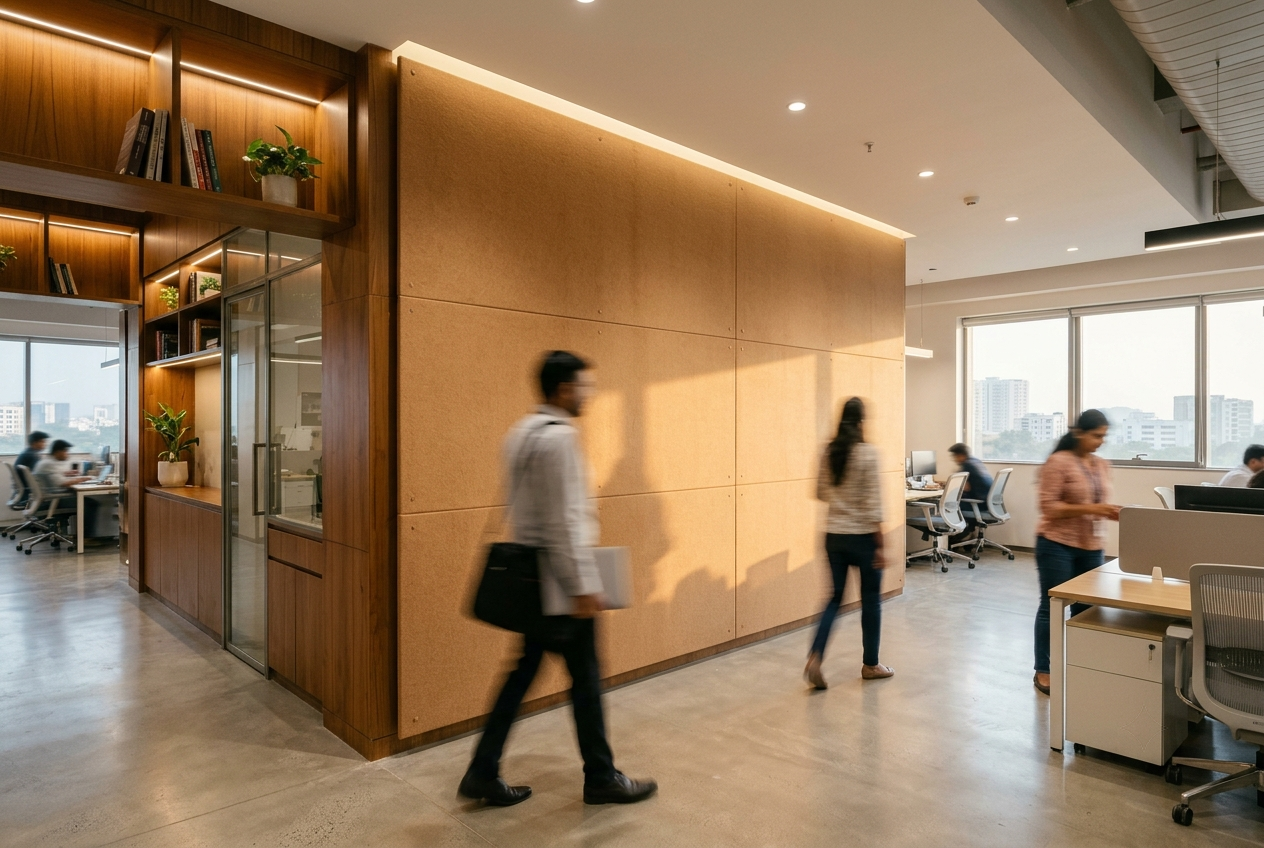
Wood wool acoustic boards are suited to interiors where acoustic treatment is expected to contribute to the material character of the space. Their textured surface works particularly well in creative offices, commercial showrooms, feature areas and other design-led commercial interiors where a visible acoustic finish is acceptable.
Amazone By Furnitech wood wool acoustic boards come in 600 x 600 and 1200 x 600 mm formats, with 15, 20 and 25 mm thickness options and NRC up to 0.70. The boards can be installed on walls or ceilings and painted in different colours, providing flexibility when the acoustic treatment needs to coordinate with a specific colour palette or become part of the interior design.
MDF acoustic panels are generally used when acoustic treatment needs to resemble a conventional decorative wall or ceiling finish. Grooved and perforated surfaces can provide acoustic absorption while contributing a wood-based architectural appearance, making them relevant to corporate offices, boardrooms, commercial interiors, gyms, public-facing spaces and selected feature areas.
Amazone By Furnitech’s MDF acoustic panels are available in 2440 mm x 128 mm and 2440 mm x 192 mm sizes, with 16 mm and 18 mm thicknesses, multiple shades, and an NRC of up to 0.70. They can be installed on walls or ceilings and use MDF, HDF or HDMR construction depending on the product. For commercial interiors where a wood-look or patterned finish is already part of the design language, these panels can integrate the acoustic requirement more naturally into the overall architectural finish.
Think in Systems, Not Just Individual Acoustic Products
Once the space has been assessed, the acoustic products can be grouped into a few practical treatment strategies. For a conventional suspended ceiling, the project may use white or black fibre glass wool tiles or mineral fibre tiles, depending on the desired appearance and specifications. Wall treatment can then be considered separately where additional absorption is required.
For an exposed or visually open ceiling, baffles or clouds can provide suspended acoustic treatment without creating a continuous ceiling plane. Wall panels or boards can be used alongside them where the walls also require treatment.
Another approach is to use wall-based products as the primary acoustic treatment, particularly where the ceiling needs to remain visually simple. Polyester fibre, fabric-wrapped panels, perforated gypsum boards, wood wool and MDF can each serve different architectural requirements. The key distinction is that these are different ways of building an acoustic system. A project does not need every product category simply because they are available.
Installation Has to Be Considered Early
Acoustic performance is only one part of a commercial specification. Ceiling height, suspension points, lighting, HVAC, sprinklers, electrical services, access requirements and maintenance all affect practical installation.
This becomes especially important when a project uses suspended baffles or clouds instead of a conventional acoustic ceiling, or when wall panels need to align with doors, glazing, partitions and other architectural elements. The acoustic strategy may also need to vary between zones. A reception area, for example, may require a different treatment from a meeting room, while a retail showroom may need acoustic control without making the ceiling feel visually heavy.
Amazone By Furnitech’s project portfolio illustrates this approach of combining different acoustic products. The P-Square Movieplex project included GI T-Grids, Black Fibre Glass Wool Acoustic Ceiling Tiles and Perforated Gypsum Acoustic Boards, while the Gujarat High Court auditorium project included GI T-Grids, Mineral Fibre Ceiling Tiles, MDF Acoustic Panels and Perforated Gypsum Acoustic Boards.
Build the Specification Around the Actual Project
There is no requirement for a commercial building to use one acoustic product throughout. The practical approach is to identify the acoustic role of each area, determine which surfaces can be treated, and select acoustic products that fit those conditions. Conventional ceilings, exposed ceilings and design-led walls may each require a different approach.
The final specification should be based on actual room dimensions, occupancy, surface finishes, reflected ceiling plans, service coordination and the intended use of each area. Selecting acoustic products becomes much more straightforward once these conditions are established.
Amazone By Furnitech is worth considering when a project needs access to several of these categories from a single supplier, particularly when acoustic panels, ceiling tiles, suspended systems, and customised acoustic products need to be coordinated. Their commercial project experience provides useful context when evaluating products alongside their installation requirements. For project-specific guidance on selecting suitable acoustic products, contact us to discuss your building’s requirements and explore the available options.
TL;DR
Commercial interiors rarely have uniform acoustic requirements, making it important to select acoustic products based on each area’s function, ceiling structure, available surfaces and design needs. From polyester fibre, MDF and fabric-wrapped panels to mineral fibre and white and black fibre glass wool acoustic ceiling tiles, as well as clouds, baffles, wood wool and perforated gypsum acoustic boards, combining suitable solutions can create a more effective acoustic system. Early planning, product specifications and installation coordination help ensure the selected acoustic products meet the project’s practical, acoustic and aesthetic requirements.
_ _
Considering acoustic treatment for your space?
Furnitech supplies and installs acoustic panels and ceiling tiles across India.
Call +91-9727092998 or send your requirements.