Conference rooms are often judged acoustically only after the furniture is in place, the screens are installed and the first meeting takes place. By then, changing the room can be considerably more difficult than planning the acoustic treatment during the design stage. A long conference table, glass partitions, painted walls, hard flooring and a large display can create a highly reflective environment.
The room may look polished, but voices can lose clarity as reflections build up around the table. This becomes particularly noticeable when several people are speaking, when someone is presenting from one end of the room, or when the same room is used for video conferences. Acoustic panels planned at the right stage can help manage these reflections and improve speech clarity.
Our approach to conference room acoustics is shaped by nearly two decades of experience across ceiling and acoustic projects. Our project portfolio includes Gujarat University Auditorium, Gujarat High Court Auditorium, CM Dashboard, P-Square Movieplex, and theatre projects across multiple states. This range of projects has given us experience with very different room sizes, finishes, installation conditions and acoustic requirements. For conference rooms, that experience leads to a fairly simple principle: selecting the right acoustic panels should not be the starting point. Start with what the people in the room need to hear.
The Real Problem Is Usually Not ‘Noise’
In a conference room, the complaint is often described as noise even when the underlying issue is reverberation. If someone speaks from the far end of the room, the listener receives the direct sound from the speaker followed by reflections from the ceiling, walls, glass and other hard surfaces. When these reflections are strong enough, speech can become less distinct even though the room itself is not particularly loud.
That is why adding absorption to the right surfaces can make a conference room feel substantially clearer without trying to make it completely quiet. A useful first step is to identify which surfaces are causing sound to reflect around the room and which of those surfaces are realistically available for acoustic treatment.
Consider a medium-sized conference room where the ceiling is already occupied by lighting, air-conditioning diffusers and other services. One wall is mostly glass, another has a display, while the remaining wall has enough uninterrupted area for acoustic treatment. In this situation, wall treatment can be more practical than redesigning the ceiling.
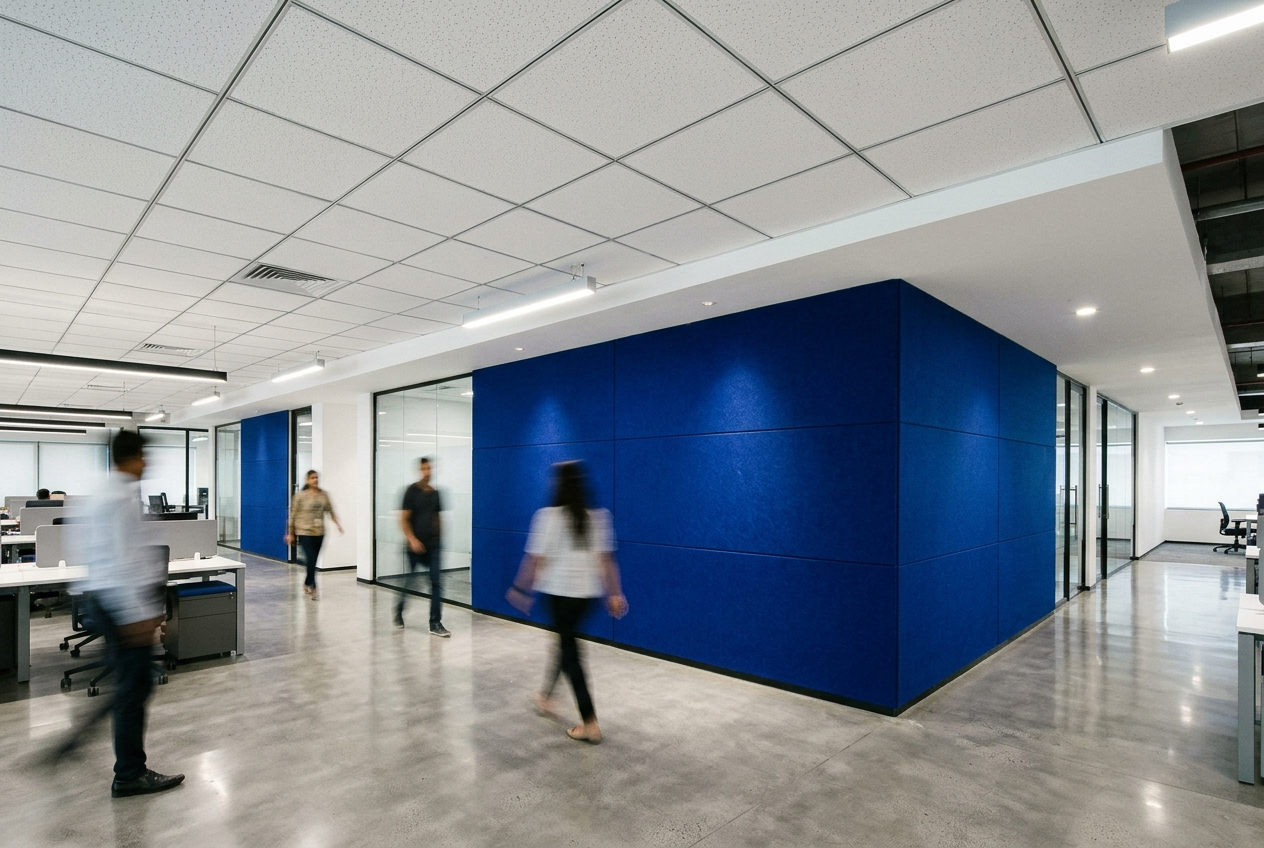
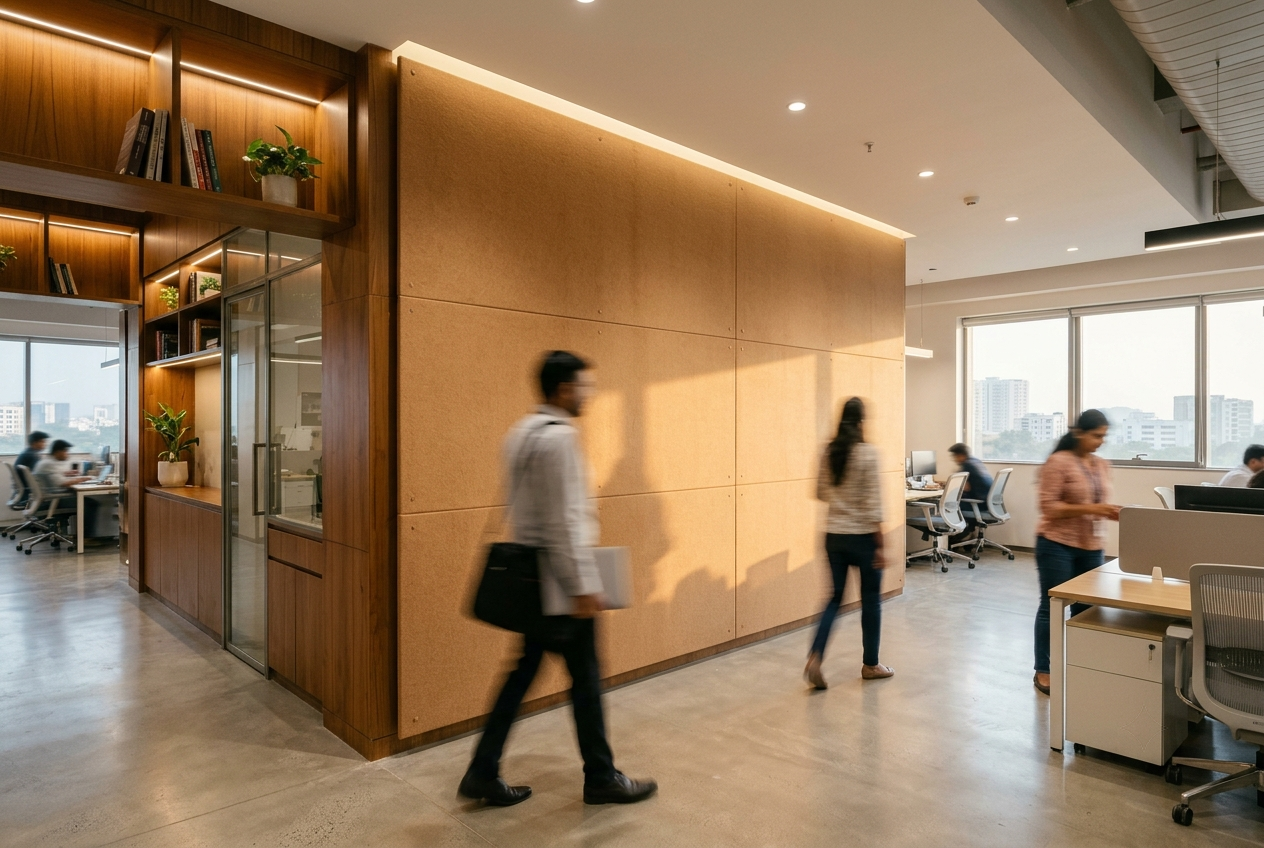
Polyester fibre acoustic panels are useful when a project needs a large, lightweight acoustic surface that can also complement the interior. Amazone By Furnitech’s Polyester Fibre Acoustic Panels are available in 2440 x 1220 mm sheets in 9 mm and 12 mm thicknesses. They offer an NRC of up to 0.70 for 9 mm and up to 0.85 for 12 mm, with 45 shades for 9 mm and 27 shades for 12 mm.
For meeting, training or conference rooms, this allows designers to treat selected wall areas instead of filling the room with smaller acoustic elements. The panels can also be CNC customised for company logos, geometric patterns, curved forms or specific interior concepts. Amazone By Furnitech’s CNC-Cut PET Acoustic Panels support CNC-ready designs in formats such as DXF, DWG, AI, and SVG.
Now consider a conference room where most wall areas are already occupied by glass partitions, displays, writing surfaces and architectural finishes. There may be very little practical wall space left for acoustic panels. In this situation, the ceiling can become the largest uninterrupted surface available for absorption.
Amazone By Furnitech’s Fibre Glass Wool Acoustic Ceiling Panels are available in 1200 x 300 mm and 1200 x 600 mm formats, with 15 mm and 20 mm variants and offer an NRC values of up to 0.90, depending on the configuration. The range is available in Square and Microlook edge options, with white and black finishes.
For large conference, training or corporate meeting rooms with limited wall area, this approach places acoustic absorption on the ceiling while keeping walls available for displays and other functions. The modular format can also be coordinated with lighting and other services, which is important in commercial installations.
A more demanding conference room can present a different set of conditions. Imagine a large table surrounded by glass, polished surfaces and little soft furnishing. The room may host presentations, negotiations and video meetings throughout the day, making speech clarity more important than simply reducing the overall sound level. This is where a thicker, high-absorption wall panel can be useful.
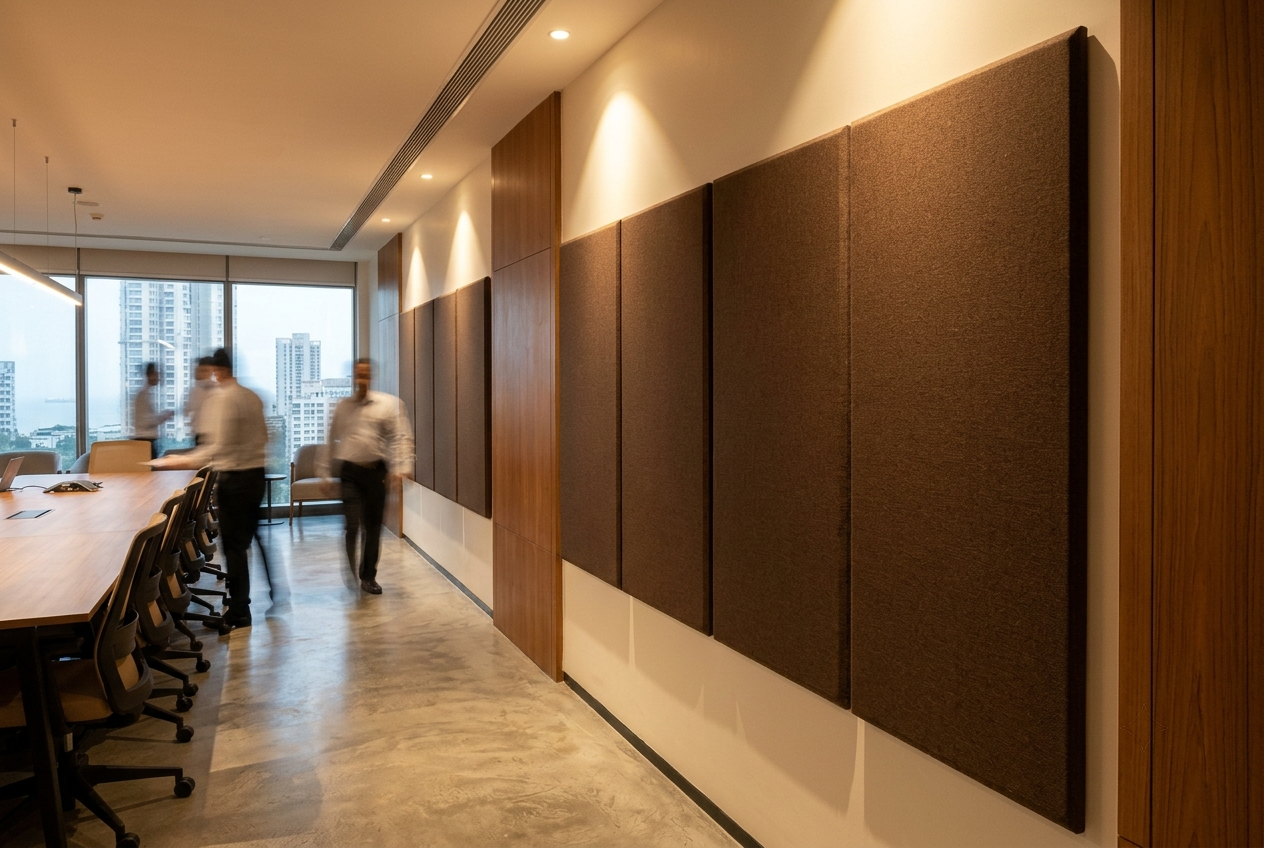
Amazone By Furnitech’s Fabric Wrapped Acoustic Panels use a high-density fibreglass acoustic core with a 25 mm thickness. They are available in 600 x 600 mm, 1200 x 600 mm, 1800 x 600 mm, 2100 x 600 mm and 2400 x 600 mm formats, with 12 jute-finish shades and an NRC of up to 0.95.
For large executive conference or client presentation rooms, the panels can be positioned across selected reflective wall areas rather than treating every wall. The fabric finish also gives architects more control over how the acoustic treatment integrates with a formal corporate interior.
The Conference Table Can Change the Acoustic Behaviour
There is another practical issue that can be missed when a room is specified only from a drawing. The conference table itself can become a significant reflective surface. A large solid table surrounded by hard flooring and walls gives sound another surface from which to reflect.
The same room can therefore behave differently depending on its furniture and finishes. That is why acoustic treatment should be reviewed once the intended furniture layout is known. For a smaller meeting room, a few strategically positioned wall acoustic panels may be enough. A larger conference room with extensive glazing and a hard ceiling may require a combination of wall and ceiling absorption.
Video Conferencing Makes the Problem More Obvious
Conference rooms today are rarely used only for people sitting around a table. A significant amount of corporate communication happens through video calls, and microphones can expose acoustic problems that people in the room may tolerate. Reflections can make voices less distinct, while excessive reverberation can make a remote participant’s audio less clear than the speech heard by someone sitting across the table.
That does not mean an acoustic panel should be selected solely for video conferencing. It means the room should be evaluated as a speech environment, whether the listener is sitting inside the room or joining remotely. Acoustic panels can help in spaces where reflective surfaces dominate, while ceiling absorption can be more useful when wall space is limited. The appropriate balance depends on the room’s geometry, finishes and intended use.
Choosing Between the Three
For conference rooms with usable wall surfaces and a strong need for design flexibility, polyester fibre acoustic panels provide a lightweight option with broad colour choices and CNC customisation.
For highly reflective conference rooms where stronger wall absorption is required, fabric wrapped acoustic panels are available with a fibreglass core, high NRC and a fabric finish that can integrate into a formal interior.
When wall space is limited and the ceiling provides the largest practical treatment surface, fibre glass wool acoustic ceiling panels offer a modular approach with high NRC values.
The important point is that these are not three competing answers to the same problem. They give project teams different ways to place acoustic absorption where the room needs it.
What an Experienced Recommendation Should Include
A useful acoustic recommendation for a conference room should go beyond saying, ‘Use this panel.’ It should account for the room dimensions, ceiling height, glazing, wall finishes, flooring, furniture layout, expected occupancy, existing services and the actual complaint from the people using the room. The acoustic product’s thickness, NRC, dimensions and installation method can then be evaluated against those conditions.
That is also why project experience matters. Amazone By Furnitech has more than two decades of experience in ceiling and room acoustics, with projects across institutional and commercial spaces and experience serving more than 1,500 commercial clients. This provides a practical basis for discussing how acoustic products perform within real project constraints rather than treating every conference room as a blank box.
A More Practical Way to Specify the Conference Room
There is no universal best acoustic panel for a conference room. A sensible specification starts with the room’s acoustic behaviour and then determines where absorption can be introduced without compromising screens, services, furniture, aesthetics or future maintenance.
For architects, interior designers, contractors and corporate project teams, the most useful information to prepare before asking for a recommendation is the room size, ceiling height, occupant count, furniture layout and existing ceiling system. It is also useful to identify whether the main issue is echo, speech clarity, video-conference quality or sound travelling outside the room. Once those details are understood, the panel becomes the final part of the decision rather than the starting point.
Amazone By Furnitech is worth considering in that process because its range includes polyester fibre acoustic panels, fabric wrapped acoustic panels and fibre glass wool acoustic ceiling panels. The polyester range also extends to CNC-cut PET acoustic panels, allowing acoustic treatment to follow a particular architectural pattern rather than being limited to standard rectangles. For a conference room that performs as well as it looks, start with the right acoustic specification. Contact us to discuss your project requirements and explore acoustic panels suited to your room layout, ceiling design and performance needs.
TL;DR
Conference room acoustics depend on more than the acoustic panel itself. Room dimensions, ceiling height, glass partitions, furniture layout, reflective surfaces and video-conferencing requirements all influence the type and placement of acoustic treatment. Polyester fibre acoustic panels are suitable for flexible wall designs and CNC customisation, fabric-wrapped acoustic panels offer stronger wall absorption, while fibre glass wool acoustic ceiling panels are useful when wall space is limited. The right specification should balance speech clarity, acoustic performance, interior design and installation requirements. With more than two decades of project experience, Amazone By Furnitech offers these acoustic solutions for different conference room requirements.
_ _
Considering acoustic treatment for your space?
Furnitech supplies and installs acoustic panels and ceiling tiles across India.
Call +91-9727092998 or send your requirements.