Large open spaces create acoustic problems that are difficult to solve with a single ceiling treatment. A high ceiling increases the volume of the room, while long distances allow sound to travel further. Hard floors, glass, concrete, and other exposed surfaces can also send reflections back into the occupied area.
The result can vary significantly depending on the building. An auditorium needs controlled sound and speech clarity. An open office can struggle with overlapping conversations. A large retail or hospitality space may become increasingly loud as occupancy rises. A university or institutional building may need acoustic treatment without compromising service access or the practicality of its acoustic ceiling systems.
Experience across these environments is useful because large-space acoustics involves more than product selection. Amazone By Furnitech‘s wider project portfolio includes work at the Gujarat High Court auditorium, Gallery at Kevadia Colony, and Meera Theatre in Modasa, along with several other acoustic projects across India.
Amazone By Furnitech has been involved in the ceiling and room-acoustics industry for more than two decades, with more than 1,500 commercial clients using its acoustic panels and ceiling tiles. That experience highlights an important point: large spaces do not all have the same acoustic problems, so they should not all receive the same acoustic ceiling systems.
Match the Problem to the Space
Before comparing products, identify what is actually going wrong.
Open-plan offices: The issue is often overlapping speech and reflected background sound. The ceiling needs broad absorption across occupied areas, particularly where conversations are continuous.
Auditoriums and theatres: Speech, music, and amplified sound need greater control, while the ceiling may also need to remain visually unobtrusive. Dark acoustic surfaces can become part of that strategy.
Universities and large educational buildings: Speech clarity matters, but so do maintenance and access to services. Modular acoustic ceiling systems are useful when a ceiling needs to perform several functions simultaneously.
Large hospitality, retail, and public interiors: The acoustic condition changes as people enter the space. Selective suspended treatments can be useful when the architecture includes exposed ceilings or when covering the entire ceiling is undesirable.
High-ceiling commercial areas: Sound has a greater vertical volume to occupy, so bringing absorbing surfaces down into that volume can be more practical than treating only the uppermost ceiling plane.
This gives a more useful way to compare acoustic ceiling systems. The question becomes not ‘Which acoustic ceiling systems are best?’ but ‘Which acoustic ceiling systems provide sound absorption where the room needs it most?’
Mineral fibre ceiling tiles suit another kind of large building: one where the ceiling needs to handle acoustics, services, and everyday maintenance together. Large offices, universities, institutional buildings, and public facilities often use suspended acoustic ceiling systems because lighting, HVAC, electrical services, and maintenance access all need to be coordinated above the occupied space.
Here, a modular mineral fibre ceiling can become part of the building infrastructure rather than a separate acoustic treatment. For large institutional or commercial buildings, mineral fibre tiles are worth considering when acoustic ceiling systems need to deliver sound absorption while remaining practical to maintain and compatible with suspended ceiling layouts.
For different ceiling layouts, Amazone By Furnitech’s mineral fibre tiles are available in 595 x 595 mm, 1195 x 295 mm, and 1195 x 595 mm sizes, with thicknesses of 12, 16, 18, and 20 mm. Square, Tegular, and Microlook edge options are available, along with Sand, Fissured, Pin-Hole, Biyo Guard, and Black textures. The tiles are manufactured using recycled newsprint, clay, perlite, starch, and fibreglass.
The 16 mm variant stands out for its range of performance characteristics, all supported by testing. SGS has tested it for Class A fire performance under ASTM E84, along with a thermal conductivity of 0.055 W/m.k and light reflectance of 90.21%. ARAI testing records an NRC of up to 0.60 for sound absorption, while the variant also has an STC of 25 dB. It can withstand up to 96% relative humidity, and its lightweight construction, at 3.96 kg, can also support easier installation and maintenance. These characteristics make it a practical option to evaluate when selecting acoustic ceiling systems for large institutional and commercial spaces.
White fibre glass wool tiles make sense when the goal is to treat a substantial ceiling area while maintaining a bright, conventional interior. In large offices, classrooms, training centres, and retail floors, the ceiling often has to remain visually consistent across a large footprint. For projects where coverage, speech comfort, and straightforward ceiling maintenance are all priorities, these acoustic ceiling systems are a practical option to consider.
Amazone By Furnitech’s white fibre glass wool acoustic ceiling tiles are available in 600 x 600 mm, 1200 x 300 mm, and 1200 x 600 mm sizes, with thicknesses of 15 and 20 mm. Square, Tegular, and Microlook edge options are available, with NRC values of up to 0.90. Designed for standard T-grid systems, the tiles can also be lifted when access above the ceiling is required, making it easier to reach building services during maintenance.
For a large open office or educational floor, this combination allows acoustic ceiling systems to provide sound absorption across a broad ceiling area without introducing a visually heavy design. The white surface helps maintain a brighter ceiling appearance, while the fibreglass core absorbs sound and reduces the reflections that can continue circulating through the room.
Black fibre glass wool approaches the same large-space problem differently. In theatres, performance spaces, studios, and darker commercial interiors, the ceiling may contain lighting, technical equipment, and other elements that designers do not want to emphasise. A black acoustic surface can visually recede while still contributing to sound absorption, making it a useful choice for acoustic ceiling systems where visual integration matters.
That makes this type of tile particularly relevant when a large room needs substantial absorption without making the ceiling a visual focal point. In a theatre or performance environment, this visual integration can be just as important as the acoustic specification itself.
For these applications, Amazone By Furnitech’s black fibre glass wool tiles are available in 600 x 600 mm and 1200 x 600 mm formats, with 15 and 20 mm thicknesses and an NRC of up to 0.95. Made from high-density fibreglass wool using 100% recycled glass fibre, the tiles are designed for standard grid installation, allowing them to work within an existing modular ceiling arrangement.
There is also direct project evidence from Amazone By Furnitech for this application. At P-Square Movieplex in Ahmedabad, Amazone By Furnitech used black fibre glass wool acoustic ceiling tiles along with galvanised T-grids and perforated gypsum acoustic boards across its multiple theatre screens. The project demonstrates how different components of acoustic ceiling systems can work together in a performance-focused environment.
Not every large space needs a conventional suspended ceiling. An exposed slab, industrial-style roof, or unusually high ceiling can be an important part of the architecture. Covering it completely may remove exactly what the designer intended to preserve.
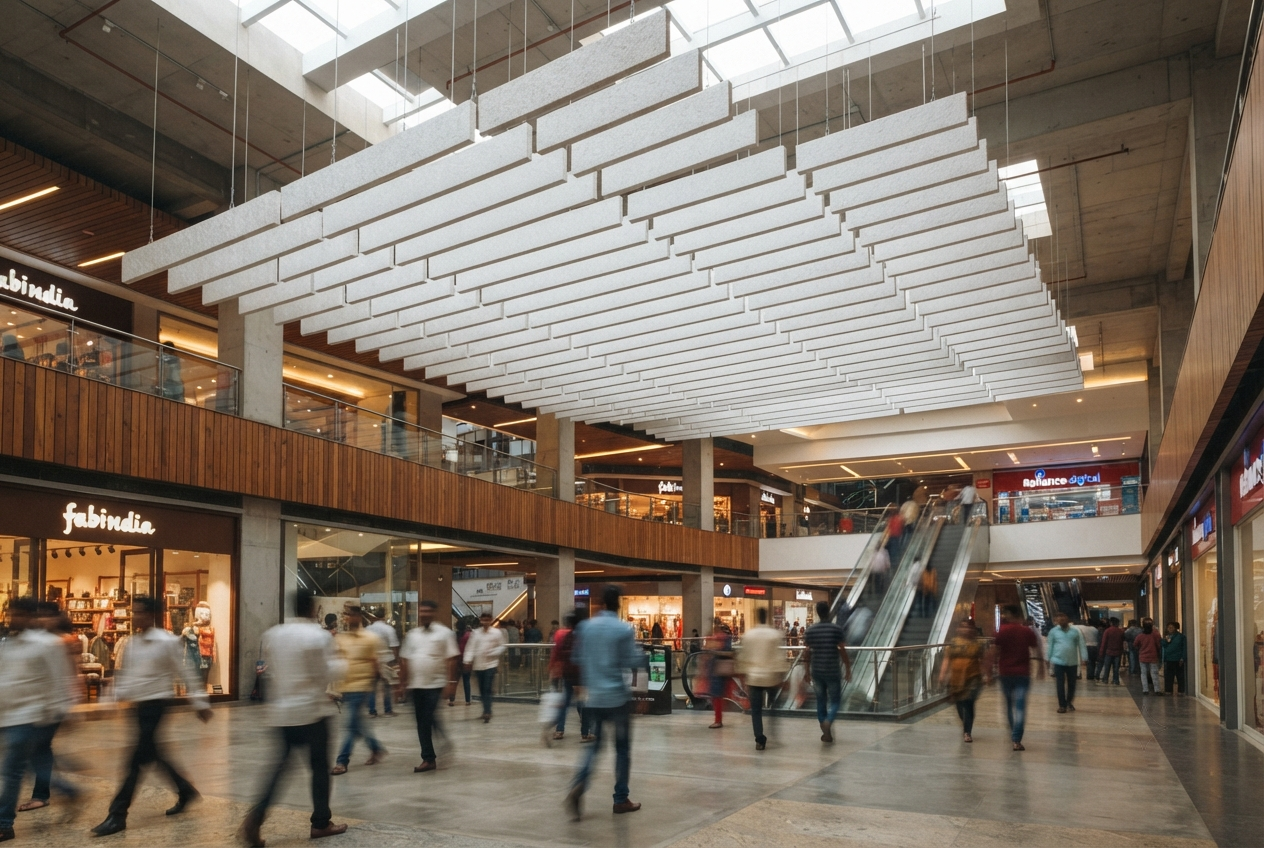
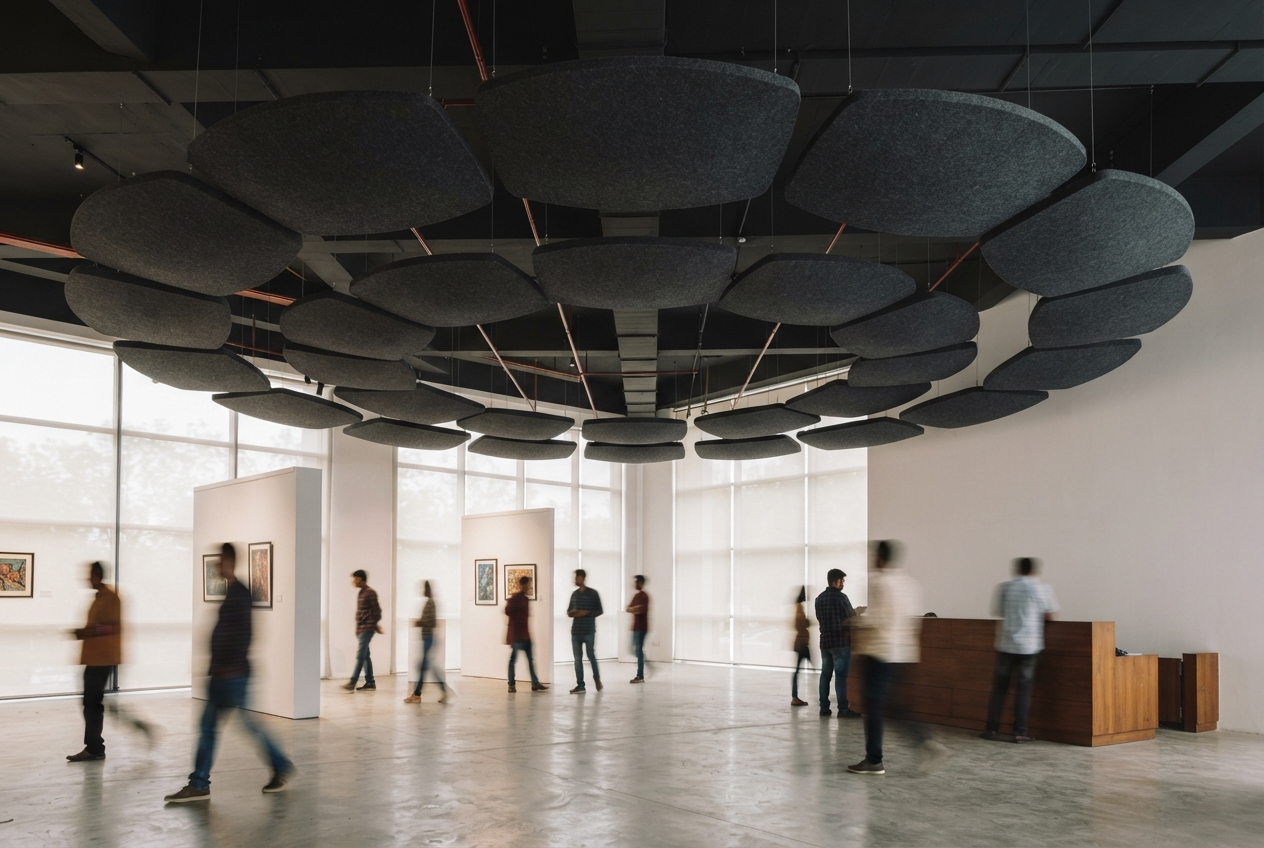
Acoustic ceiling clouds provide another route. They are suspended below the existing ceiling, allowing absorbing surfaces to be introduced without filling the entire overhead plane. For large open offices, atriums, hospitality areas, schools, and other high-ceiling interiors, clouds can therefore be useful when acoustic ceiling systems are needed but the existing ceiling architecture should remain exposed.
Amazone By Furnitech’s standard acoustic clouds offer several ways to work with different ceiling layouts, including 600, 900, and 1200 mm diameter options, as well as 1200 x 600 mm, 1200 x 1200 mm, and 2700 x 1200 mm formats. The available shapes include circles, waves, squares, curves, hexagons, and rectangles, with standard thicknesses of 30 and 40 mm and NRC values of up to 0.95.
When the ceiling requires something beyond standard formats, Amazone By Furnitech’s Custom Acoustic Ceiling Clouds service allows the size, shape, thickness, and colour to be developed around the ceiling plan. The clouds combine fibreglass and polyester fibre and can be CNC- or hand-cut into customised forms, with installation through adjustable cables or direct mounting. This flexibility makes them a useful option when planning acoustic ceiling systems for large interiors with exposed or unconventional ceiling structures.
Acoustic baffles are another option for spaces where ceiling height is contributing to reverberation. Instead of creating a horizontal absorbing plane, vertical baffles hang into the room volume. This can increase the amount of exposed absorbing surface while leaving the upper ceiling available for services, structure, and visual expression. This makes them a useful alternative within acoustic ceiling systems for spaces where full ceiling coverage is not practical.
Amazone By Furnitech’s acoustic baffles are rectangular, measuring 2400 x 300 mm and 30 mm thick. Made from fibreglass wool, they offer an NRC of up to 0.90 and are designed for suspended installation. Their size, shape, and layout can also be customised, allowing the arrangement to respond to the dimensions and requirements of the space.
This makes baffles worth considering for high-ceiling offices, classrooms, studios, gyms, halls, and hospitality areas where a conventional ceiling would either be impractical or alter the character of the room. In a large open space with a strong architectural concept, they give designers more freedom to use the ceiling volume rather than simply covering it with a continuous acoustic ceiling system.
The coverage question matters more than the product label
One mistake in large-space acoustics is assuming that the product alone determines the result. A high-NRC tile does not automatically solve a reverberation problem if the treated area is insufficient. Likewise, a lower-rated system can form part of a suitable strategy when the coverage, placement, and room geometry are appropriate. The effectiveness of acoustic ceiling systems depends on how well the selected products are matched to the room’s acoustic requirements.
Look at the ceiling height, floor area, reflective finishes, occupancy, and location of the main activity. Then consider whether sound absorption needs to be continuous across the ceiling or concentrated in particular zones.
This is also where installation becomes important. Lighting, HVAC diffusers, sprinklers, and access panels can influence where tiles, clouds, or baffles can be positioned. In a large commercial project, acoustic ceiling systems need to be coordinated with the reflected ceiling plan rather than added after the ceiling layout has already been established.
Make the Ceiling Work for the Room
Large open spaces rarely benefit from choosing a ceiling system simply because it has the strongest headline specification. A more useful approach is to identify where reflections are building up, how the space is used, how much of the ceiling can be treated, and whether the ceiling needs to remain visually prominent or recede into the architecture. This helps project teams identify acoustic ceiling systems that suit both the acoustic requirements and the architectural intent.
White fibre glass wool works well for broad, bright coverage; black fibre glass wool suits spaces where the ceiling needs to recede; mineral fibre fits practical suspended-ceiling environments; clouds preserve exposed ceilings while adding targeted absorption; and baffles use the vertical room volume to introduce more absorbing surface.
For project teams comparing suppliers, Amazone By Furnitech is one option worth including because its range covers mineral fibre ceiling tiles, white and black fibre glass wool tiles, acoustic ceiling clouds, acoustic baffles, and custom acoustic clouds for projects with specific requirements. The important step is still to match the acoustic ceiling systems to the building rather than treating every large space the same. If you are planning a large commercial, institutional, or public-space project and need help identifying suitable ceiling solutions, contact us to discuss your project requirements and explore the available acoustic ceiling systems.
TL;DR
Large open spaces need acoustic ceiling systems that address reverberation, speech clarity, and sound reflections without compromising the building’s design or functionality. Mineral fibre tiles are suitable for practical suspended ceilings, white and black fibre glass wool tiles provide broad sound absorption, while acoustic clouds and baffles offer targeted solutions for exposed and high ceilings. The right system depends on ceiling height, room usage, required coverage, and acoustic performance. Amazone By Furnitech offers these solutions in standard and customised options for large commercial, institutional, and public spaces.
_ _
Considering acoustic treatment for your space?
Furnitech supplies and installs acoustic panels and ceiling tiles across India.
Call +91-9727092998 or send your requirements.
Related Articles