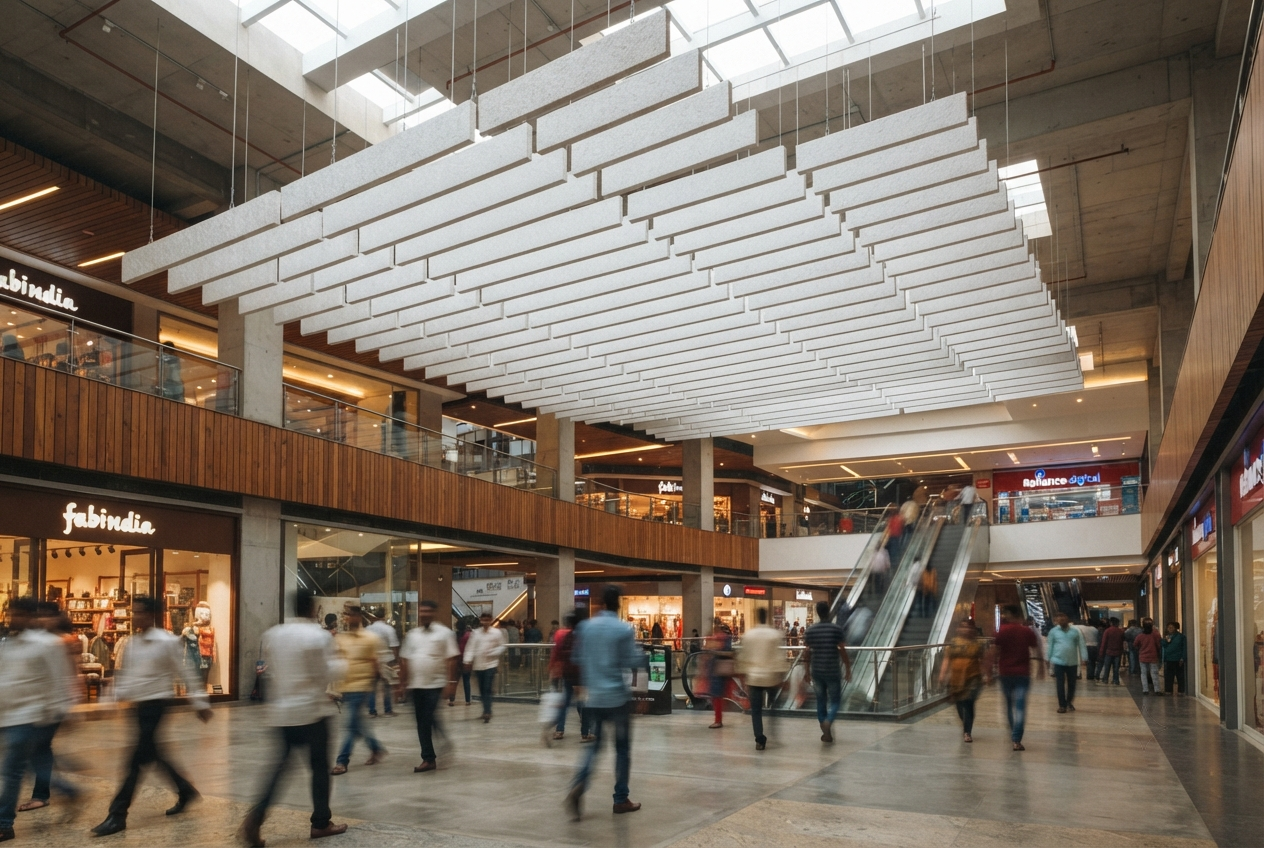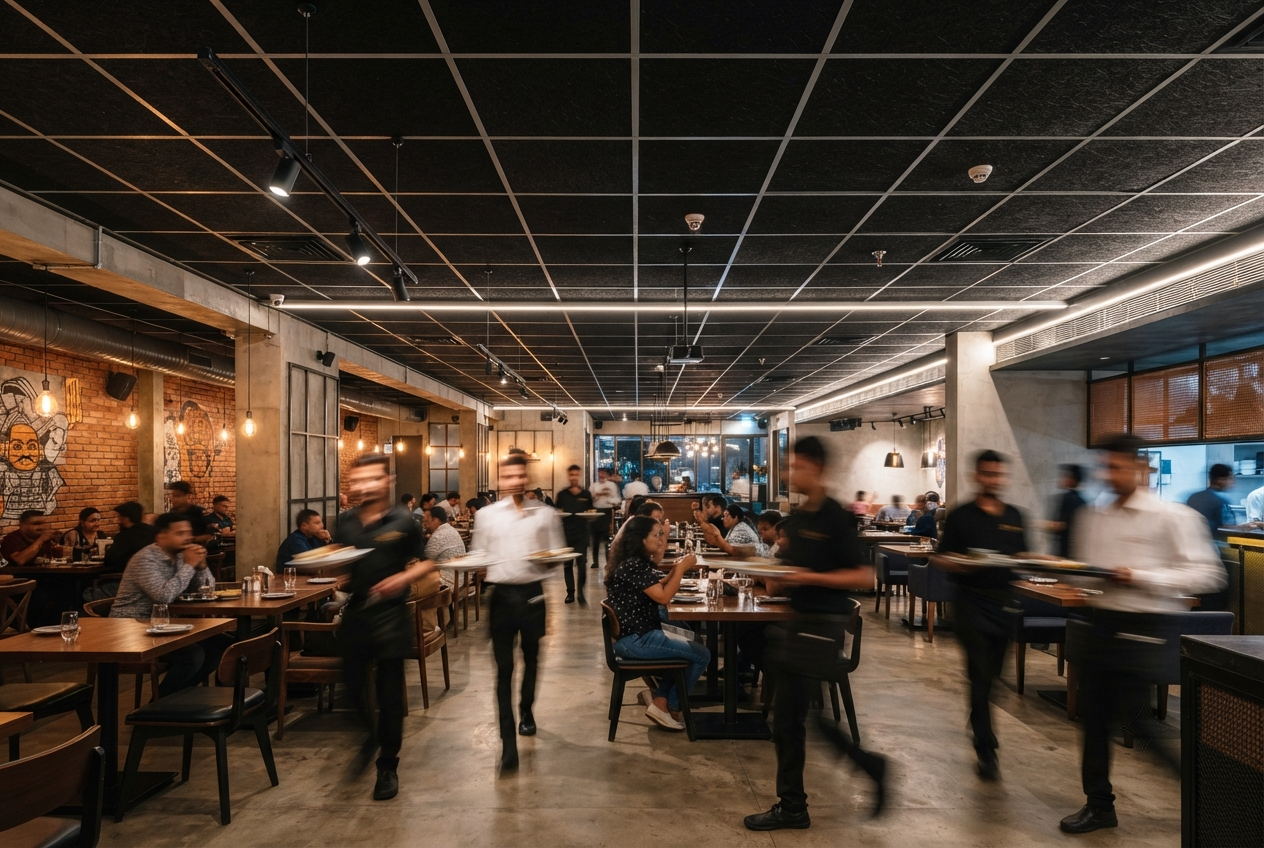

Choosing acoustic ceiling tiles for a commercial building is rarely just about finding tiles that look good or offer strong acoustic performance. The ceiling has to work within the building’s overall design. It needs to coordinate with lighting, HVAC, sprinklers, and electrical services, provide practical access for maintenance, and suit the visual character of the space. At the same time, it has to contribute to the acoustic environment once the building is occupied.
That becomes more complicated because different acoustic ceiling tiles can address different aspects of the same problem. Some are designed to keep a large commercial interior bright and visually neutral. Others are better suited to spaces where the ceiling should recede from view. Some offer a combination of acoustic performance and modular ceiling functionality, while others allow acoustic treatment to be incorporated into a more conventional ceiling appearance.
So, the right question is not simply, ‘Which acoustic ceiling tiles have the highest NRC?’ It is, ‘What does this ceiling need to achieve in this particular building?’ That distinction matters when specifying materials for offices, retail stores, showrooms, call centres, theatres, institutional spaces, and other commercial interiors.
Four Things to Check Before Comparing Tile Samples
Before looking at colours and edge profiles, there are four practical conditions worth establishing.
First, understand the ceiling system. Is the project already based on a standard T-grid? If so, acoustic ceiling tiles designed for that system may be much easier to coordinate than introducing a completely different ceiling construction.
Second, look at the room volume. A large office floor, university classroom block, and theatre may all need acoustic absorption, but their ceiling heights and occupancy patterns can be completely different.
Third, consider what is happening above the ceiling. Lighting, air-conditioning, sprinklers, electrical services, and maintenance access all compete for space. Acoustic ceiling tiles that can be easily lifted and replaced offer an operational advantage in buildings where services require frequent access.
Finally, look beyond the empty room. Commercial buildings are designed to operate with people, furniture, equipment, and movement. The acoustic result after occupation can be very different from what the empty shell suggests.
This kind of project coordination is particularly relevant when a supplier has experience across different building types. Amazone By Furnitech’s project portfolio includes offices, hospitality spaces, healthcare spaces, theatres, commercial buildings, universities, and auditoriums. Amazone By Furnitech has been working in the ceiling and room-acoustics industry for more than two decades and has supplied acoustic ceiling tiles and panels across India.
White fibre glass wool acoustic ceiling tiles are suited to projects where acoustic treatment needs to blend into a bright, conventional ceiling environment. They can work particularly well in offices, classrooms, training centres, retail environments, hospitality areas, and institutional buildings where the ceiling is expected to contribute to an open and visually light interior.
Amazone By Furnitech’s white fibre glass wool acoustic ceiling tiles include 600 x 600 mm, 1200 x 300 mm, and 1200 x 600 mm formats, with thicknesses of 15, and 20 mm. Square, Tegular, and Microlook edge options are available, with an NRC of up to 0.90. The tiles are designed for standard T-grid installation. The range of sizes and edge profiles gives designers some flexibility in how the ceiling reads visually. Square edges can provide a more continuous appearance, while Tegular and Microlook profiles create greater definition between individual tiles.
Black fibre glass wool acoustic ceiling tiles approach the same acoustic requirement from a different visual direction. Rather than keeping the ceiling bright, these tiles can help the overhead plane visually recede. This can be particularly relevant in theatres, screening rooms, studios, performance environments, and contemporary commercial interiors where lighting equipment and other ceiling services are intended to attract less attention.
Amazone By Furnitech’s black fibre glass wool acoustic ceiling tiles are available in 600 x 600 mm and 1200 x 600 mm sizes, with thicknesses of 15 and 20 mm. They offer an NRC of up to 0.95, and the tiles use high-density fibre glass wool with 100% recycled glass-fibre content. They are designed for standard T–grid installation.
There is also project evidence for this product category. Amazone By Furnitech’s P-Square Movieplex project in Ahmedabad specifically lists Black Fibre Glass Wool Acoustic Ceiling Tiles, along with galvanised T-grids and perforated gypsum acoustic boards.
Not all commercial acoustic ceiling tiles are selected primarily for its visual character. In offices, university classrooms, institutional buildings, and public facilities, the ceiling may need to maintain a consistent appearance, accommodate building services, remain accessible for maintenance, and contribute to acoustic comfort. This makes mineral fibre ceiling tiles another category worth comparing.
Amazone By Furnitech’s mineral fibre tiles are made from recycled newsprint, clay, perlite, starch, and fibreglass. The range includes 595 x 595 mm, 1195 x 295 mm, and 1195 x 595 mm formats, with thicknesses of 12, 16, 18, and 20 mm. Square, Tegular, and Microlook edges are available, with Pin-Hole, Fissured, Sand, Biyo Guard, and Black textures.
One specification should be read carefully: the detailed testing of the 16 mm variant. It was tested by SGS for Class A fire performance under ASTM E84, thermal conductivity of 0.055 W/m.k, and 90.21% light reflectance, while ARAI testing reports an NRC of up to 0.60 and an STC of 25 dB. The variant also offers resistance to up to 96% relative humidity.
There is also direct project evidence for this product category from Amazone By Furnitech. The Gujarat High Court auditorium project features Mineral Fibre Ceiling Tiles alongside galvanised T-grids, MDF acoustic panels, and perforated gypsum acoustic boards.
Sometimes, acoustic treatment should not look like a specialised acoustic product at all. A clean white modular ceiling may already be part of the architectural language of an office, university, theatre, or institutional building. In those situations, perforated gypsum acoustic ceiling tiles offer another way to introduce sound absorption while maintaining a familiar ceiling appearance.
Amazone By Furnitech‘s perforated gypsum acoustic ceiling tiles are available in 595 x 595 mm, with a square shape, 12 mm thickness, and white finish, and offer an NRC of up to 0.60. These products are designed for grid-based ceiling installation and are positioned for offices, universities, retail stores, theatres, and other spaces requiring acoustic control.
There is also project evidence from Amazone By Furnitech for this product. Perforated gypsum acoustic boards are used at both P-Square Movieplex and the Gujarat High Court auditorium, where they form part of broader acoustic ceiling systems.
Don't Compare Acoustic Ceiling Tiles Without Comparing the Ceiling Around Them
A common specification mistake is to compare four acoustic ceiling tiles on a datasheet and choose one before looking at the rest of the reflected ceiling plan. The tile has to coexist with the grid, lighting, diffusers, sprinkler heads, access panels, and other services.
For example, a ceiling with a dense lighting layout may leave less continuous area available for certain treatments. A project with frequent maintenance access above the ceiling may benefit from a system where individual acoustic ceiling tiles can be removed without disturbing surrounding components.
The visual environment matters too. In a theatre, black fibre glass wool acoustic ceiling tiles may support the intended ceiling treatment better than white ones. In an office, a brighter ceiling may be more appropriate to the interior strategy. Edge selection also deserves attention. Square, Tegular, and Microlook profiles can change the visual depth and rhythm of the ceiling, even when the acoustic material itself remains similar.
NRC Is Important, But It Is Only One Part of the Specification
NRC is one of the most useful numbers for comparing acoustic ceiling materials, but it should not be treated as the acoustic performance of the finished room. A higher NRC indicates greater sound absorption under relevant test conditions, but it does not tell you how much ceiling coverage is needed or how the finished room will respond to speech.
Consider two rooms using the same tile. One may have a large area of continuous acoustic ceiling, while the other has extensive lighting, exposed services, and other interruptions. Their finished acoustic environments can still differ. Room dimensions, ceiling height, occupancy, floor and wall finishes, furniture, glazing, and the amount and location of acoustic coverage all influence the final result.
This is why NRC values across different product categories should be compared carefully. A high NRC does not automatically make acoustic ceiling tiles suitable for every commercial building, just as a moderate NRC should not be dismissed without considering the overall ceiling strategy. NRC is best treated as one specification within the broader acoustic and architectural decision.
Match the Tile to the Building, Not Just the Datasheet
By this point, the four ceiling categories can be seen as serving different purposes.
White fibre glass wool acoustic ceiling tiles are suitable for bright commercial interiors where effective sound absorption needs to complement a neutral ceiling appearance.
Black fibre glass wool acoustic ceiling tiles can suit theatres, screening environments, and other spaces where the ceiling is intended to visually recede.
Mineral fibre ceiling tiles can be considered where modular ceiling construction, maintenance, finish options, and acoustic performance all need to work together.
Perforated gypsum acoustic ceiling tiles can suit projects where the acoustic ceiling needs to retain the appearance of a conventional white modular ceiling.
The specification should then be checked against the actual ceiling plan. Dimensions, thickness, edge profile, grid compatibility, acoustic rating, maintenance access, and visual requirements all need to align with the project.
Need Help Comparing the Right Acoustic Ceiling Tiles?
If you’re specifying acoustic ceiling tiles for an office, retail stores, showrooms, call centres, theatre, institutional project, or another commercial space, the first step is to compare the ceiling requirement with the available product specifications. For a project-specific comparison, you can review the available specifications, shortlist the suitable ceiling types, and then discuss the required size, thickness, edge profile, NRC, and installation system with the supplier before finalising the specification.
Amazone By Furnitech offers white and black fibre glass wool tiles, mineral fibre ceiling tiles, and perforated gypsum acoustic tiles, with different sizes, thicknesses, edge profiles, and finishes. Their project portfolio also provides examples of these materials being used across commercial and institutional environments. This makes the range relevant for supplier comparisons where the focus is not simply on the NRC value, but on how each product fits the building, ceiling system, and intended use of the space. Contact us to discuss your commercial ceiling requirements, compare suitable acoustic ceiling tiles, and get guidance on selecting products that align with your project’s specifications and installation needs.
TL;DR
Selecting acoustic ceiling tiles for commercial buildings involves more than comparing NRC ratings. The ceiling system, room volume, maintenance access, building services, and interior design all influence which product is suitable. White and black fibre glass wool tiles, mineral fibre ceiling tiles, and perforated gypsum acoustic tiles each offer different advantages depending on the project requirements. Comparing their specifications, installation compatibility, edge profiles, and acoustic performance helps ensure the final ceiling meets both functional and aesthetic expectations.
_ _
Considering acoustic treatment for your space?
Furnitech supplies and installs acoustic panels and ceiling tiles across India.
Call +91-9727092998 or send your requirements.
Related Articles