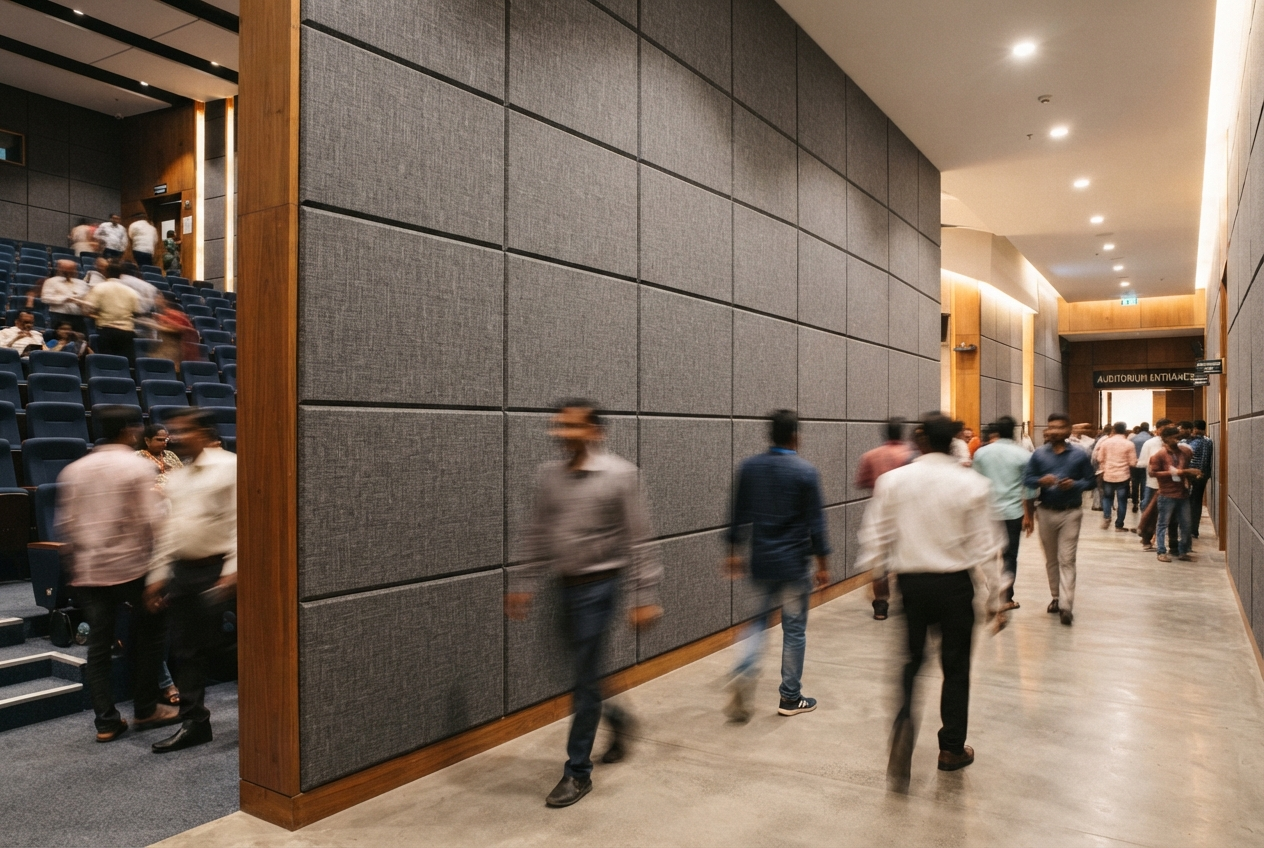

An acoustic product specification in a tender document has a very different job from a product description in a catalogue. A catalogue helps someone understand what a product is. A tender specification needs to give multiple parties enough information to price, compare, approve, supply, and install that product without making assumptions along the way.
That distinction becomes particularly important when a project involves several acoustic treatments, different ceiling conditions, custom shapes, or multiple vendors. A specification that looks technically detailed can still leave important questions unanswered.
Amazone By Furnitech has more than 20 years of experience working across acoustic and ceiling requirements for commercial projects. Our project experience shows how much of the final outcome depends on the details surrounding the acoustic product, not just the product name itself. Our project portfolio covers a range of applications where acoustic materials must work within architectural, functional, and installation requirements. So, what should actually be considered when preparing an acoustic product specification for a tender?
1. Define What the Acoustic Product Is Supposed to Achieve
Before writing the acoustic product description, establish what the acoustic treatment is intended to do. Is the item being specified to:
- Control reverberation?
- Absorb reflected sound?
- Improve speech clarity?
- Provide ceiling-based sound absorption?
- Treat a particular wall or ceiling area?
- Form part of a larger acoustic system?
This gives the acoustic product specification a clear purpose. The tender should therefore connect the acoustic requirement to the intended application rather than treating every acoustic product as interchangeable. This is particularly useful when a project has several room types. A classroom, office, reception area, and auditorium may require different acoustic treatments even when the overall project has one acoustic consultant or follows a common design language.
2. Define the Acoustic Product and Its Scope
Once the application is established, identify what is actually being tendered. The description may need to establish:
- Product category
- Material or core
- Thickness
- Standard or custom format
- Dimensions
- Application
- Required performance
- Finish or appearance
- Installation arrangement
Amazone By Furnitech‘s product range includes polyester fibre panels, fabric-wrapped panels, fibre glass wool panels and tiles, mineral fibre ceiling tiles, acoustic baffles, ceiling clouds, perforated acoustic gypsum tiles and boards, and other acoustic products.
3. State the Required Performance Separately
Acoustic performance should be stated as a measurable requirement wherever the project calls for it. Depending on the application, this may include:
- NRC or other sound absorption data
- Reverberation-related requirements
- Relevant fire-performance requirements
- Other project-specific technical criteria
For example, if a specific acoustic performance value is required, the bidder should be able to demonstrate that the proposed acoustic product or system meets that requirement through relevant technical documentation.
4. Treat installation as part of the specification
One of the easiest things to overlook is how the acoustic product will actually become part of the building. A tender should establish whether the acoustic item is:
For suspended acoustic products, this could include suspension hardware and the required arrangement. For ceiling systems, the supporting grid and visible finish may need to be specified separately. This matters because two quotations can appear comparable while one includes the installation components and the other prices only the visible acoustic material.
5. Define What Is Included in the Tender Rate
This is one of the easiest areas to overlook. A tender should make it clear whether the quoted rate includes only the acoustic material or the complete installed item. Depending on the project, the scope could include:
- Supply of acoustic material
- Cutting and fabrication
- Fixing accessories
- Adhesive or mechanical fixing
- Suspension hardware
- Grid components
- Installation
- Finishing
- Protection of installed material
This becomes particularly important for suspended acoustic products. A ceiling cloud, for example, is not completely described by its acoustic material alone. The tender should establish whether its suspension system and installation are included in the same item or covered elsewhere.
6. Establish How the Quantity Will Be Measured
The BOQ should use a clear basis of measurement. Depending on the acoustic product, the tender may measure:
The specification and drawings should use the same logic. For instance, if the BOQ is area-based but the design consists of individually fabricated acoustic elements, the tender should explain how those elements are to be quantified. This matters because two bidders can otherwise interpret the same drawing differently and arrive at different prices without either one necessarily making an arithmetic error.
7. State the Technical Documents Required With the Bid
A tender can also establish what bidders need to submit for technical evaluation. Depending on the project, this could include:
- Acoustic product datasheet
- Relevant acoustic test report
- Fire-test documentation, where required
- Acoustic product literature
- Colour or finish samples
- Physical product samples
- Compliance statement
- Installation information
- Supplier or manufacturer information
The important part is to identify which documents are actually required for evaluation. For example, Amazone By Furnitech’s 16 mm mineral fibre tiles come with specific technical data, including SGS-tested ASTM E84 Class A fire-performance results and other measured characteristics. That type of information should be tied to the actual specified variant rather than broadly applied to every product within a category. This is especially useful when several acoustic products look similar but are manufactured using different materials or configurations.
8. Be Specific About Approved Equivalents
The phrase ‘or approved equivalent’ appears frequently in construction tenders, but the term ‘equivalent’ should have a defined basis. An alternative acoustic product can be reviewed against the requirements established in the tender, such as:
- Acoustic performance
- Material construction
- Thickness
- Relevant fire requirements
- Dimensions
- Finish
- Installation method
- Supporting technical documentation
The visual appearance of two acoustic products is not enough to establish technical equivalence. Amazone By Furnitech has experience across different projects that include different combinations of ceiling and acoustic products depending on the application.
9. Clarify Substitutions After Tender Award
The specification should also anticipate what happens after the contract is awarded. If a contractor later proposes a different acoustic product because of availability, manufacturing constraints, lead time, or another reason, the substitution should go through the project’s established technical approval process.
The proposed alternative should be compared against the original requirements rather than being accepted simply because it belongs to the same broad acoustic product category. This protects the intent of the tender and gives the project team a consistent way to review proposed changes.
Acoustic Tender Specification Checklist
Before issuing the tender, check whether the acoustic item clearly establishes:
- Intended acoustic application
- Acoustic product category and material
- Required thickness and dimensions
- Acoustic performance requirements
- Applicable fire requirements
- Finish and appearance requirements
- Installation method
- Accessories and suspension requirements
- Scope included in the tender rate
- Unit of measurement
- Required technical submissions
- Sample or mock-up requirements
- Compliance/deviation procedure
- Approved-equivalent criteria
- Substitution procedure after award
None of these checks is particularly complicated on its own. The difficulty arises when several of them are missing and the site team has to make decisions during installation.
A Good Tender Specification Should Remove Procurement Ambiguity
The purpose of an acoustic specification is not to make the tender document unnecessarily long. It is to make the requirement clear enough that different bidders are pricing the same thing and that the submitted acoustic products can be technically evaluated against the same criteria.
A good acoustic tender specification shouldn’t simply tell a bidder what acoustic product to quote. It should establish what is required, where it is required, how it should perform, how it should look, how it should be installed, what evidence supports the submission, and how alternatives will be evaluated.
For projects where acoustic panels or ceiling systems are being specified through a tender, Amazone By Furnitech is one brand worth considering as a reference point. Its experience across commercial projects and more than 1,500 commercial clients provides a useful basis for looking at how acoustic products are specified for different spaces, performance requirements, finishes, and installation conditions. Contact us to discuss your project requirements and explore suitable acoustic products with specifications that align with your tender’s technical and design criteria.
TL;DR
Preparing acoustic product specifications for tender projects requires more than listing product names and performance values. Contractors need clear details about the intended application, material, dimensions, acoustic performance, installation method, scope of supply, and technical documentation. The tender should also establish measurement methods, approved-equivalent criteria, and procedures for post-award substitutions. Defining these requirements clearly helps bidders quote on a consistent basis, allows project teams to evaluate products fairly, and reduces confusion during procurement, approval, and installation.
_ _
Considering acoustic treatment for your space?
Furnitech supplies and installs acoustic panels and ceiling tiles across India.
Call +91-9727092998 or send your requirements.
Related Articles