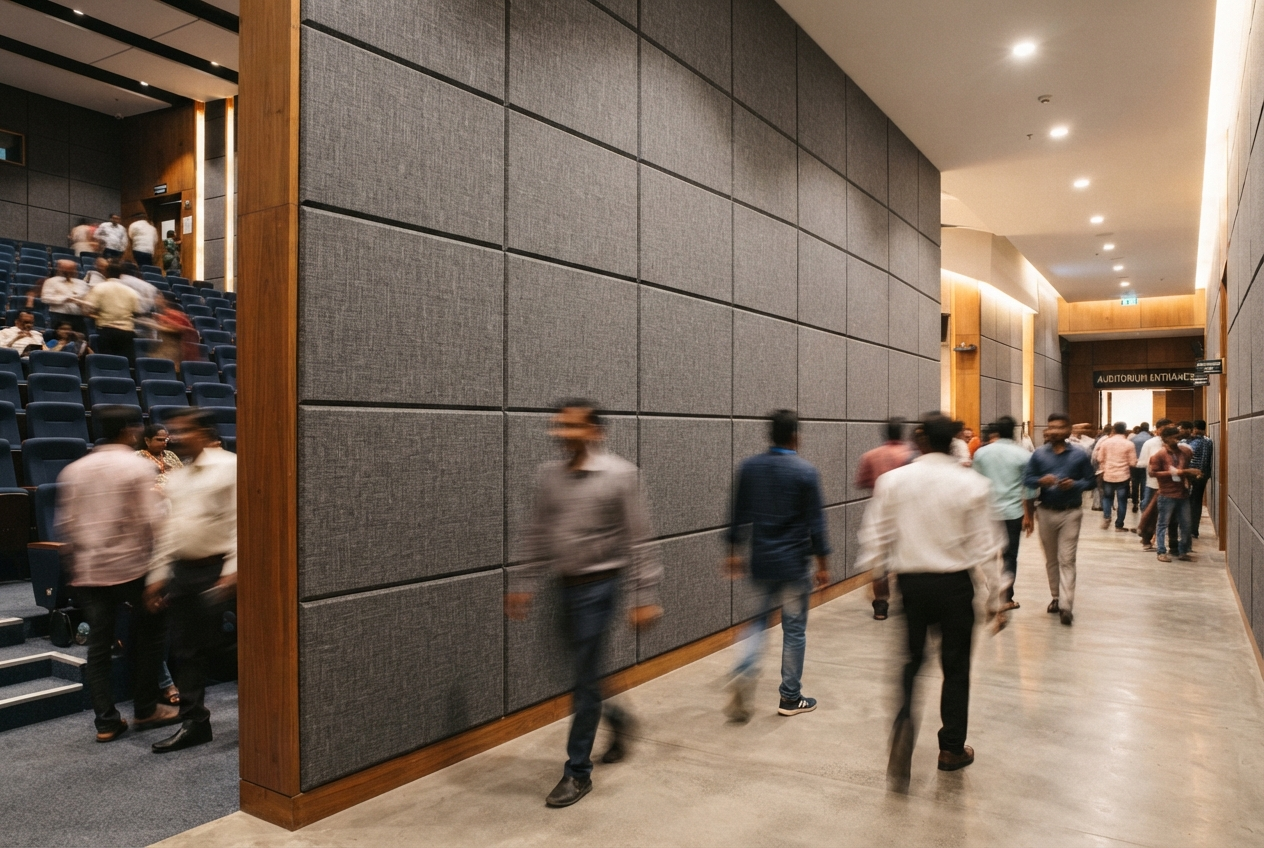
Acoustic specifications can look complete when they say something like 25 mm fabric–wrapped acoustic panels with an NRC of up to 0.95. But anyone who has worked with acoustic materials on real projects knows that this still leaves a lot open to interpretation.
After more than two decades of work across ceiling and room-acoustic applications, Amazone By Furnitech has dealt with projects where acoustic panels, ceiling tiles, baffles, clouds, and other systems have had to meet both performance and design requirements. Our project portfolio includes institutional buildings, offices, theatres, and other commercial applications throughout India.
That experience highlights a simple point: Acoustic specifications are about more than just how much sound a product absorbs. It also needs to define exactly what is being supplied and how it is expected to perform and look.
1. Start With the Acoustic Performance
NRC is usually the first specification contractors look for when reviewing acoustic specifications, but it needs some context. The value should be connected to the exact product thickness, construction, and configuration for which the performance has been established.
Take polyester fibre panels from Amazone By Furnitech as an example. They are available in 9 mm thickness with an NRC of up to 0.70 and in 12 mm thickness with an NRC of up to 0.85. Fabric-wrapped acoustic panels are available at 25 mm thickness with an NRC of up to 0.95. These acoustic specifications help contractors identify the right product for their requirements. Simply writing polyester acoustic panel, NRC 0.85, does not fully identify the required product.
The same applies to test data. When verifying acoustic specifications, contractors should check whether a performance figure belongs to a particular thickness or configuration rather than assuming it applies to every version in that product category. NRC itself also has limits. It describes sound absorption but does not cover every acoustic objective a project might have.
2. Thickness, Size and Construction Define the Product
Thickness is obviously important for acoustic performance, but it also helps identify exactly which product is being specified. Size and construction matter for the same reason. These details are essential parts of acoustic specifications because they help contractors identify the correct material and avoid confusion during procurement and installation.
A specification saying acoustic panel doesn’t tell a contractor whether the project requires a 2440 x 1220 mm polyester sheet, smaller modular panels, or custom fabrication. Similarly, a ceiling tile needs more than a generic product name and NRC value. Its dimensions, thickness, and construction should be clearly mentioned when preparing acoustic specifications.
This becomes especially important when several acoustic products appear in the same project. A polyester fibre panel, fabric-wrapped panel, and MDF acoustic panel may all be called acoustic panels informally, but they aren’t interchangeable products. A well-defined acoustic specification should distinguish between them by stating their material, dimensions, thickness, and construction. This gives contractors a clearer reference during material selection, quantity estimation, and installation planning.
3. Shape, Edge and Customisation Matter More Than They Look
Acoustic products are increasingly part of architectural design, so physical form is often as important as the material itself. A ceiling tile may have a square, tegular or microlook edge profile. An acoustic panel may be rectangular, square, or CNC-cut. A ceiling cloud may be circular, hexagonal, or wave-shaped. A baffle may have a specific width, length, and spacing. These design details should be included in acoustic specifications, particularly when products need to complement a particular interior design.
Amazone By Furnitech‘s product ranges demonstrate this variation. Its fibre glass wool and mineral fibre ceiling tiles include different edge profiles, while its polyester fibre panels can be CNC-customised and its ceiling clouds are available in several shapes. These options allow acoustic materials to meet both functional and architectural requirements.
For a contractor, specifying a custom acoustic panel isn’t enough information. The actual dimensions, geometry, edge profile, and fabrication pattern need to be clearly established in the acoustic specifications or associated drawings. This level of detail helps avoid interpretation differences between the approved design, material supply, and on-site installation.
4. Colour, Texture and Finish Are Part of the Specification
This is where acoustic specifications often become too technical and overlook the visual requirements of a project. If the acoustic material is visible, its appearance is part of the finished design. A panel isn’t fully defined simply because its thickness and NRC are known.
Colour, fabric, texture, surface pattern, and finish can all affect what the installed product looks like. Amazone By Furnitech’s polyester fibre panels are available in different shade options, while its fabric-wrapped panels use jute fabric in multiple shades. Its mineral fibre range also includes different textures, such as pin hole, fissured, and sand.
Therefore, descriptions such as black acoustic tile or fabric-wrapped panel may still be incomplete. The approved colour, surface texture, and finish should correspond to the exact product being specified. Including these details in acoustic specifications is particularly important when acoustic products serve as visible design elements rather than hidden acoustic treatments.
5. The Application Changes the Specification
A contractor doesn’t need the same information for every acoustic product because each product can serve a different purpose and work in a different way. For a ceiling tile, the acoustic specifications may revolve around thickness, size, edge profile, surface finish, colour, grid compatibility, and acoustic performance. A fabric-wrapped wall panel requires additional fabric and mounting details, while a suspended baffle or ceiling cloud introduces shape, dimensions, and suspension configuration.
For example, Amazone By Furnitech’s baffles are available in 2400 x 300 x 30 mm dimensions with an NRC of up to 0.90, while its ceiling clouds are available in different shapes and configurations. These products cannot be properly specified using the same description as a standard ceiling tile. Acoustic specifications should therefore describe the complete acoustic element being used in a particular space, rather than simply identifying its material category.
6. Don't Mix Data From Different Variants
This is one of the easiest ways for acoustic specifications to become misleading. A supplier or manufacturer may offer several thicknesses, sizes, colours, edge profiles, and finishes within the same product range. The acoustic performance may belong to one variant, while the colour or visual reference comes from another. This is why identifying the product by name alone isn’t enough.
When reviewing acoustic specifications, a contractor should be able to identify the exact product, its thickness and dimensions, the relevant acoustic performance, the approved finish, the shape or edge profile, and the intended application without making assumptions. If these details refer to different product variants, the specification needs clarification before procurement or fabrication begins.
What a Contractor Should Be Able to Identify
A good acoustic specification doesn’t have to be unnecessarily long. It just needs to eliminate important areas of ambiguity. At a minimum, the contractor should be able to establish:
- Performance: NRC and other required acoustic data
- Construction: material, core, and thickness
- Dimensions: size and format
- Geometry: shape, edge, and configuration
- Customisation: CNC patterns, cut-outs, or special fabrication
- Appearance: colour, texture, fabric, and surface finish
- Application: wall, ceiling, baffle, cloud, or other configuration
Covering these points makes acoustic specifications much more useful than simply listing a product name followed by an NRC value. Every product needs to be defined from both sides: what it needs to do and exactly what it needs to be.
The Real Check Is Whether the Specification Leaves Room for Guesswork
A contractor shouldn’t have to decide whether the project requires 9 mm or 12 mm, Square or Tegular, one fabric shade or another, or standard panels instead of CNC-cut panels. Those decisions should already be clearly defined in the acoustic specifications and associated drawings.
That’s ultimately what makes acoustic specifications useful. They connect the acoustic requirements with the physical product and architectural finish, ensuring that the material being procured matches the designer’s intent and that the referenced acoustic performance actually belongs to that product. For a contractor, that’s the real acoustic specification to verify: performance, product, and appearance, all describing the same exact variant.
This is also where clearly defined product ranges become useful. Amazone By Furnitech offers acoustic products across different materials, thicknesses, colours, dimensions, finishes, shapes, and configurations, supported by product-specific acoustic data. For contractors and project teams, referring to the exact product variant and its corresponding acoustic specifications makes it easier to match the specified material with the intended application. Contractors and project teams contact us to discuss their project requirements and identify suitable acoustic products with specifications that match the intended application.
TL;DR
Acoustic specifications should define more than a product’s NRC value. Contractors need to verify the exact material, thickness, dimensions, construction, shape, edge profile, colour, finish, and intended application. Each acoustic performance figure must also correspond to the specific product variant being supplied. Checking these details together helps prevent confusion during procurement, fabrication, and installation while ensuring the finished product meets both the project’s acoustic and design requirements.
_ _
Considering acoustic treatment for your space?
Furnitech supplies and installs acoustic panels and ceiling tiles across India.
Call +91-9727092998 or send your requirements.
Related Articles