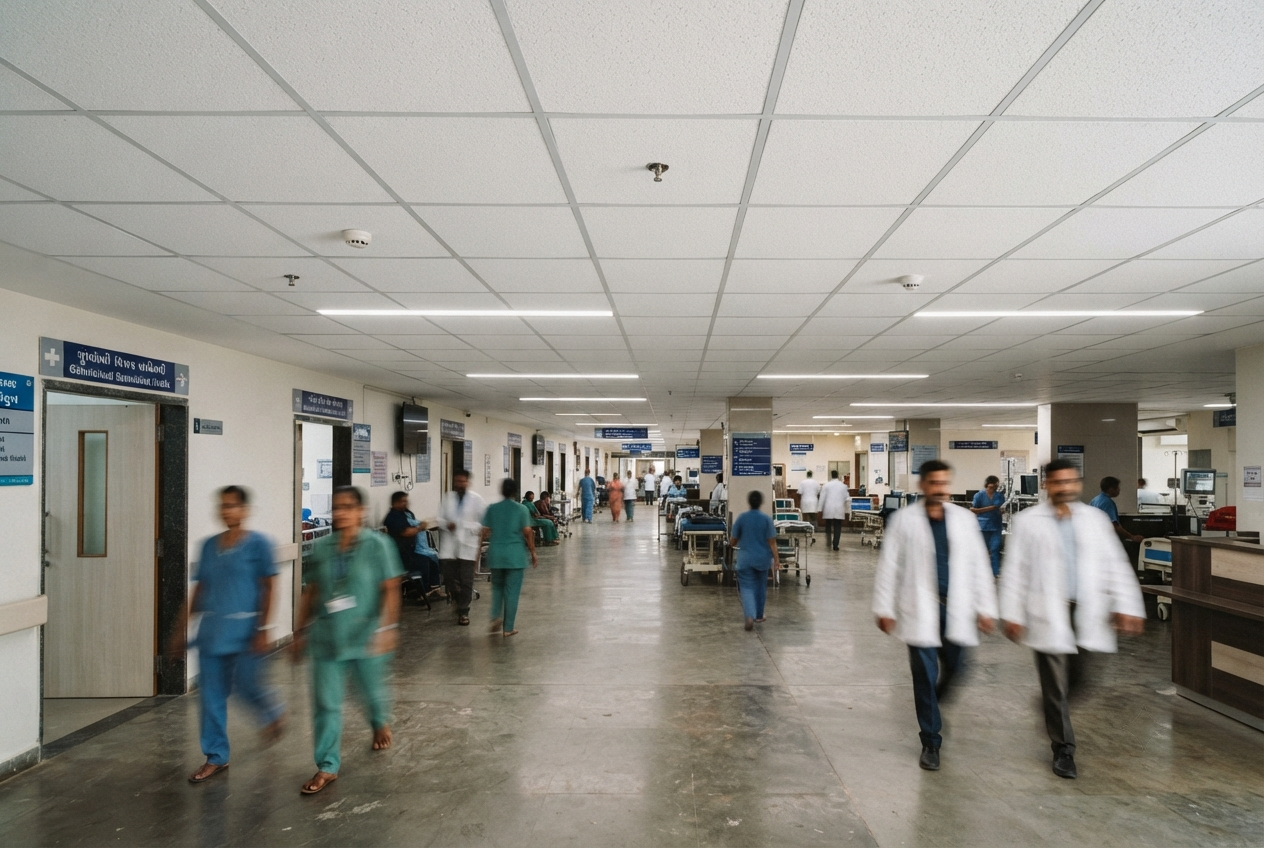
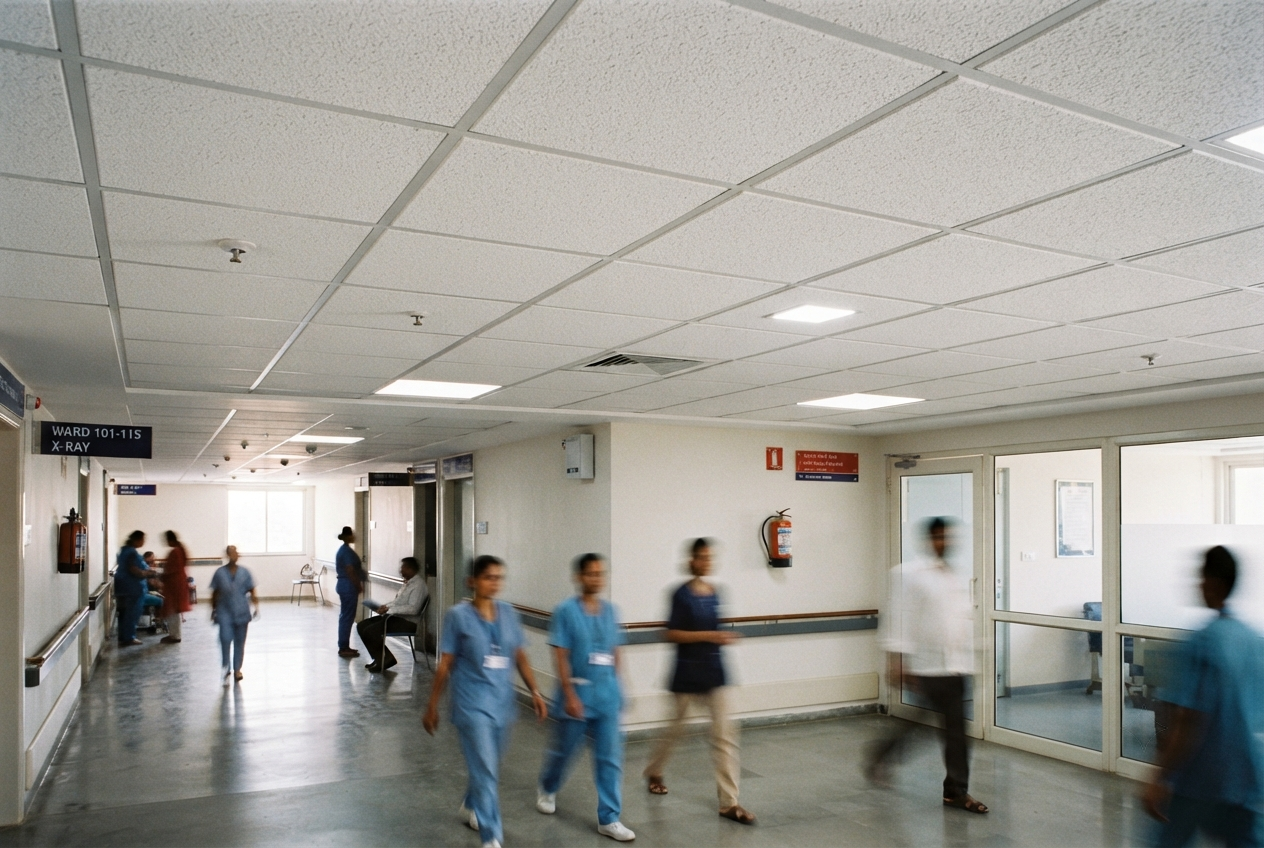
A hospital ceiling has to do more work than almost any other ceiling in a building. Acoustic ceiling systems need to control noise for patient rest and staff communication while withstanding daily cleaning and disinfection. They must also resist humidity and demanding clinical conditions, meet fire-code requirements, and provide easy access for biomedical, electrical, and HVAC teams working above the ceiling.
Having worked on ceiling and acoustic projects across institutional, hospitality, and commercial environments in India for more than 20 years, we’ve found that healthcare projects require a more disciplined approach to ceiling selection. Acoustics, hygiene, moisture resistance, fire performance, durability, and accessibility all need to work together. A ceiling that performs well in a conventional commercial space isn’t automatically suitable for every hospital environment.
Choosing a tile based on acoustic performance alone and addressing the other requirements later can result in ceilings that sound fine but fail infection-control audits or sag within a year in humid conditions. The Indian market offers many ceiling tile options, but the right acoustic ceiling systems for hospital projects ultimately depend on how well they meet these combined demands.
What makes a ceiling 'hospital-grade'
A few requirements come up specifically in healthcare projects that don’t matter as much elsewhere. For acoustic ceiling systems in hospitals, the selection needs to go beyond sound absorption and consider hygiene, humidity, fire performance, serviceability, and long-term replacement requirements.
Hygiene and cleanability: Surfaces should withstand repeated wiping and disinfection without breaking down, staining, or losing their finish. Hospital cleaning protocols are typically more frequent and demanding than those in standard office environments.
Humidity resistance: Operating theatres, CSSD areas, laboratory-adjacent spaces, and other high-humidity zones can expose ceilings to consistently elevated relative humidity. Tiles that are not designed for these conditions may sag, warp, or deteriorate well before a standard commercial ceiling would.
Fire compliance: Acoustic ceiling systems need to meet the applicable fire-safety requirements under the National Building Code of India, including Part 4, along with any project-specific requirements. In healthcare projects, fire performance also needs to be considered alongside broader compliance and accreditation requirements.
Serviceability: Hospitals have MEP services, medical gas lines, electrical systems, and other critical infrastructure above the ceiling. These systems need regular inspection and maintenance, so easily removable tiles on a standard grid are especially useful. This is particularly important compared with areas that are rarely accessed after handover.
Replacement availability: A damaged, stained, or contaminated tile in a ward, corridor, or clinical area may need to be replaced quickly. Therefore, having matching replacement tiles readily available is important for healthcare projects, not only during construction but throughout the building’s operational life.
Acoustic ceiling systems available to buy in India
Mineral fibre ceiling tiles are a practical option within acoustic ceiling systems for healthcare spaces where acoustic control, fire performance, moisture resistance, and easy maintenance need to work together. Their compatibility with T-grid systems also allows individual tiles to be removed for access to services above the ceiling, making them suitable for general wards, corridors, waiting areas, and administrative spaces.
Amazone By Furnitech’s mineral fibre ceiling tiles are available in multiple thicknesses, edge options, and textures. Their 16 mm mineral fibre tiles have been tested by SGS for a Class A rating under ASTM E84, while ARAI testing reports an NRC of up to 0.60 and an STC rating of 25 dB. The tiles are also stated to withstand up to 96% relative humidity without losing their shape, providing a documented basis for considering them in moisture-prone healthcare areas.
Fibre glass wool ceiling tiles are another option for acoustic ceiling systems in healthcare spaces where controlling reverberation and maintaining speech clarity are important. Their glass-wool construction provides sound absorption while keeping the tiles lightweight and easy to handle, making them suitable for waiting rooms, nurses’ stations, consultation areas, and other shared spaces where clear communication matters.
Amazone By Furnitech’s fibre glass wool acoustic ceiling tiles are available in white and black finishes, offering flexibility for different interior requirements. The white finish provides a clean, bright appearance, while the black option suits darker, contemporary spaces. Both versions are designed for standard T-grid installation and are available in different sizes, thicknesses, and edge configurations to suit the project’s functional and aesthetic requirements.
Perforated acoustic gypsum ceiling tiles are another option for acoustic ceiling systems where sound absorption needs to be combined with a more continuous, finished ceiling appearance. Their perforated surface helps with acoustic absorption, while the gypsum construction provides a rigid, clean-lined finish. Gypsum is also inherently fire-resistant due to the chemically bound water within the material, making fire performance an important consideration for healthcare interiors.
Amazone By Furnitech’s perforated acoustic gypsum ceiling tiles are designed for suspended ceiling applications and can be integrated with standard grid systems. Their clean surface and perforated pattern make them suitable for areas where acoustic performance needs to be combined with a refined architectural finish, such as reception areas, OPDs, waiting areas, and administrative spaces. The system also allows access to services above the ceiling when required.
Suppliers to buy from in India
Amazone By Furnitech
Amazone By Furnitech supplies acoustic ceiling systems for different requirements across healthcare and other commercial projects. Its range includes mineral fibre tiles, fibre glass wool tiles, and perforated acoustic gypsum ceiling tiles, along with galvanized T-grid suspension systems made from non-combustible GI steel. This gives healthcare projects the option to source different ceiling tile types and compatible grid systems from the same supplier, depending on the requirements of each area.
The range includes SGS and ARAI tested mineral fibre tiles, fibre glass wool tiles in white and black finishes, and perforated acoustic gypsum tiles for projects requiring a more finished ceiling appearance. Having these ceiling types and compatible grid systems within one range can also simplify specification and sourcing for projects with different requirements across hospital areas.
Armstrong
Armstrong offers mineral fibre and fibreglass ceiling tiles across its product range, including options with Class A fire ratings and products positioned for healthcare environments. Its acoustic ceiling systems are available through dealer and distribution networks in India, although the specific products available for hospital projects can vary depending on location and supplier stock.
Saint-Gobain Ecophon
Saint-Gobain Ecophon offers acoustic ceiling systems through its Hygiene product line, which is designed for clinical spaces and features cleanable, disinfectant-resistant surfaces. These solutions are intended for environments such as ICUs, OTs, and consulting rooms, where hygiene and acoustic performance need to be considered together. The products are typically specified through architects and healthcare interior consultants rather than purchased off the shelf, so sourcing usually involves project-specific ordering.
Final Considerations for Healthcare Acoustic Ceiling Systems
Hospital ceiling projects often require more than one tile type across the same floor. This could include a moisture-resistant mineral fibre tile in an OT-adjacent area, a fibreglass wool tile where acoustic control is important, or a perforated gypsum tile where a cleaner architectural finish is preferred. The decision is therefore less about finding the best ceiling tile and more about matching each product to the performance requirements of the space.
When evaluating acoustic ceiling systems for a hospital project, acoustic performance should be considered alongside hygiene, humidity resistance, fire performance, serviceability, maintenance, and replacement availability. Amazone By Furnitech offers mineral fibre tiles, fibre glass wool tiles, and perforated acoustic gypsum ceiling tiles for these different requirements.
Where test certificates and performance documentation are available, such as the SGS and ARAI reports for its mineral fibre range, these should be reviewed alongside the product specifications when comparing options for a hospital project. For product specifications, project requirements, or sourcing assistance, Contact Us to discuss the right ceiling solution for your healthcare project.
TL;DR
Restaurant acoustics need to balance sound control with the design and practical demands of a working dining space. The right acoustic panels can help reduce reverberation while fitting around ceilings, lighting, exposed structures, walls and furniture. For a renovation, factors such as grease and moisture exposure, fire safety, maintenance and placement should also be considered when shortlisting options such as ceiling clouds, baffles, fabric-wrapped, MDF and polyester fibre acoustic panels.
_ _
Considering acoustic treatment for your space?
Furnitech supplies and installs acoustic panels and ceiling tiles across India.
Call +91-9727092998 or send your requirements.
Related Articles