We’ve spent close to two decades on the supply and installation side of suspended ceilings and acoustics, working on everything from government auditoriums and university buildings to full commercial fit-outs across multiple states in India. One project we still talk about internally was a government facility where the installation had to be carried out under Z-category security clearance, on a locked timeline, with zero room for rework.
That kind of pressure teaches you quickly which ceiling decisions are nice to have and which ones can blow up your schedule or budget if you get them wrong. Ceiling systems are one of those decisions that can have a surprisingly big impact on both the look and performance of an office, so it’s worth understanding what to consider before making a choice.
Start with the performance spec, not the look
Everyone jumps straight to which tile pattern looks premium. Wrong order. Grade A buildings usually come with baseline specifications from the facility consultant: fire rating, NRC (Noise Reduction Coefficient) targets for open-plan acoustics, humidity resistance, and light reflectance requirements for energy compliance. These requirements should guide your ceiling system selection before aesthetics come into the picture.
Get these numbers before you shortlist products. We’ve seen fit-outs redone because someone picked a tile that looked great but couldn’t meet the NRC target required by the acoustic consultant.
Know your core material trade-offs
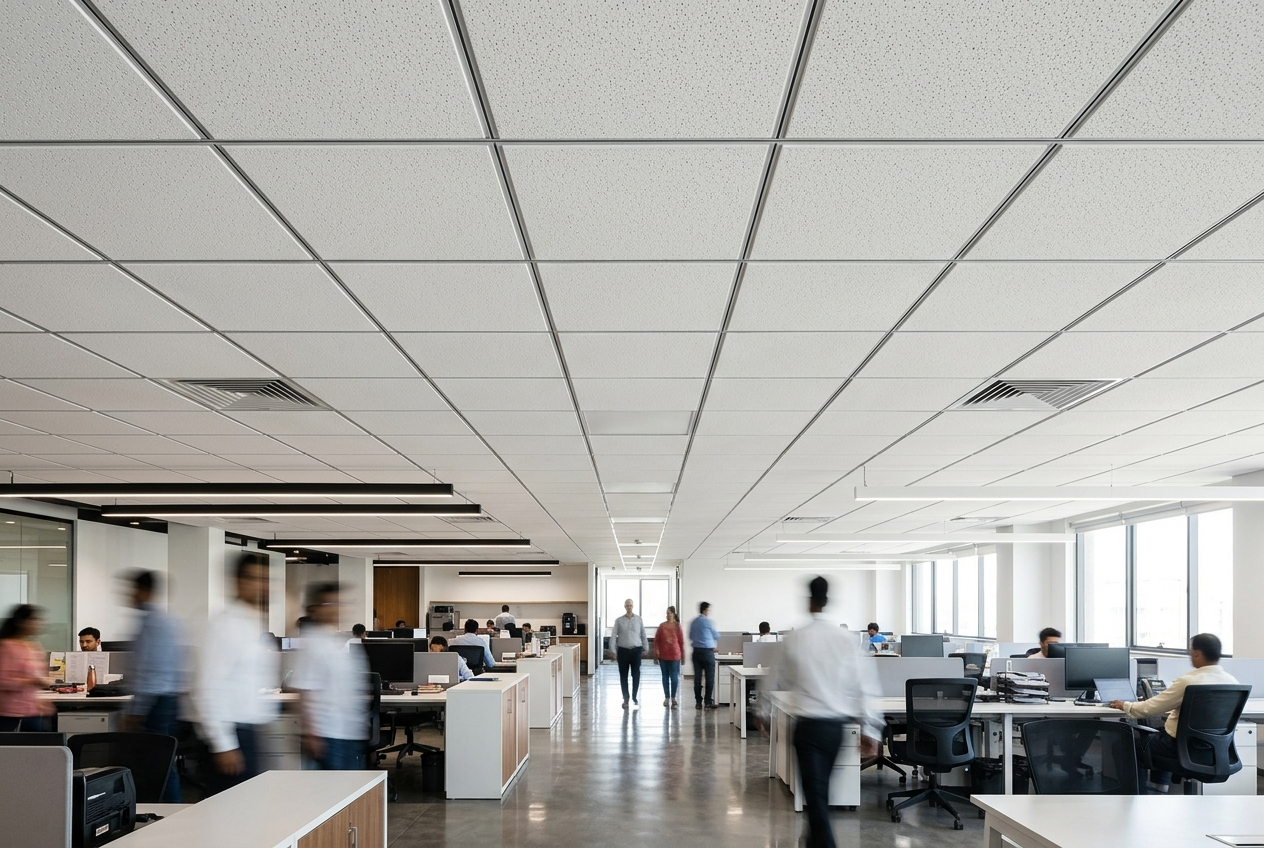
Mineral fibre tiles remain a practical choice for office ceiling systems, offering a balance of acoustic performance, fire safety, and cost. Their range of surface textures and edge options also makes them suitable for different corporate interiors. However, humidity resistance is an important consideration, particularly in basements and areas adjoining washrooms. Checking the relative humidity rating before selecting a ceiling system can help reduce the risk of sagging, staining, and premature deterioration.
Amazone By Furnitech’s 16mm mineral fibre ceiling tiles are independently tested, with their performance backed by third-party testing rather than relying solely on spec-sheet claims. SGS testing rates the tiles Class A for fire performance under ASTM E84, while ARAI testing reports an NRC of up to 0.60 and an STC of 25 dB. These specifications help project teams assess the tiles when planning an office ceiling system around acoustic and fire-performance requirements.
The tiles also maintain their shape at up to 96% relative humidity, which can be particularly relevant for AC-heavy Indian office buildings during the monsoon. They are available in Sand, Fissured, Pin-Hole, Biyo Guard, and Black textures, with Square, Tegular, and Microlook edge options, giving designers flexibility without having to compromise on acoustic performance. This variety allows designers to coordinate the ceiling system with the interior design while considering the required acoustic performance and installation requirements.
Metal ceiling tiles, whether aluminium or galvanised steel, are the better call for high-traffic, high-spec lobbies and reception zones. They are durable, easy to clean, and hold a sharp, modern finish for years without denting or warping. The trade-off is that metal alone doesn’t absorb sound, so if the space also needs acoustic control, it has to be paired with a dedicated acoustic product.
Amazone By Furnitech offers plain and perforated metal ceiling tile textures with Tegular or Microlook edges, available in 0.5mm or 0.7mm gauges depending on the level of rigidity required for the project. For reception areas where appearance and noise control are equally important, pairing the metal ceiling system with a suitable acoustic panel can help address both requirements.
Fibre glass wool acoustic tiles are a suitable option for ceiling systems in boardrooms, open-plan offices, media rooms, and other spaces where speech clarity and sound absorption are priorities. Their lightweight construction and acoustic performance make them worth considering when selecting ceiling materials for noise control.
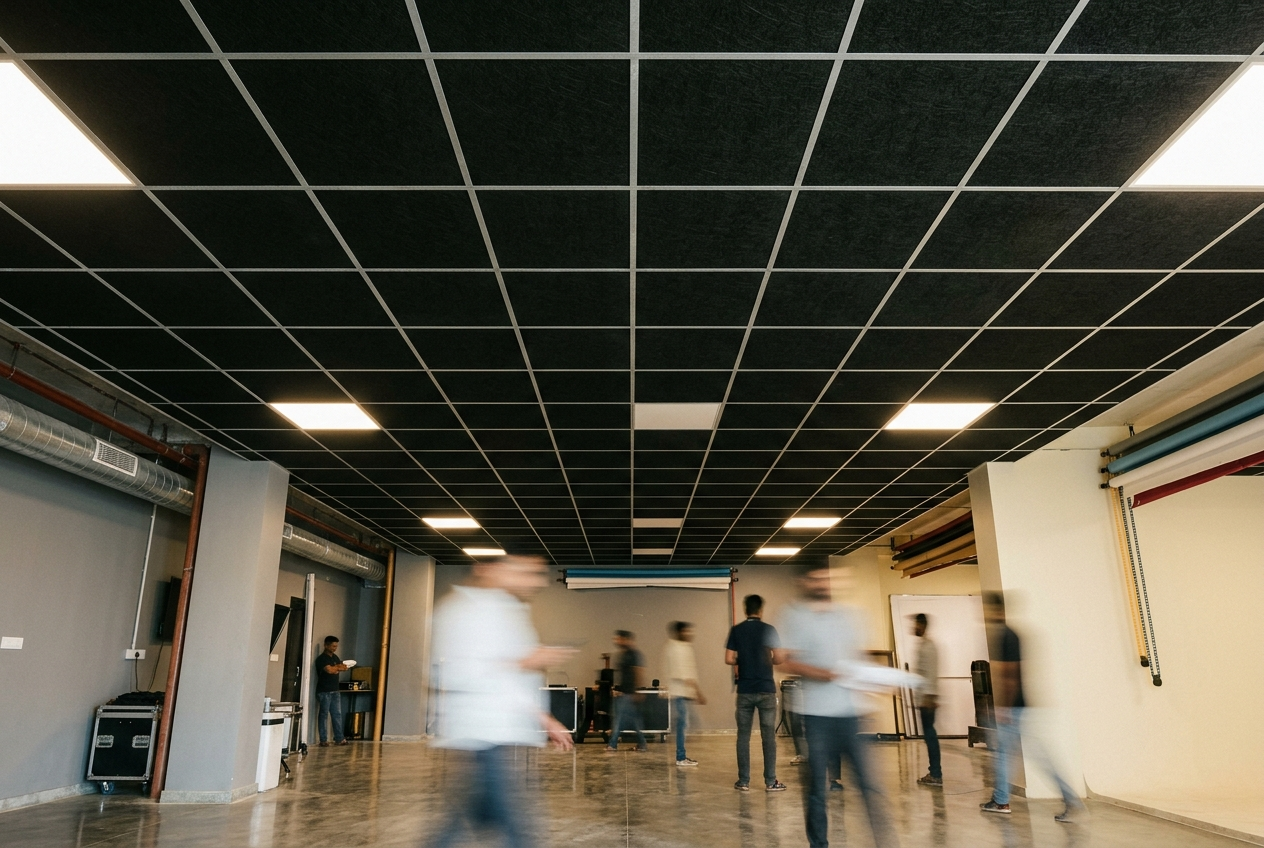
Amazone By Furnitech’s fibre glass wool acoustic ceiling tiles can achieve an NRC of up to 0.90 in white and 0.95 in black, offering a meaningfully higher level of sound absorption than standard tiles. The white variant works well where the ceiling needs to stay bright and blend into the overall interior. The black variant, is well suited to studios, AV rooms, and darker-toned interiors where a low-profile, non-reflective ceiling is an intentional part of the design rather than an afterthought.
Perforated gypsum acoustic tiles give you a seamless, monolithic-leaning look, with the perforation pattern doing the acoustic work. They offer a good middle ground between the plain gypsum aesthetic executive floors often want and the acoustic performance an open floor plan needs.
Amazone By Furnitech’s 12mm perforated gypsum ceiling tiles have an NRC of up to 0.60 and are available in a standard 595 × 595mm white format for installation in a standard T-grid ceiling system. This is particularly useful for Grade A office fit-outs because it keeps MEP access serviceable without requiring sections of the ceiling to be redone every time maintenance is needed above the ceiling.
Don't ignore the grid, it's not a footnote
The suspension grid is just as important as the ceiling tiles when planning a commercial ceiling system. It must be suitable for the specified ceiling loads and coordinated with other services in the ceiling void, including ductwork, cable trays, and sprinklers. The grid must also match the selected tile’s edge profile to ensure proper seating and alignment. A suitable tile cannot compensate for an incorrectly specified suspension system, so load requirements and compatibility should be checked before installation.
Amazone By Furnitech’s Galvanized T-Grids are made from GI steel with a thickness of 0.3mm and are available in four cross-section sizes and multiple finishes, including Plain White, Plain Black, Centre Black, Black Silhouette, White Silhouette, and FUT Grid. These options allow the grid to blend with the ceiling tiles or contribute to the overall interior design. The appropriate grid should be selected based on the ceiling layout, tile compatibility, and verified load-bearing requirements.
FAQs
1. What’s the difference between mineral fibre and fibre glass wool acoustic tiles?
Mineral fibre tiles are denser and better suited to general-purpose applications, offering solid all-round acoustic and fire performance (NRC around 0.60). Fibre glass wool tiles are lighter and designed specifically for higher sound absorption (NRC up to 0.90-0.95), making them the better choice when speech clarity or noise control is the primary driver.
2. Do metal ceiling tiles provide any sound absorption on their own?
Not meaningfully, as metal is a hard, reflective surface. It needs to be paired with an acoustic product such as fibre glass wool or polyester fibre panels if the space also requires noise control, rather than just a clean, durable finish.
3. What NRC rating should a Grade A office actually target?
It depends on the zone. Open-plan work areas typically require an NRC of 0.55-0.70, while boardrooms, media rooms, or high-focus zones often target 0.85-0.95. The acoustic consultant’s brief, if there is one, should establish this requirement before you shortlist the tiles.
4. Are perforated gypsum tiles as durable as mineral fibre?
Yes, when installed correctly. Gypsum has a naturally rigid core and holds its shape well under normal indoor conditions; the perforation pattern does not compromise its structural strength. The main difference is aesthetic: gypsum gives a more seamless, monolithic look.
5. Why does the T-grid matter as much as the tile choice?
The grid carries the load of everything above the ceiling, including sprinklers, ducting, and cable trays, and determines how securely the tiles sit and how easily they can be accessed for maintenance. An undersized or mismatched grid can undermine even a well-specified tile.
The Spec Matters More Than the Tile
If you’re at the stage of shortlisting a ceiling system for a Grade A fit-out, the biggest mistake we see isn’t picking the wrong material. Most of the options above work fine when specified correctly. It’s skipping the spec conversation entirely and letting the contractor default to whatever’s cheapest or fastest to source, which usually shows up as a callback six months later.
Amazone By Furnitech offers mineral fibre tiles, metal ceiling tiles, fibre glass wool acoustic tiles in white and black, perforated gypsum tiles, and T-grid ceiling solutions, with detailed technical specifications covering product sizes, finishes, and performance characteristics. These specifications can be considered alongside other shortlisted ceiling systems to enable a brand-agnostic comparison of materials, finishes, technical performance, and suitability for different applications. Contact us to discuss your ceiling requirements and identify suitable options for your fit-out.
TL;DR
A well-planned Grade A office ceiling system balances acoustic performance, fire safety, durability, and design requirements. Mineral fibre suits general office areas, metal tiles work well in lobbies, fibre glass wool supports stronger sound absorption, and perforated gypsum offers a refined finish with acoustic benefits. The suspension T-grid also needs careful attention, particularly its load capacity and compatibility with the chosen tiles. Comparing technical specifications before procurement helps keep the installation aligned with project requirements and avoid costly corrections later.
_ _
Considering acoustic treatment for your space?
Furnitech supplies and installs acoustic panels and ceiling tiles across India.
Call +91-9727092998 or send your requirements.
Related Articles