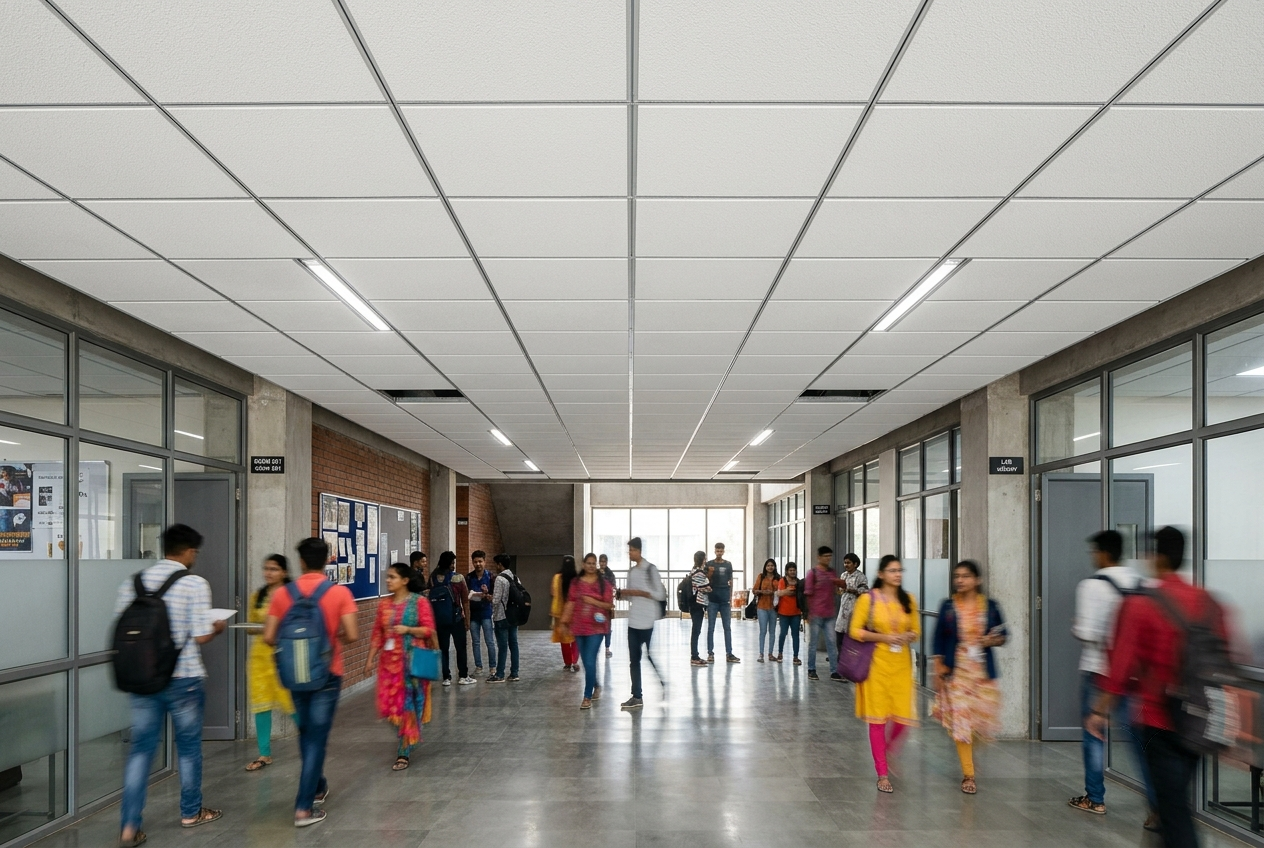
Choosing ceiling tiles for a college or university is rarely just an interior-design decision. Educational buildings have a combination of requirements that can make ceiling selection surprisingly complicated. Classrooms need speech clarity, corridors experience constant movement and noise, libraries require quieter environments, laboratories may need durable and easy-to-maintain surfaces, while auditoriums and lecture halls can have serious reverberation problems.
Then there are the practical requirements: lighting, HVAC, electrical services, fire safety, maintenance access, humidity, durability, and the ability to replace individual ceiling panels without disturbing an entire area. The right ceiling tiles therefore depend heavily on how the space is used and what problem the ceiling needs to solve.
What Changes Across a University or College Building?
A classroom for 40 students has very different acoustic needs from a 500-seat lecture hall. Libraries need sound control without a visually heavy ceiling, while laboratories and corridors often place more emphasis on durability, maintenance and access to services. Large auditoriums and lecture halls are even more challenging, as hard surfaces can create multiple reflections and reduce speech intelligibility. That is why the ceiling should be considered as part of the room’s acoustic design, not as a decision made at the end of the project.
We have seen this first-hand through projects including auditorium acoustics and suspended ceilings at Gujarat University, as well as work for institutions such as Gujarat High Court and Kevadia. With nearly two decades in the ceiling and acoustics industry and projects across several states, we have found that one ceiling system rarely works equally well across an entire university. The right choice depends on the space, its acoustic needs, how it will be used and how easily it needs to be maintained.
Five Ceiling Tiles, Five Different Use Cases
Rather than comparing ceiling tiles only by material, it is more useful to look at the problem each system is better suited to address.
Universities often have complex ceiling zones with lighting, HVAC ducts, sprinklers, electrical cabling and other services. Enclosing everything behind a conventional ceiling can make maintenance more difficult, while a visually dense ceiling can make large spaces feel lower. Open-cell ceilings offer a different approach. Their open grid can help organise or partially screen services while keeping the ceiling visually lighter. The structure also allows easier access to services above the ceiling.
One point to keep in mind: an open-cell ceiling is not automatically an acoustic solution. Where echo is a concern, additional acoustic treatment may be needed. For example, Amazone By Furnitech’s open-cell ceiling tiles are available in GI metal, with a 100 x 100 mm cell and black or white finishes. They are designed to work with standard suspension systems while keeping services above the ceiling accessible.
Some university buildings simply take a lot of use. Thousands of students moving through corridors, laboratories, workshops, cafeterias and common areas create a more demanding maintenance environment than a typical office. In these spaces, the ceiling needs to handle everyday wear while remaining easy to clean and maintain. Metal ceiling tiles can be a practical option because they provide a rigid surface and are generally well suited to high-use environments.
There is also an important acoustic distinction: a plain metal ceiling does not provide significant sound absorption on its own. Where acoustic control is needed, separate acoustic treatment may be required. For example, Amazone By Furnitech’s metal ceiling tiles are available in 595 x 595 mm sizes, with 0.5 mm thickness, tegular and microlook edges, and plain or 1.8mm perforated finishes. They are available in aluminium or galvanised steel.
If there is one space where ceiling acoustics can directly affect learning, it is the classroom. Students need to hear clearly, teachers need to communicate without constantly raising their voices, and group discussions become harder when sound keeps reflecting off hard surfaces.
This is where mineral fibre ceiling tiles can be a practical choice. Their sound-absorbing properties, modular installation and familiar suspended-ceiling appearance make them suitable for classrooms, lecture rooms, libraries and other academic spaces where acoustic comfort is important. They are also practical to maintain. In large universities with many standard classrooms, damaged or stained tiles can generally be replaced individually rather than replacing the entire ceiling.
For example, Amazone By Furnitech’s mineral fibre ceiling tiles are available in several sizes and thicknesses, with square, tegular and microlook edges, with textures such as sand, fissured, pin-hole, biyo guard and black. The 16 mm mineral fibre tiles has been tested by SGS and ARAI, with listed results including an NRC of up to 0.60, a Class A fire rating under ASTM E84 and resistance to relative humidity of up to 96%. These specifications are particularly relevant in classrooms, where acoustic performance, fire safety and durability all need to be considered together.
Some academic spaces need more acoustic control than a standard classroom. In these rooms, stronger sound absorption can improve speech clarity and make the space more comfortable. White fibreglass wool ceiling tiles are worth considering when the ceiling needs to play a significant role in the acoustic treatment.
The white finish also keeps the ceiling bright and neutral, making it easier to integrate into conventional educational interiors. For example, Amazone By Furnitech’s white fibre glass wool acoustic ceiling tiles use a high-density fibreglass wool core, with square, tegular and microlook edge options. They offer an NRC of up to 0.90.
Not every educational building needs a visibly acoustic-looking ceiling. In newer campuses and premium academic buildings, the design may call for a clean, continuous appearance while still requiring acoustic control.
Perforated gypsum ceiling tiles offer a useful middle ground. The perforations allow sound to interact with the acoustic construction behind the surface, while the gypsum face maintains a more conventional architectural appearance. They can also suit spaces where designers want to avoid a visibly fibrous or heavily textured ceiling. For example, Amazone By Furnitech’s perforated acoustic gypsum ceiling tiles are white and designed for standard grid installation, with perforations that assist with sound absorption. They offer an NRC of up to 0.60.
Where Each Ceiling Makes the Most Sense
A useful way to shortlist these systems is to stop thinking about the university or college as one building and start thinking about it as a collection of different acoustic and functional zones.
Auditoriums
- Primary concern: High reverberation and speech clarity
- Ceiling types worth considering: Fibre Glass Wool or Perforated Gypsum
Seminar / Conference Rooms
- Primary concern: Speech clarity and appearance
- Ceiling types worth considering: Fibre Glass Wool or Perforated Gypsum
Corridors
- Primary concern: Durability and maintenance
- Ceiling type worth considering: Metal Ceiling Tiles
Laboratories
- Primary concern: Durability, maintenance and accessibility to services
- Ceiling type worth considering: Metal Ceiling Tiles
Libraries
- Primary concern: Quietness and acoustic comfort
- Ceiling types worth considering: Mineral Fibre or Fibre Glass Wool
Academic Administration Areas
- Primary concern: Acoustic comfort and a clean appearance
- Ceiling types worth considering: Mineral Fibre or Perforated Gypsum
Standard Classrooms
- Primary concern: Speech clarity and reverberation control
- Ceiling type worth considering: Mineral Fibre
Student Common Areas
- Primary concern: Noise control, services and visual openness
- Ceiling type worth considering: Open Cell Ceilings, with acoustic treatment where required
Lobbies / Entrance Areas
- Primary concern: Services integration and architectural appearance
- Ceiling type worth considering: Open Cell Ceilings
Large Lecture Halls
- Primary concern: Speech intelligibility and echo control
- Ceiling types worth considering: White Fibre Glass Wool or Perforated Gypsum
This isn’t a universal specification. Room dimensions, occupancy, existing finishes, HVAC, lighting, acoustic targets and installation conditions can change the appropriate choice.
Putting the Ceiling Specification Together
For a college or university project, the specification should ideally establish more than the tile size.
Consider:
- Acoustic requirements: What level of sound absorption is actually needed?
- Fire performance: What tested classification applies to the product and ceiling system?
- Humidity: Will the building operate in a high-humidity or heavily air-conditioned environment?
- Maintenance: How frequently will tiles need to be accessed, cleaned or replaced?
- Services: How much HVAC, electrical, lighting and fire-safety infrastructure will be located above the ceiling?
- Visual requirements: Should the ceiling disappear into the architecture or become part of it?
- Installation: Is the product compatible with the proposed grid and site conditions?
- Testing: Are the acoustic and other performance claims supported by appropriate test data?
A Practical Shortlist for Academic Buildings
There isn’t a single winner among these five systems.
- Open-cell ceilings make sense where openness, service access and architectural visibility are important.
- Metal ceiling tiles are well suited to areas where durability, cleaning and long-term maintenance matter.
- Mineral fibre tiles are a strong option for standard classrooms and academic rooms where everyday acoustic comfort is important.
- White fibre glass wool tiles are worth considering where sound absorption is a higher priority, particularly in lecture halls, libraries and larger teaching spaces.
- Perforated gypsum acoustic tiles can work well when acoustic treatment needs to coexist with a cleaner, more architectural ceiling appearance.
The key point is that a large university or college may legitimately use several of these systems across the same campus.
A Better Way to Specify a College or University Ceiling
For a new campus or renovation, the best starting point isn’t a product catalogue. Start with the building zones and the problems each one needs to solve. Classrooms need clear communication. Libraries need calm. Lecture halls need intelligibility. Laboratories need durability, while corridors need resilience and service access. Auditoriums require a more deliberate acoustic strategy. Once these requirements are mapped, choosing the right ceiling becomes much easier.
Amazone By Furnitech can be included in that comparison because its range covers all five approaches, from open-cell ceilings and metal ceiling tiles to mineral fibre ceiling tiles, white fibre glass wool acoustic tiles and perforated gypsum acoustic tiles. Its experience across academic and institutional projects also provides useful context beyond the catalogue specifications.
For architects, consultants, contractors and university or college facility teams, the next step is to compare room type, acoustic requirements, services, maintenance expectations and tested product data before selecting the final system. Contact us to discuss your campus ceiling requirements and explore suitable solutions for different academic spaces.
TL;DR
Different areas of a college or university require different ceiling solutions based on their acoustic, functional and maintenance needs. Open-cell ceilings offer service accessibility, metal ceiling tiles provide durability, mineral fibre tiles suit standard classrooms, white fibre glass wool tiles support higher sound absorption, and perforated gypsum tiles offer an architectural finish with acoustic benefits. Amazone By Furnitech provides all five options, allowing architects, contractors and facility teams to compare acoustic performance, fire safety, durability and maintenance requirements before selecting suitable ceiling tiles for each campus zone.
_ _
Considering acoustic treatment for your space?
Furnitech supplies and installs acoustic panels and ceiling tiles across India.
Call +91-9727092998 or send your requirements.
Related Articles