Restaurants are one of the few commercial spaces where clients actually want some noise. They want the energy, the buzz and the feeling of a full room. The problem is that there’s a big difference between a lively restaurant and one where you have to lean across the table just to hear the person next to you. That line is easy to cross, especially when the interior focuses on exposed concrete, glass and hard flooring without considering how much sound those surfaces reflect.
We’ve worked on acoustic projects across restaurants, hospitality spaces, education spaces, healthcare spaces, commercial spaces, auditoriums, theatres and other public buildings. When too many hard surfaces reflect sound back into a room, conversations become harder to follow, and the space quickly feels louder than intended. In a restaurant, the goal isn’t to make the room silent. It’s to keep the energy while making it comfortable enough for people to actually enjoy a conversation.
Where the noise actually comes from?
After working on acoustic and ceiling projects across a wide range of hospitality spaces, including restaurants and cafés, as well as commercial, education and public spaces, for more than two decades. We’ve seen firsthand how differently sound behaves from one environment to another. The right acoustic treatment depends on the size of the space, how it’s used, the level of occupancy and the surfaces already in the room. Our experience across a wide range of acoustic projects gives us a practical understanding of how these factors come together when planning an acoustic specification for a restaurant.
The bar and lounge area faces a different mix of challenges. Music, glassware, a standing crowd and hard surfaces at the counter all contribute to the noise. Peak hours bring all these sources together, which is why bars often feel disproportionately loud compared to their actual size. The fix needs high absorption, but without flattening the energy the space is designed to have. Nobody wants a bar that suddenly feels muted.
Private dining rooms and booth zones have the opposite spatial problem. A smaller enclosed volume means reflected sound has less room to disperse before it bounces straight back, so even modest reflections from hard surfaces can feel more noticeable than they would in an open hall. These zones usually need a higher NRC concentrated in a smaller footprint, sometimes paired with wall treatment alongside the ceiling.
An open or exhibition kitchen pass presents a different challenge. Direct exposure to heat and extraction fan noise can wear down acoustic ceiling tiles quickly. Fire rating and humidity tolerance need to come first here, ahead of the raw acoustic score.
Fast-casual and food court seating deals with high turnover, hard cleaning surfaces and dense communal seating. The bigger long-term issue is what constant cleaning does to the ceiling above it. Cleaning chemicals and daily humidity from mopping can affect the cores of lower-quality acoustic ceiling tiles over time, making humidity resistance and ease of replacement more important than chasing the highest possible NRC.
The restaurant-specific constraints most acoustic guides skip past
Restaurant ceilings live a harder life than office or retail ceilings, and most generic acoustic advice doesn’t account for it. Kitchen-adjacent zones deal with airborne particles, which can settle on acoustic ceiling tiles over time and, on porous materials, can be difficult to clean without affecting the acoustic material. Fire code requirements can also be more demanding near open-flame cooking lines than in a typical commercial ceiling specification, so acoustic performance can’t be the only factor on the specification sheet.
Fire rating needs to be considered first, but humidity is just as important when selecting a ceiling for a restaurant. Between kitchen steam, dishwashing stations and daily mopping, some restaurant areas can experience higher humidity than a comparable office. This can affect ceiling materials over time, particularly when the material isn’t suited to the conditions. Any shortlist of acoustic ceiling tiles for a restaurant should account for these factors rather than relying on NRC ratings alone.
Three Acoustic Ceiling Tiles Worth Considering
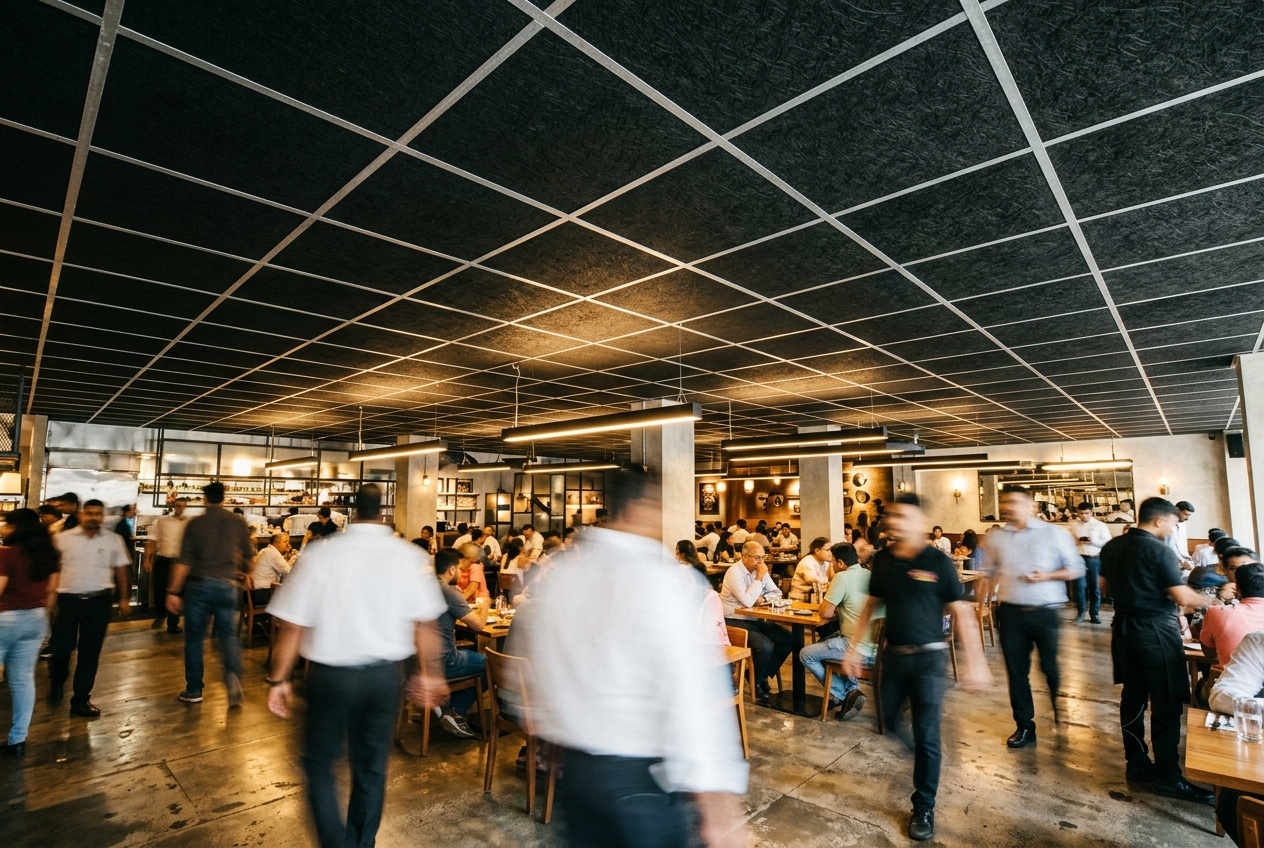
Why it gets picked: Nothing else can absorb as much sound per square foot as this one, which matters in a dense dining hall where you’re trying to bring the noise down significantly, not just take the edge off. The white finish keeps a bright dining room bright, while the black finish blends into darker bar and lounge interiors instead of standing out.
Where it needs a second look: It’s not the first material you’d choose directly over an open cooking line. Heat exposure calls for something else there, so it tends to be specified for the main dining hall and bar ceiling rather than the kitchen pass zone.
Amazone By Furnitech’s white fibre glass wool acoustic ceiling tiles reach an NRC of 0.90 across multiple sizes, with a sealed fibreglass core designed to resist sagging under everyday humidity. That’s a relevant detail in a dining room located near a kitchen where ambient moisture can be higher. The black fibre glass wool acoustic ceiling tiles reach an NRC of 0.95 and is a natural fit for bar and lounge ceilings that want to look moody rather than bright.
Why it gets picked: It’s the category designed to handle many of the condition’s restaurants can put a ceiling through, including humidity, regular cleaning and fire-safety requirements. For food-court-style seating and general dining areas where the budget has to stretch across a large footprint, it’s often the more practical specification.
Where it needs a second look: Its acoustic performance is more modest than some other ceiling options, so in a genuinely loud bar or packed dining hall, mineral fibre alone may not close the gap completely without additional acoustic treatment, such as wall acoustic panels.
Amazone By Furnitech’s 16mm mineral fibre tiles carry SGS testing confirming a Class A fire rating under ASTM E84 and retain their shape at up to 96% relative humidity. That’s a relevant consideration for areas near kitchens where humidity can be higher. NRC reaches up to 0.60, with an STC of 25 dB. Five texture options, including Sand, Fissured, Pin-Hole, Biyo Guard and Black, across four thicknesses also mean that fire and humidity performance doesn’t have to come at the expense of the dining room’s visual design.
Why it gets picked: Fine dining and upscale casual concepts often want a ceiling with zero visible texture, with a flat, monolithic look that feels like an intentional design choice rather than functional acoustic hardware. Gypsum’s naturally fire-resistant core also gives it a safety advantage that can be relevant when considering restaurant fire-safety requirements.
Where it needs a second look: Its acoustic performance is more modest than the other two options here, so it tends to be paired with wall panels in private dining rooms or booth zones rather than used as the sole acoustic treatment in a loud main hall.
Amazone By Furnitech’s perforated gypsum acoustic ceiling tiles comes in a standard 595 x 595mm white format at 12mm thickness, with an NRC of up to 0.60. In a private dining room or upscale main hall where the brief calls for a ceiling that looks premium rather than overtly acoustic, that clean appearance combined with standard T-grid installation can be a deciding factor alongside raw absorption performance.
Closing the gap between buzzy and too loud
The restaurants that get this right usually don’t rely on one ceiling tile to solve every zone. They match the fire, humidity and cleaning demands of kitchen and food-court areas with a tougher material, while reserving higher-NRC options for the dining hall and bar, where the acoustic improvement is more noticeable to guests. Treating the whole footprint with one product chosen for looks alone is one of the most common reasons a restaurant can reopen after renovation and still feel just as loud as before.
When you’re narrowing down the final shortlist, the useful comparison isn’t just which tile has the highest NRC. Fire rating, humidity performance and the demands of each zone matter just as much. Amazone By Furnitech‘s range of fibre glass wool acoustic ceiling tiles, mineral fibre tiles and perforated gypsum acoustic ceiling tiles gives project teams different options to consider across these conditions, with the relevant performance specifications available to review before the final restaurant ceiling specification is locked in. Contact us to discuss your restaurant’s acoustic requirements and find suitable ceiling tile options for different areas of your project.
TL;DR
A restaurant’s acoustic ceiling specification should reflect the conditions in each area, from busy dining halls and bars to kitchen-adjacent zones and food courts. Fibre glass wool acoustic ceiling tiles offer higher sound absorption, with NRC ratings up to 0.90 for white tiles and 0.95 for black tiles, while mineral fibre tiles provide a practical option where humidity and fire performance matter. Perforated gypsum acoustic ceiling tiles suit interiors that call for a clean, refined ceiling finish. Amazone By Furnitech offers all three options, allowing project teams to balance acoustic performance, durability, safety and design requirements.
_ _
Considering acoustic treatment for your space?
Furnitech supplies and installs acoustic panels and ceiling tiles across India.
Call +91-9727092998 or send your requirements.
Related Articles