People usually come to us assuming this is a harder decision than it actually is. Acoustic baffles and acoustic ceiling clouds are often treated like competing products, when in most commercial spaces, the room itself already answers the question, you just need to know which measurement to check first.
We have been working across ceiling and acoustic applications for almost two decades, with experience spanning commercial offices, corporate spaces, theatres, auditoriums, university buildings, government facilities, and other large interiors. Working across such a wide range of commercial and institutional spaces has highlighted an important point: acoustic treatment needs to work with the room’s geometry, activity, ceiling height, and existing infrastructure, not just the product specification.
That’s why choosing between acoustic baffles and acoustic ceiling clouds should start with understanding the space, rather than simply comparing two products.
Start With the Space, Not the Product
Here is a practical way to look at common commercial environments.
Open-plan offices
The main problem is rarely a single loud sound source. It is the accumulation of conversations, phone calls, meetings, keyboard noise, HVAC systems, and movement across a large open floor. The objective is usually to reduce reverberation and prevent speech from becoming overly dominant across the room. Suspended ceiling treatments can be particularly useful here because they add absorption without taking up valuable wall space needed for workstations, storage, or glazing.
Meeting rooms and training rooms
These spaces have different priorities. People need to hear the person speaking clearly, presentations need to remain intelligible, and video-conference audio should not have to compete with excessive room reflections. Acoustic treatment can be particularly effective when the ceiling is a significant reflective surface and more concentrated acoustic control is required above the occupied zone.
Cafeterias and breakout areas
These spaces can become progressively louder as occupancy increases. Hard floors, glass, furniture, and exposed ceilings can create a significant amount of reflected sound. Here, the objective is not necessarily silence. It is to control the build-up of reverberant sound so that multiple conversations can take place without the entire room turning into one continuous noise field.
Lobbies, atriums, and high-volume commercial interiors
Large vertical volumes change the acoustic equation. Sound has more room to travel, while hard architectural surfaces can keep reflections active for longer. Vertical acoustic elements can be useful in these situations because they introduce absorption into the volume rather than relying only on the ceiling plane.
Studios, AV rooms, and presentation spaces
Speech, recorded audio, and playback quality are particularly important in these environments. Acoustic treatment needs to be selected according to the relevant frequency range, the room’s reverberation characteristics, and the required level of acoustic control.
Look Up Before You Decide
The ceiling itself can tell you which format makes more sense. Acoustic ceiling clouds are essentially a horizontal acoustic panel suspended below the existing ceiling. Acoustic baffles are a vertical acoustic element suspended from the ceiling. That difference becomes useful when looking at:
- Ceiling height
- Available suspension depth
- Exposed ducts and services
- Lighting arrangement
- HVAC airflow
- Existing ceiling grids
- Amount of open ceiling area
- Desired visual zoning
- Where people actually occupy the room
For example, a large open-plan office with exposed services may benefit from a carefully spaced baffle arrangement because the treatment can work within the vertical volume while keeping the services visible. A meeting or collaboration area may instead benefit from a cluster of clouds positioned above the occupied zone. Neither approach should be selected purely from a catalogue of photographs.
Acoustic ceiling clouds are particularly useful when the ceiling is contributing heavily to reflections, and the project needs acoustic treatment without covering the entire ceiling. Their biggest advantage is placement flexibility.
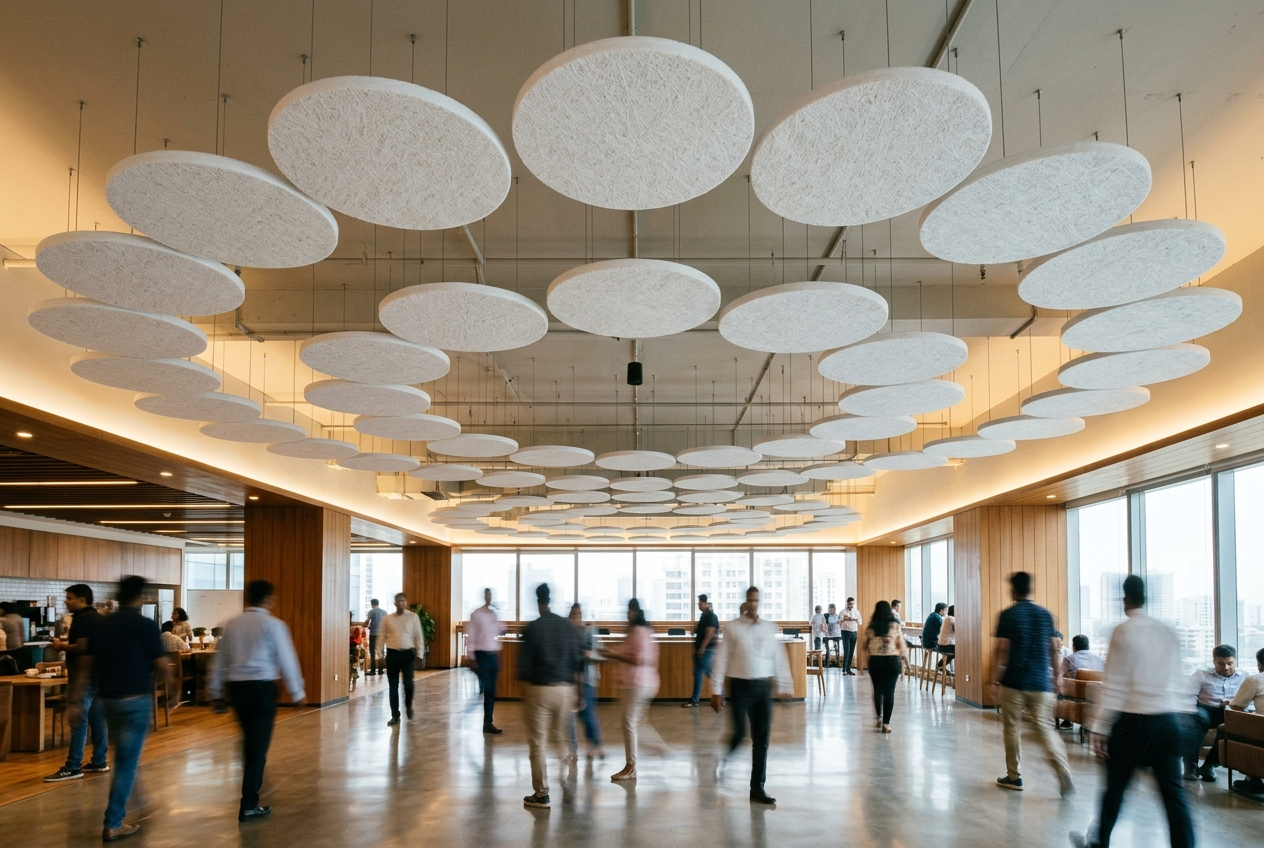
Instead of treating the ceiling as one continuous surface, acoustic ceiling clouds can be positioned where the acoustic requirement is greatest. They can also be arranged in groups, patterns, or zones, making them useful in interiors where acoustic treatment needs to become part of the visual design. They are worth considering for:
- Open offices
- Conference and meeting rooms
- Co-working areas
- Cafeterias
- Reception areas
- Restaurants
- Educational spaces
- Studios
- Large multipurpose rooms
A project also needs to look beyond the NRC figure. The number of panels, panel spacing, suspension height, available surface area, and placement all affect the final acoustic result.
Applying the same approach in practice
For example, Amazone By Furnitech’s Acoustic Ceiling Clouds are available in 600, 900, and 1200 mm diameter circular formats, as well as 1200 x 600 mm, 1200 x 1200 mm, and 2700 x 1200 mm rectangular options. The range includes circle, wave, square, curve, hexagon, and rectangle shapes, with 30 mm and 40 mm thicknesses and an NRC of up to 0.95.
Acoustic ceiling clouds are designed for suspended installation, which can be useful in spaces where existing ceilings already accommodate services, lighting, or other infrastructure and modifying the ceiling plane may not be practical. Amazone By Furnitech also provides customised cloud designs, allowing the acoustic treatment to be developed around a specific interior concept or design requirement.
Acoustic baffles solve a slightly different design problem. Because they hang vertically, they expose a larger portion of their absorbing surface to the room. This can be useful in spaces with high ceilings, exposed services, or large open volumes where treating only the horizontal ceiling plane may not be the most practical approach. They can also create a visual rhythm across a large ceiling without turning the entire surface into a conventional acoustic ceiling. Acoustic baffles are commonly worth investigating for:
- Large open-plan offices
- Cafeterias and food courts
- High-ceiling commercial areas
- Studios
- Classrooms and training facilities
- Libraries
- Gyms and halls
- Hospitality interiors
Spacing becomes particularly important. Baffles should not simply be hung wherever there is free space. Their arrangement needs to work around lighting, HVAC, circulation, and the areas where people actually generate and receive sound.
Applying the same approach in practice
For example, Amazone By Furnitech’s rectangular Acoustic Baffles measure 2400 x 300 mm, with a thickness of 30 mm, a white finish, and an NRC of up to 0.90. The baffles use high-density fibreglass wool and are intended to absorb mid- and high-frequency sound, helping to reduce reverberation and improve speech clarity.
Acoustic baffles are suspended from the ceiling using cables or rods, allowing them to be introduced without major changes to the walls or existing ceiling structure. Amazone By Furnitech also provides customised sizes, shapes, and layouts for projects with specific acoustic or design requirements.
A Simple Way to Narrow It Down
A useful starting point is to look at the type of commercial space, identify its main acoustic challenge, and then consider which format is more likely to suit the room.
Open-plan offices: When speech spill and general reverberation are the main concerns, baffles, ceiling clouds, or a combination of both may be worth considering.
Boardrooms: Where speech clarity and reflections are the priority, ceiling clouds can provide more concentrated treatment above the occupied area.
Training rooms: When voice intelligibility is critical, ceiling clouds can help control reflections around the speaking and listening zones.
Cafeterias: As occupancy increases, noise can build up quickly. Baffles or a combination of baffles and clouds can help manage reverberation across the space.
High-ceiling offices: Large reverberant volumes may benefit from baffles, particularly where the vertical volume and exposed ceiling infrastructure make treating only the ceiling plane less practical.
Lobbies and atriums: In large volumes where reflections can travel across the space, baffles or a carefully designed cloud arrangement may be worth exploring.
Collaboration zones: For more localised conversation noise, ceiling clouds can provide targeted acoustic treatment above the occupied area.
Studios and AV spaces: Where controlled reflections and clarity are important, the choice between clouds and baffles depends more heavily on the room design, required acoustic control, and intended use.
Years of experience across commercial projects have given us a practical understanding of how acoustic requirements can vary from one space to another. That experience has been built through partnerships with more than 1,500 commercial clients using our acoustic panels and ceiling solutions.
At the same time, every project has its own design intent and specifications. Architects, interior designers, acoustic consultants, and project teams may have their own requirements, and the acoustic solution needs to work within those considerations while addressing the room’s specific needs. These are therefore starting points, not fixed rules.
The Practical Takeaway
If the goal is to create suspended acoustic zones below an existing ceiling, acoustic ceiling clouds offer flexibility in positioning, shape, and visual design. If the project has a large vertical volume, exposed services, or a high ceiling where vertical absorption can be useful, acoustic baffles deserve consideration. In some commercial spaces, the right answer may actually be a combination of both, rather than forcing the project into one format.
For projects being evaluated today, Amazone By Furnitech’s range covers both approaches. Acoustic ceiling clouds are available in multiple sizes, shapes, and thicknesses, with an NRC of up to 0.95, while the acoustic baffles are available in standard size and thickness, with an NRC of up to 0.90. Both can be considered alongside the project’s ceiling height, layout, services, and intended acoustic outcome, rather than being selected as standalone decorative products. Contact us to explore acoustic ceiling clouds and acoustic baffles, discuss your project’s acoustic requirements, and find the right solution for your space.
TL;DR
Acoustic ceiling clouds and acoustic baffles address reverberation in different ways, making room geometry an important factor in determining their suitability. Clouds provide targeted absorption across selected ceiling areas, while vertical baffles introduce absorbing surfaces into larger volumes, particularly where ceilings are high or services remain exposed. Amazone By Furnitech offers acoustic ceiling clouds in circular and rectangular formats, along with options such as wave, curve, and hexagon designs, while its acoustic baffles provide an alternative for spaces that require vertical treatment. With NRC ratings of up to 0.95 for clouds and 0.90 for baffles, both options can support acoustic planning when their placement, spacing, and installation height are carefully considered.
_ _
Considering acoustic treatment for your space?
Furnitech supplies and installs acoustic panels and ceiling tiles across India.
Call +91-9727092998 or send your requirements.
Related Articles