
A library or study space can look quiet and still sound distracting. The problem is often not loud noise, but the accumulation of smaller sounds: chairs moving across floors, people speaking softly, keyboards, footsteps between shelves, printers, doors opening, group discussions, and sound reflecting from ceilings and walls. In a large reading room, even low-level activity can become noticeable when the room has too many hard surfaces.
That is why selecting acoustic products for libraries and study environments needs a slightly different approach. The objective is not to make every room completely silent. It is to create conditions where reading, concentration, discussion, and learning can happen without unnecessary sound carrying through the space. The right acoustic products can help manage sound reflections while complementing the room’s layout and interior design.
This also applies beyond conventional libraries. University study centres, coaching institutes, school libraries, research rooms, tuition centres, digital learning areas, and shared academic spaces can all have different acoustic requirements. The same acoustic products do not necessarily need to be used everywhere. A useful starting point is to look at where people are sitting, what kind of activity is happening around them, and which surfaces are allowing sound to keep travelling. These factors help determine which acoustic products are suitable for each learning environment.
Think in Terms of Acoustic Zones, Not Just Rooms
Consider a university library with individual reading desks, computer workstations, and a small group-study section. Although these areas share the same building, they can have different acoustic needs. Reading areas benefit from fewer sound reflections, while computer sections have continuous low-level operational noise. Group-study areas introduce speech, which can become more noticeable when it reflects from nearby hard surfaces.
The same principle applies to coaching centres. A lecture classroom has different acoustic priorities from a corridor outside the classrooms, or a discussion room used by students after class. Acoustic products should therefore reflect how each space is occupied and used.
This is where project experience becomes relevant. Amazone By Furnitech has more than two decades of experience in acoustic and ceiling work, including auditorium acoustics and suspended ceilings at Gujarat University auditorium, Gujarat High Court auditorium, and theatre acoustics across multiple states. The key is to consider acoustic products alongside the room’s architecture, occupancy, ceiling system, and intended use.
Polyester fibre panels make sense when acoustic products need to be flexible rather than dictated by a fixed ceiling or wall module. In a reading area with long rows of desks and a large uninterrupted wall, PET panels can use repeated shapes, colours, or patterns to define sections without physically dividing the room.
This flexibility is also useful in children’s libraries, student learning centres, and creative study environments where a conventional acoustic wall may feel too institutional. In a university study area, panels can form a visual band behind seating rather than covering the wall from floor to ceiling.
Amazone By Furnitech’s Polyester Fibre Acoustic Panels are available in 2440 x 1220 mm sheets in 9 mm and 12 mm thicknesses. The 9 mm option comes in 45 shades with an NRC of up to 0.70, while the 12 mm option has 27 shades and reaches up to 0.85 NRC. Both can be CNC customised.
Amazone By Furnitech’s CNC-Cut PET panels can be created in geometric forms, curves, patterns, decorative perforations, and engraved detailing. This allows acoustic products to incorporate visual wayfinding, academic motifs, or repeating patterns instead of relying on plain rectangular panels.
Some study spaces need softer architectural acoustic products. Think of a postgraduate reading room, research library, or private study area where people may spend several hours. With bookshelves, timber furniture, glass partitions, and other finishes already present, another visually strong material may not suit the interior.
Fabric-wrapped panels offer a different approach, making the acoustic surface feel more like part of the furniture and interior palette. They can be placed behind reading seats, around enclosed study rooms, or on selected wall sections where conversations and reflections need control.
Amazone By Furnitech’s Fabric Wrapped Acoustic Panels use a high-density fibreglass acoustic core with a fabric finish. They are 25 mm thick and available in 600 x 600 mm, 1200 x 600 mm, 1800 x 600 mm, 2100 x 600 mm and 2400 x 600 mm formats, with square and rectangular options. The standard range includes 12 jute-finish shades, with acoustic performance of up to 0.95 NRC.
Not all acoustic products need to become a feature. In a large institutional library, the ceiling may already accommodate lighting, air-conditioning, sprinklers, and other services. The brief may simply call for a clean, bright ceiling that performs acoustically without drawing attention to itself.
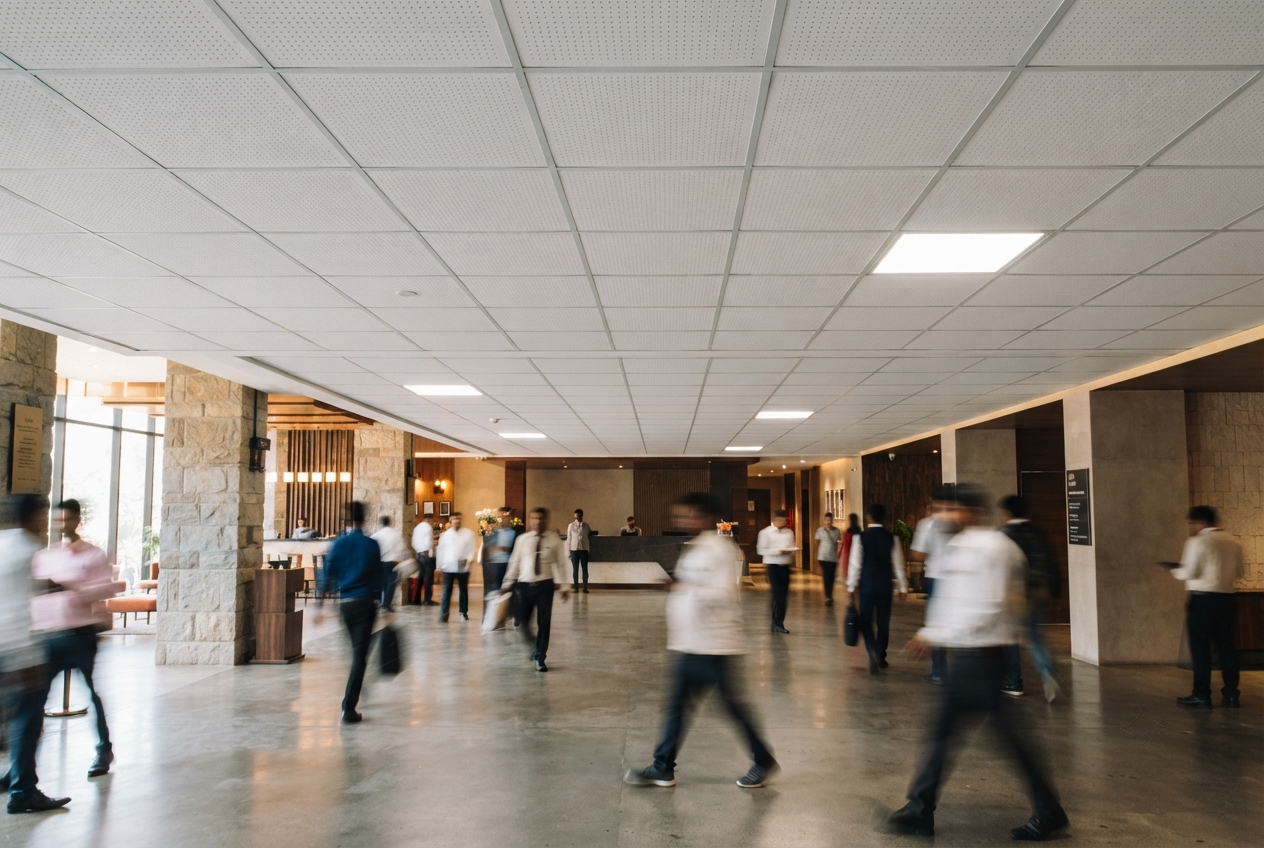
White fibre glass wool ceiling tiles can suit larger reading halls, school and university libraries, and study centres where the ceiling forms a substantial continuous surface. Instead of relying entirely on wall treatment, the ceiling can become part of the absorption strategy while retaining a conventional suspended-ceiling appearance.
Amazone By Furnitech’s White Fibre Glass Wool Acoustic Ceiling Tiles are available in 600 x 600 mm, 1200 x 300 mm, and 1200 x 600 mm formats. They come in 15 mm, 20 mm, and 25 mm thicknesses, with Square, Tegular, and Microlook edges, and NRC of up to 0.90. They are designed for standard T-grid systems. The edge profiles also provide design flexibility. Square offers a straightforward grid, while Tegular and Microlook create a more defined shadow line.
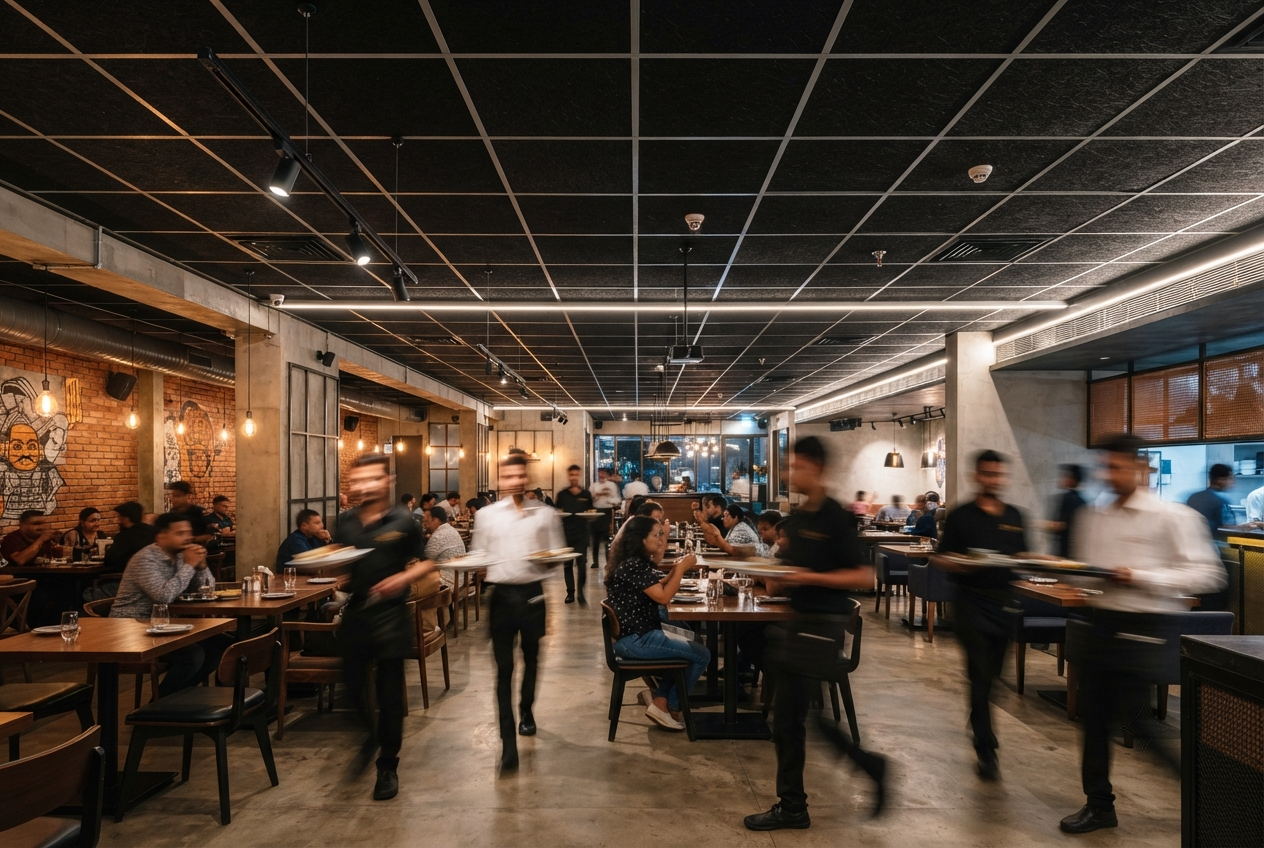
Some study environments do not suit decorative wall acoustic products. A university study centre may already have a strong ceiling design and require a consistent white finish. A coaching institute may need a repeatable ceiling system across classrooms, while a library renovation may need to retain a familiar suspended-ceiling appearance while improving acoustics. Perforated gypsum tiles can suit these requirements because the acoustic treatment is incorporated into the ceiling tile itself.
Amazone By Furnitech’s Perforated Acoustic Gypsum Ceiling Tiles are 595 x 595 mm square tiles, 12 mm thick, and finished in white, with acoustic performance of up to 0.60 NRC. The perforations allow the ceiling to contribute to sound absorption while maintaining a conventional visual appearance.
They are particularly useful when consistency is important. The uniform grid can be maintained across classrooms, study rooms, and academic spaces without introducing a visibly different material. The standard 595 x 595 mm format also simplifies coordination with grid-based ceiling layouts on larger projects.
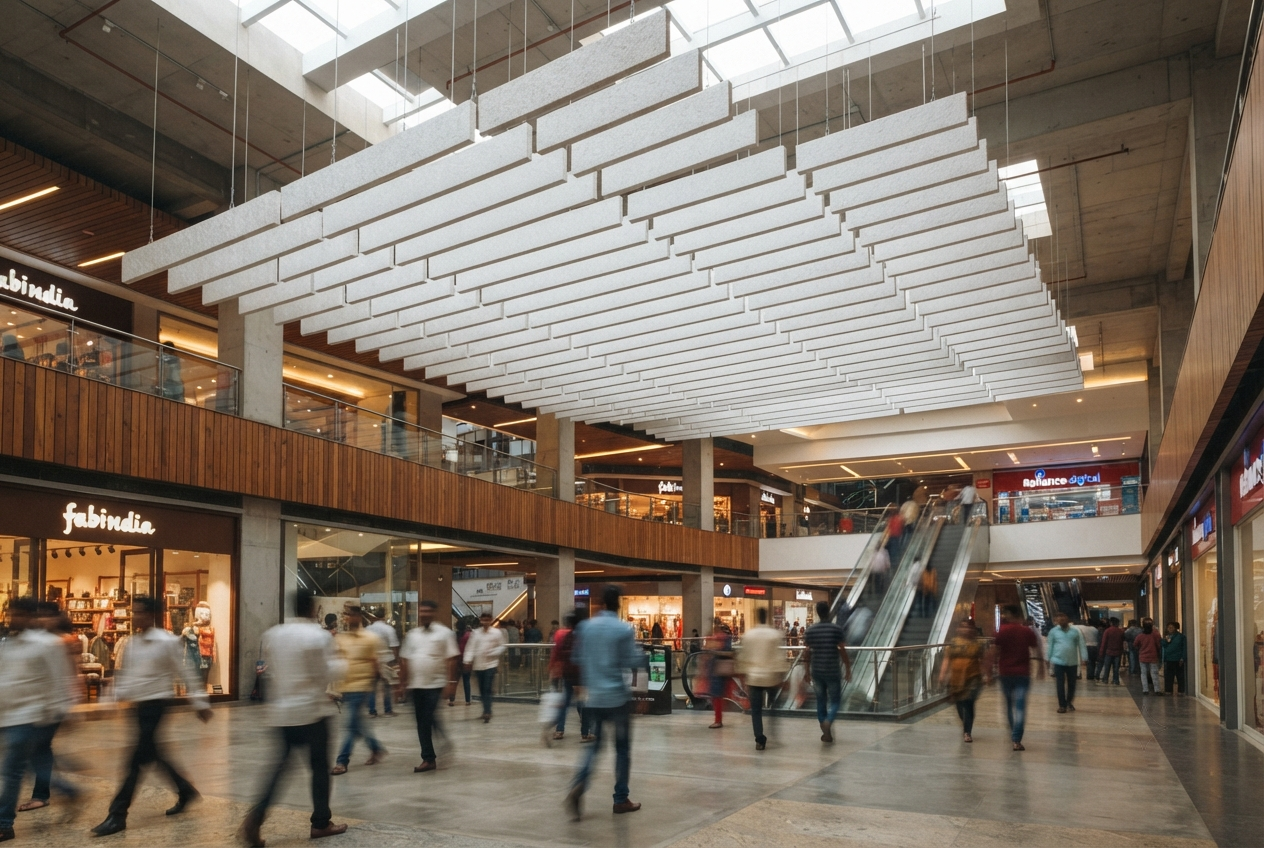
Wood wool approaches acoustic treatment differently. Rather than disappearing into the ceiling or blending into wall, its natural fibrous texture can become part of the interior. This makes it suitable for libraries and study environments built around timber, natural materials, or warmer architectural palettes.
A library reading lounge, university research area, or study space with natural finishes could use wood wool boards on selected walls or ceilings to introduce texture while contributing to acoustic control. Among the different acoustic products available, wood wool offers a distinctive combination of surface texture and sound absorption.
Amazone By Furnitech’s Wood Wool Acoustic Boards are available in 600 x 600 mm and 1200 x 600 mm formats, with 15 mm, 20 mm, and 25 mm thicknesses. Available in square and rectangular formats, the boards can be painted to suit the interior and installed on walls or ceilings, with acoustic performance of up to 0.70 NRC. Their paintable surface also allows designers to coordinate the boards with an established colour scheme.
What Should Be Checked Before Finalising the Acoustic Products?
Before choosing the acoustic products, it is worth looking at the space from the user’s point of view.
- For individual study: Look at nearby reflective walls, desk arrangements, and the amount of background activity.
- For group study: Consider where speech is likely to originate and whether sound can easily travel into adjacent quiet areas.
- For large reading rooms: Examine the ceiling as well as the walls. Large, uninterrupted surfaces can strongly influence how long sound remains in the room.
- For classrooms and coaching spaces: Speech clarity becomes especially important because the acoustic environment affects both teaching and listening.
- For open learning centres: Consider visual zoning alongside acoustic zoning. Different materials, colours, or panel arrangements can help distinguish spaces without constructing permanent partitions.
- For existing buildings: Check the ceiling grid, lighting, HVAC, and service access before deciding how much of the ceiling can be changed.
These decisions also help prevent a common specification problem: selecting acoustic products first and then trying to make the room fit around it.
Choosing the Right Acoustic Direction
There is no need for every library or study space to look acoustically identical.
- Polyester fibre is the flexible option when colour, geometry, and CNC design are important.
- Fabric-wrapped panels suit interiors where wall treatment needs a finished, softer appearance with high acoustic performance.
- White fibre glass wool tiles make sense when the suspended ceiling should contribute substantially to acoustic control while retaining a clean appearance.
- Perforated gypsum tiles suit projects that want acoustic functionality incorporated into a conventional architectural ceiling.
- Wood wool brings a textured, natural material character to walls or ceilings.
Therefore, the more useful question is not which acoustic products are universally suitable, but which combination matches the way the space is occupied and the architectural language already being developed.
Bringing Acoustic Treatment into the Study Environment
Good acoustics in a library or study environment should support concentration without making the interior feel engineered purely around sound control. Reading rooms, research areas, classrooms, coaching centres, digital study zones, and collaborative learning spaces can each require different treatment strategies.
The practical next step is to view the study environment as a collection of activities rather than one room. Once reading, teaching, discussion, and circulation areas are mapped, acoustic products can be selected according to where they will contribute most effectively.
For projects where several approaches need to be considered together, Amazone By Furnitech offers a range covering flexible PET panels, fabric-wrapped panels, fibre glass wool ceiling tiles, perforated gypsum tiles, and wood wool boards. Acoustic products provide architects, interior designers, and contractors with useful information for comparing formats, thicknesses, finishes, and acoustic performance during the initial selection stage. Contact us to discuss your library or study space requirements and explore acoustic products suited to your project’s functional, architectural, and acoustic needs.
TL;DR
The right acoustic products for libraries and study spaces depend on how each area is used, the level of sound activity, and the interior design requirements. Polyester fibre panels offer design flexibility, fabric-wrapped panels provide a softer wall finish, white fibre glass wool and perforated gypsum tiles support ceiling-based acoustic treatment, while wood wool boards add natural texture. Considering factors such as sound absorption, NRC ratings, installation requirements, ceiling systems, and visual preferences helps architects and interior designers select suitable acoustic products for reading rooms, classrooms, research areas, and collaborative learning spaces.
_ _
Considering acoustic treatment for your space?
Furnitech supplies and installs acoustic panels and ceiling tiles across India.
Call +91-9727092998 or send your requirements.
Related Articles