
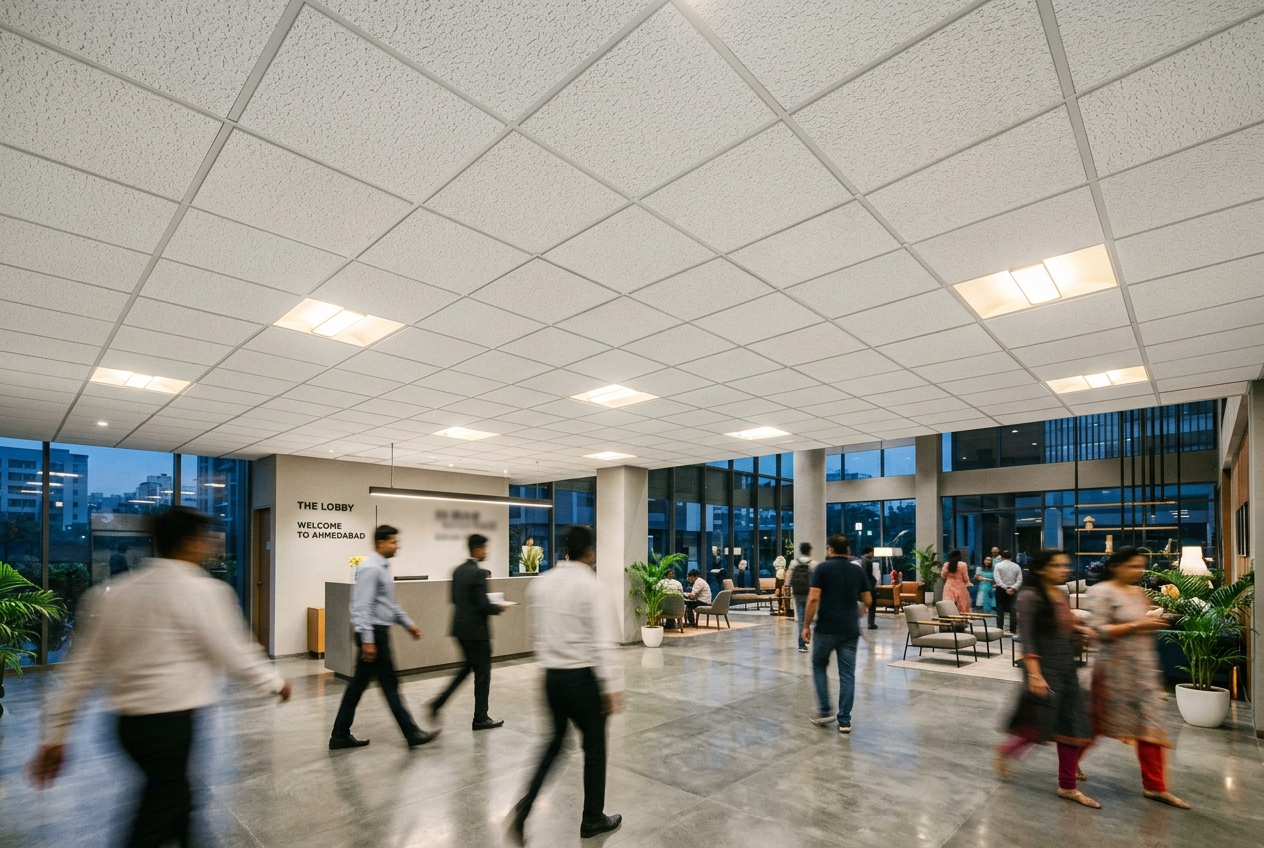
We get this question in some form on almost every commercial project brief now: not what ceiling tile looks good, but what other architects are actually putting in their specs this year. It’s a fair question because ceiling specs have quietly become more specific over the last few years. Clients are asking for NRC values, fire ratings, and humidity tolerance up front, rather than leaving those decisions to whoever is handling the interior fit-out.
We’ve sat across the table for that conversation on projects such as the acoustic treatment for the auditorium at Gujarat High Court, suspended ceiling work across several buildings at Gujarat University, the acoustic installations within the CM Dashboard at the Chief Minister’s Office in Gujarat. Watching how the same three or four categories of acoustic ceiling tiles get specified differently from project to project tells you a lot more than any single spec sheet does.
Why the same ‘best’ tile answer doesn't actually exist
The honest answer to ‘which tile is best?’ is that it depends on the problem the architect is solving on that specific project. We’ve been working in the ceiling and acoustic industry for almost two decades, across projects of all kinds. We’ve seen how architects, consultants, and clients make that choice when performance, aesthetics, and site conditions must work together. The pattern only becomes obvious once you’ve sat through enough of these conversations to see the same trade-offs repeat.
On a university auditorium project, the acoustic consultant’s NRC target was non-negotiable. The brief was built around speech intelligibility first and ceiling aesthetics second. That pushed the specification towards fibre glass wool almost automatically, because few other acoustic ceiling tiles can deliver comparable sound absorption at a similar weight.
On a hospital corridor and clinic fit-out, the priorities flipped entirely. Fire rating and humidity resistance mattered more than pushing NRC as high as possible, because these are spaces exposed to constant foot traffic, cleaning chemicals, and 24-hour HVAC cycling. Mineral fibre was specified there almost by default not because it is a safer choice in the abstract, but because it is a category with products specifically tested for the conditions the project needed to handle.
On a retail or hospitality interior where the client wanted the ceiling to look monolithic and premium from below with no visible texture and no grid pattern breaking up the sightline, perforated gypsum won out. Its acoustic performance may be more modest than fibre glass wool, but that was not the primary requirement. The brief was explicitly clean visual appearance first, acceptable acoustic control second, and gypsum was the category best suited to delivering that look without giving up sound control entirely.
None of these are universal rules. They are patterns we’ve seen repeatedly across real projects: the best acoustic ceiling tiles depend on whether the architect is trying to maximise acoustic absorption, meet fire and environmental requirements, achieve a particular visual aesthetic, or balance all three. That is why, after enough projects, the question stops being ‘Which tile is best?’ and becomes a much more useful one: ‘What does this particular ceiling need to do?’
What it’s actually good at: The highest sound absorption among the acoustic products at a comparable weight, which is why it’s usually the first thing considered once an acoustic consultant hands over a hard NRC target rather than a vague make it quieter brief.
Where it starts to make sense: Auditoriums, lecture halls, open-plan offices with heavy speech traffic, studios, anywhere the room’s primary job is helping people hear each other clearly, not just looking finished.
The trade-off nobody mentions upfront: It’s a premium product, and the acoustic gain only shows up if the coverage is right. Half-treating a ceiling with a premium tile can leave you with a mediocre result at a premium price.
Amazone By Furnitech’s white fibre glass wool acoustic ceiling tiles are rated up to NRC 0.90 and come in 600 x 600 mm, 1200 x 300 mm, and 1200 x 600 mm sizes, with square, tegular, or microlook edges. They also hold their shape under everyday humidity, a small detail that matters more than it sounds in a retrofit that may not be revisited for years. The black variants push NRC up to 0.95. Their low-reflectance finish is particularly suited to studios or AV rooms where the goal is a ceiling that disappears rather than draws the eye.
Ask most people why mineral fibre still dominates commercial ceiling specs, and the honest answer isn’t glamorous: it’s the option where fire rating, humidity tolerance, and acoustic performance are all good enough simultaneously, without forcing a trade-off in any one direction. That’s exactly why it shows up so often in hospitals, schools, and general offices, spaces where the ceiling has to withstand constant cleaning, 24-hour HVAC cycling, and heavy foot traffic more than it has to hit a maximum NRC number.
It’s also the category most likely to be chosen from a lab report rather than a mood board. Amazone By Furnitech’s 16 mm mineral fibre tiles carry SGS testing confirming a Class A fire rating under ASTM E84. They also have an ARAI-tested NRC of up to 0.60, an STC of 25 dB, and a rating to withstand up to 96% relative humidity without losing their shape, a figure that can be critical when specifying ceilings for high-humidity environments such as hospital corridors. Five textures, Sand, Fissured, Pin-Hole, Biyo Guard, and Black, across four thicknesses mean the tested performance doesn’t have to come at the expense of appearance.
This is the category that wins when the brief is explicitly about restraint: a reception or boardroom ceiling that should read as flat, seamless, and architecturally deliberate, with no visible grid pattern or texture breaking the sightline. Its acoustic numbers are the most modest of the three, and that’s a fair trade-off being made on purpose, not a gap in the product.
Amazone By Furnitech’s perforated gypsum acoustic ceiling tiles comes in a standard 595 x 595 mm white format at 12 mm thickness, rated up to NRC 0.60. What tends to seal the decision on real jobs isn’t the NRC figure alone; it’s that the tile sits within a standard T-grid rather than requiring a fully monolithic installation. That means MEP access above the ceiling remains serviceable without sacrificing the clean look the brief was asking for in the first place.
The Right Question Isn’t ‘Which Tile Is Best?’
If there’s one pattern worth taking away from watching this play out across different project types, it’s that ‘which tile is best?’ is the wrong question to bring to an architect. The better question is: ‘What is this ceiling actually being asked to do in this specific room?’ Fire rating, humidity tolerance, NRC target, and visual language rarely all point to the same product, and the projects that go smoothly are usually the ones where that trade-off is made deliberately rather than by default.
If you want to compare real specifications rather than category averages while working through that trade-off, you can refer to the specifications for Amazone By Furnitech’s fibre glass wool acoustic ceiling tiles (white and black), mineral fibre tiles, and perforated gypsum acoustic ceiling tiles. The details cover sizes, thicknesses, NRC, fire rating, and humidity resistance, giving you a useful basis for comparing them with other suppliers’ specifications.
Need help comparing ceiling options for your project? Contact us to discuss your requirements and identify suitable options based on your project’s acoustic, technical, and design needs.
TL;DR
The best acoustic ceiling tiles depend on the project’s acoustic targets, fire safety requirements, humidity conditions, and design preferences. Fibre glass wool acoustic ceiling tiles are ideal for spaces requiring high sound absorption, such as auditoriums, lecture halls, and studios. Mineral fibre ceiling tiles offer a practical balance of fire performance, humidity resistance, and sound absorption for hospitals, schools, and offices. Perforated gypsum acoustic ceiling tiles suit interiors where a clean, understated ceiling appearance and moderate acoustic control are priorities. Comparing tested specifications, including NRC, fire ratings, thickness, and humidity resistance, helps architects select the right ceiling solution for each space.
_ _
Considering acoustic treatment for your space?
Furnitech supplies and installs acoustic panels and ceiling tiles across India.
Call +91-9727092998 or send your requirements.
Related Articles