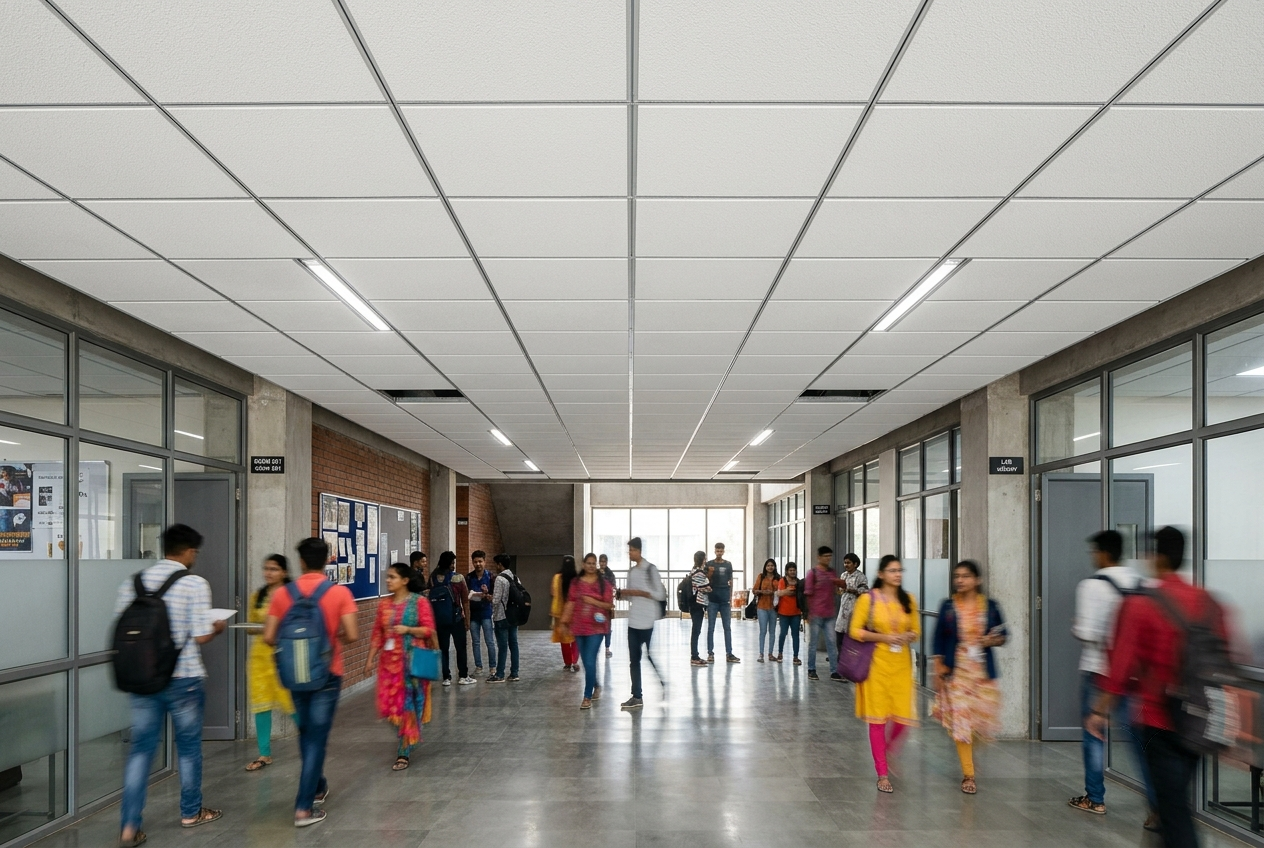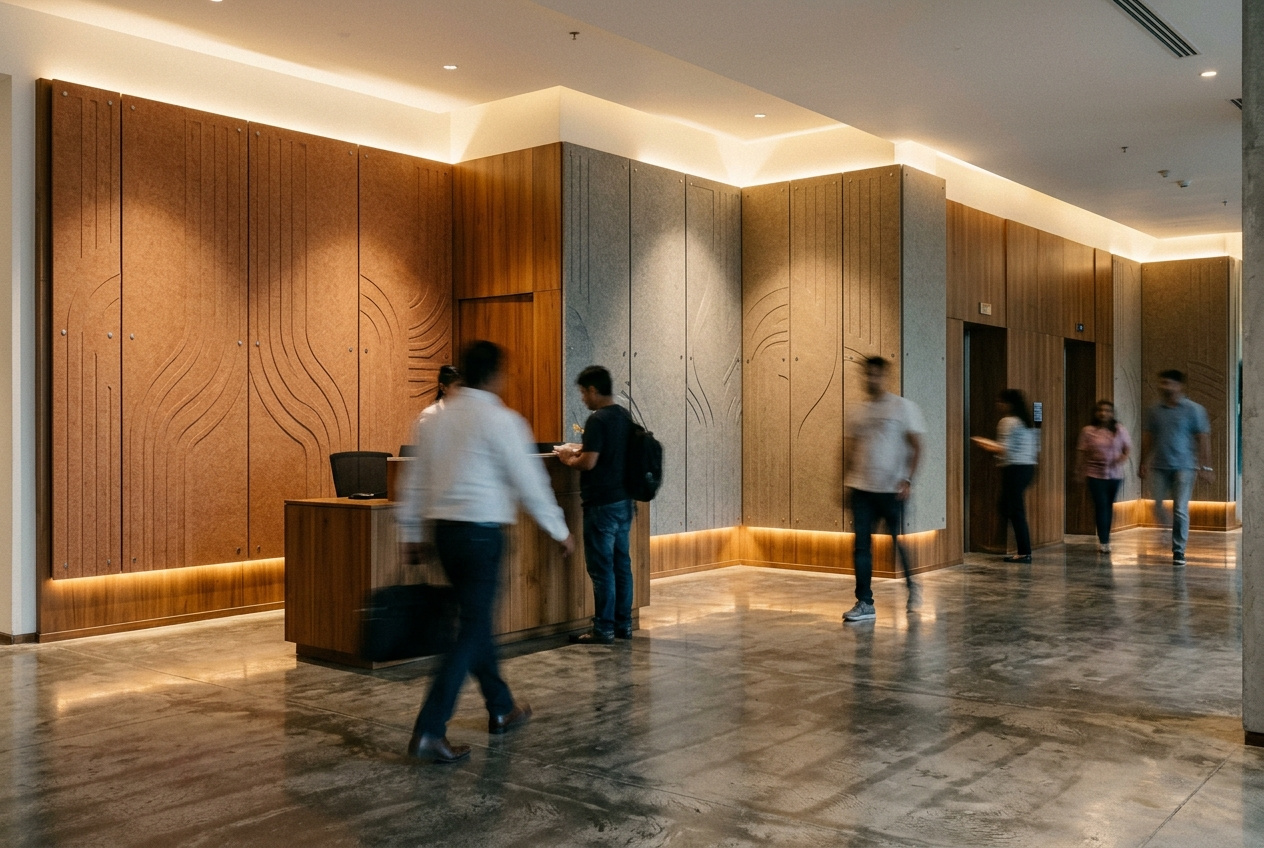
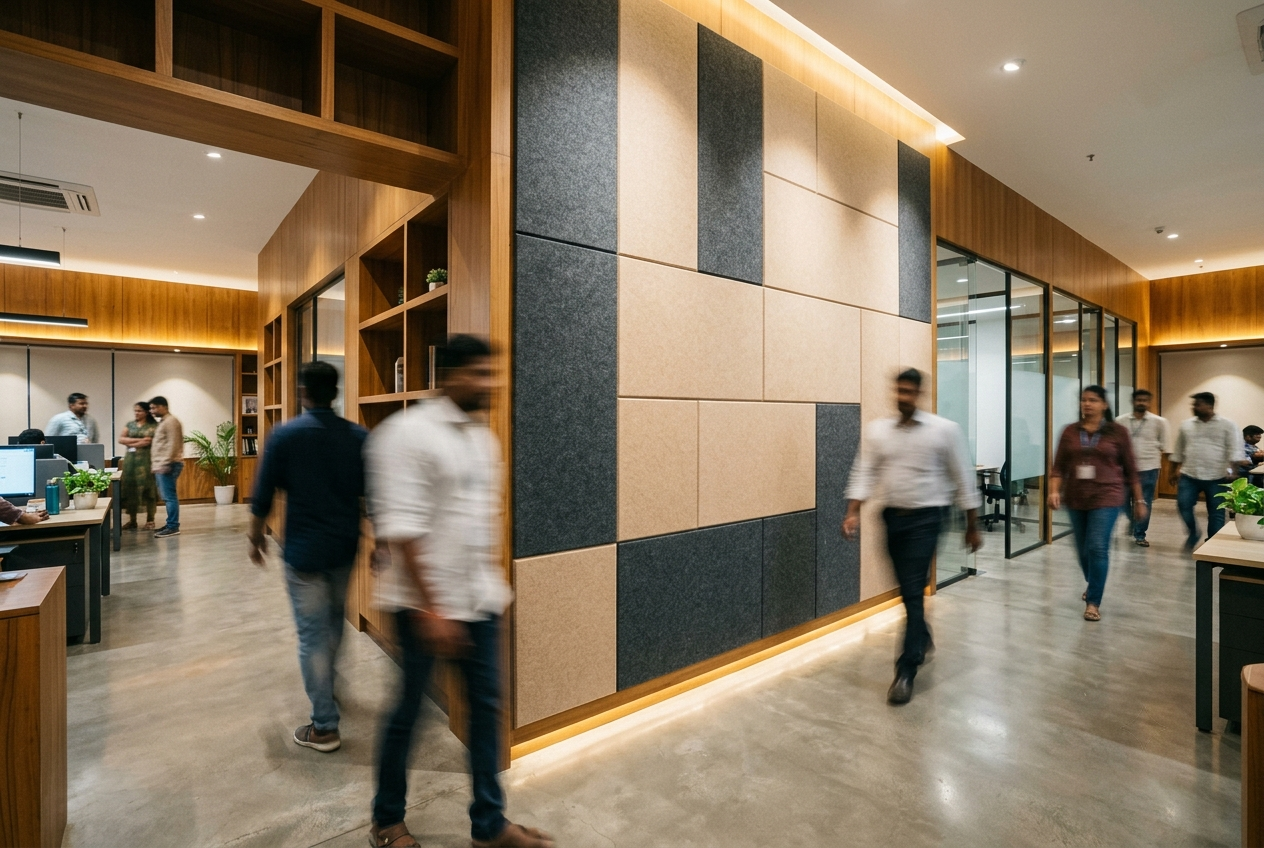
If an office has a noise problem, the obvious question is usually: Which acoustic panel should we install? But that question comes a little too early. The first thing to understand is what is actually making the office uncomfortable. Is it the constant background conversation in an open-plan workspace? Echo from glass partitions and hard floors? Poor speech clarity in meeting rooms? Video calls that sound harsh? Or simply a room that feels tiring because sound keeps bouncing around?
Both polyester fibre acoustic panels and fabric wrapped acoustic panels can help with these problems, but they address acoustic challenges differently. And that difference becomes important when you’re specifying panels for an actual office rather than choosing them from a catalogue.
The Office Problem Usually Isn't Just ‘Noise’
Modern offices can have a lot of acoustically reflective surfaces in one room: glass partitions, concrete or tiled floors, painted walls, exposed ceilings, desks, screens, and large windows. These surfaces don’t absorb sound, so conversations and other sounds can continue reflecting around the room. In an open office, that can make it harder to concentrate. In a meeting room, it can reduce speech clarity. In a video-conferencing room, reflections can make voices sound less controlled.
The objective of an acoustic panel is therefore generally sound absorption, not soundproofing. That’s an important distinction. A sound-absorbing panel can reduce reflections and reverberation within a room. It does not automatically stop sound from travelling through a wall into the next office.
What Experience From Real Projects Tells You
Acoustic specification becomes much easier when it is based on actual project conditions rather than only on product literature. Our experience across the ceiling and acoustics industry has shown us that no two spaces have exactly the same acoustic requirements. For almost two decades, we have worked on projects across several Indian states, covering institutional spaces, auditoriums, commercial interiors, theatres, offices, educational buildings, and other environments where acoustic performance is an important part of the design.
Today, more than 1,500 corporate partners use Amazone By Furnitech’s acoustic ceilings and panels across these applications. This experience also given us an understanding of how different spaces respond to sound and why acoustic treatment needs to be considered in the context of how a space is actually used.
That leads to a useful lesson for office projects:
- The acoustic requirement changes with the way the room is used.
- An open-plan office needs a different approach from a private cabin.
- A conference room has different priorities from a reception area.
- A boardroom may need stronger control of reflections around the speaker position.
- A collaborative workspace may need broader treatment across several reflective surfaces.
So, the choice between polyester fibre acoustic panels and fabric wrapped acoustic panels should start with the space and its acoustic needs, not simply with the material name.
Polyester fibre acoustic panels are made from compressed polyester fibres and are lightweight compared with many traditional acoustic constructions. They can be used as wall treatments, partitions, suspended elements, and customised decorative panels.
Think open-plan, flexible, and design-led. Consider them for:
- Open-plan workspaces
- Creative agencies
- Co-working spaces
- Collaboration areas
- Cafeterias and breakout zones
- Informal meeting areas
- Feature walls
- Offices with strong branding or interior design requirements
The major advantage isn’t simply that they absorb sound. It is the freedom they offer in terms of what can be done with the surface. Polyester fibre acoustic panels can be cut into geometric patterns, curves, branding elements, or decorative forms. This means the acoustic treatment can become part of the office design instead of looking like a correction added after the interior is finished. This can be particularly useful in offices where acoustic panels need to perform two jobs: control reflections and contribute to the visual character of the space.
A product example worth comparing: Amazone By Furnitech’s polyester fibre acoustic panels are available in 2440 x 1220 mm sheets, with 9 mm and 12 mm thicknesses. They offer an NRC up to 0.70 for 9 mm and up to 0.85 for 12 mm. The range includes 45 shades in 9 mm and 27 shades in 12 mm, with CNC cutting available for customised shapes and patterns.
Fabric wrapped acoustic panels take a different approach. Instead of making the acoustic surface itself the visual feature, the acoustic core is enclosed behind a fabric finish. This creates a softer architectural appearance and gives designers another way to coordinate acoustic treatment with the rest of the interior.
Think focused, formal, and conversation-heavy. Fabric wrapped acoustic panels can be particularly suitable for:
- Boardrooms
- Conference rooms
- Executive meeting rooms
- Private offices
- Video-conferencing rooms
- Training rooms
- Client meeting areas
- Studios
- Reception and waiting areas where acoustic comfort matters
These spaces often have a specific acoustic requirement: people need to hear each other clearly. A conference room with a long table, glass walls, and hard flooring can generate strong reflections between speakers. Treating appropriate wall surfaces can help reduce those reflections and make conversations feel more controlled. Fabric also gives the panel a more conventional interior finish, which can work well in offices where acoustic treatment needs to look integrated rather than highly decorative.
A product example worth comparing: Amazone By Furnitech’s fabric wrapped acoustic panels use a high-density fibreglass acoustic core with a fabric finish. They are available in a standard thickness of 25 mm, with panel sizes of 600 x 600 mm, 1200 x 600 mm, 1800 x 600 mm, 2100 x 600 and 2400 x 600 mm. They offer an NRC of up to 0.95, with 12 shades in a jute-finish fabric range. The panels come in square and rectangular formats.
Design freedom
- Polyester fibre: Custom shapes, patterns, colours, and large-format treatments.
- Fabric wrapped: More conventional panel formats with a fabric-based finish.
Visual character
- Polyester fibre: Can become a visible design feature within the workplace.
- Fabric wrapped: Creates a softer, more conventional architectural finish.
Acoustic role
- Polyester fibre: Sound absorption combined with design flexibility.
- Fabric wrapped: Sound absorption with a strong focus on acoustic comfort and speech clarity.
Where they fit best
- Polyester fibre: Open offices, creative areas, collaboration spaces, partitions, cafeterias, breakout zones, and feature walls.
- Fabric wrapped: Meeting rooms, boardrooms, private offices, video-conferencing rooms, training rooms, studios, and client meeting areas.
Customisation
- Polyester fibre: CNC cutting allows custom shapes and decorative patterns.
- Fabric wrapped: Better suited to clean, conventional panel layouts.
Colour and finish
- Polyester fibre: Broad colour and design flexibility.
- Fabric wrapped: Fabric-based finish for a softer, more integrated appearance.
Best starting point
- Polyester fibre: When the workplace is flexible, open, and design-led.
- Fabric wrapped: When the space is formal, speech-focused, and needs a refined acoustic finish.
This shouldn’t be interpreted as a universal ranking of performance.
What Would Actually Drive the Decision?
A practical way to choose is to work backwards from the office problem.
If the office feels visually busy and acoustically harsh: PET panels can provide treatment while becoming part of the interior design.
If the main issue is conversation in a boardroom: Fabric wrapped panels may be the more natural starting point because of their higher listed absorption and softer finish.
If the office has large glass partitions: Either system can be useful, but placement and coverage become especially important.
If branding is part of the interior: CNC-cut PET panels provide more opportunities for patterns, logos and custom forms.
If the design is understated and formal: Fabric wrapped panels can blend more easily into a conventional office environment.
If one office has several different zones: There is no reason to use only one panel type. Different spaces can use different acoustic treatments according to their function.
One More Specification Detail Worth Checking
Acoustic panels are often compared using a single number, usually NRC. That is useful, but it isn’t enough information to write a good office specification. Before selecting a panel, look at:
- Thickness
- Sizes
- NRC and how it was determined
- Installation method
- Panel coverage
- Existing room finishes
- Cleaning and maintenance requirements
- Available colours and finishes
- Customisation possibilities
There isn’t a universal winner. For a design-led open office, collaborative workspace or branded interior, polyester fibre acoustic panels are often the more flexible option. For a boardroom, meeting room, executive office or speech-focused space, fabric wrapped acoustic panels can be the more compelling choice. And for a larger workplace, the most sensible answer may be both. Use the material where its particular strengths make sense instead of forcing one panel type throughout the entire office.
A Practical Way to Shortlist the Right Panel
The best acoustic specification usually starts with the room rather than the product. Map the office into zones, identify where conversations or reflections are causing problems, check the existing hard and soft surfaces, and then decide how much absorption is actually required. From there, the choice between Polyester fibre acoustic panels and fabric wrapped acoustic panels becomes much easier to justify.
For projects where both options need to be evaluated, Amazone By Furnitech is worth including in the shortlist because its range covers both approaches. The polyester fibre acoustic panels comes in 9 mm and 12 mm thickness options, multiple colours, and CNC customisation, while the fabric wrapped acoustic panels provides a 25 mm fibreglass core, multiple formats, and an NRC of up to 0.95. Contact us to discuss your office’s acoustic requirements and explore suitable panel options for different workspaces.
TL;DR
Polyester fibre acoustic panels are ideal for open-plan offices, collaborative workspaces, and design-led interiors where custom shapes, colours, and CNC-cut patterns matter. Fabric wrapped acoustic panels are better suited to boardrooms, conference rooms, and private offices where speech clarity and a refined finish are priorities. Amazone By Furnitech offers polyester fibre panels with an NRC of up to 0.85 and fabric wrapped panels with an NRC of up to 0.95. The right choice depends on the room’s acoustic requirements, design preferences, panel coverage, and installation method. For larger offices with different functional zones, combining both panel types can provide a more practical solution.
_ _
Considering acoustic treatment for your space?
Furnitech supplies and installs acoustic panels and ceiling tiles across India.
Call +91-9727092998 or send your requirements.
Related Articles