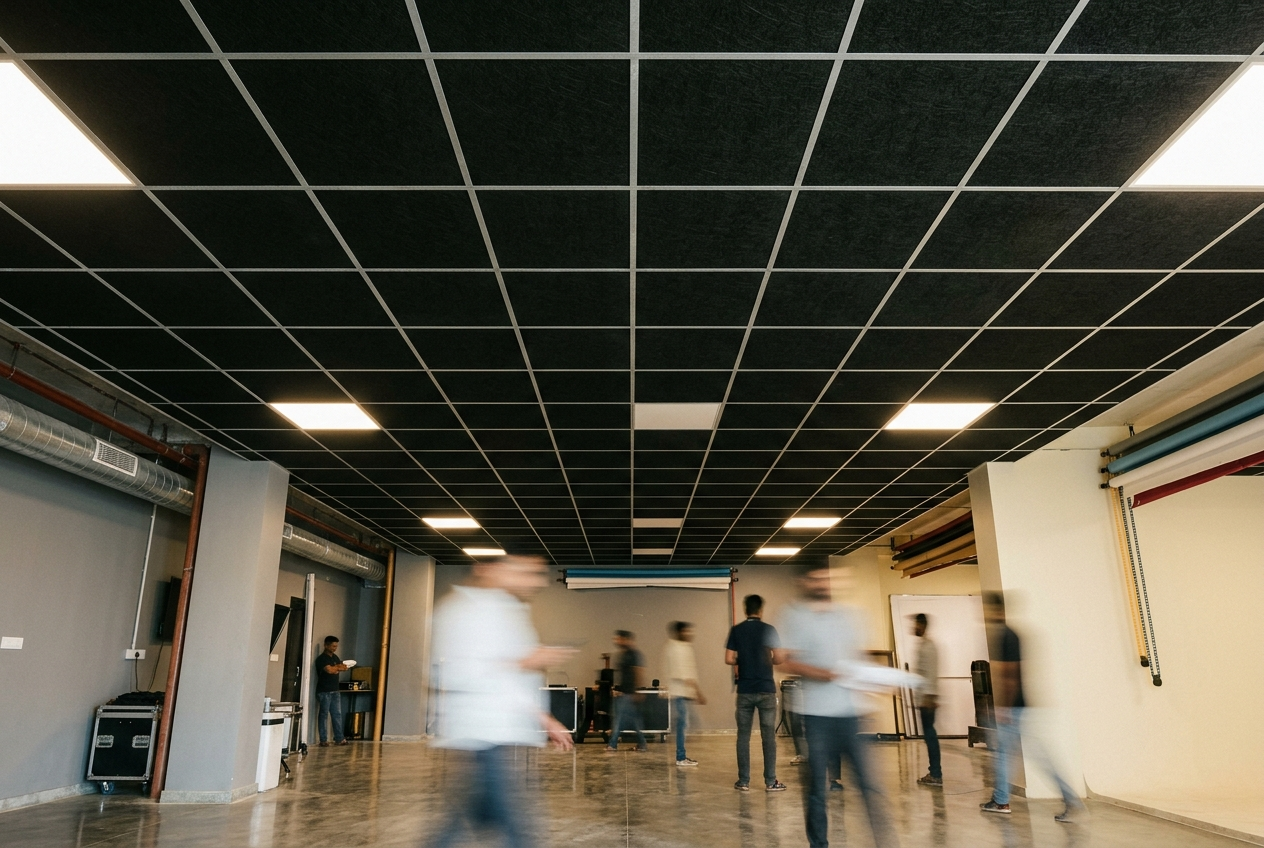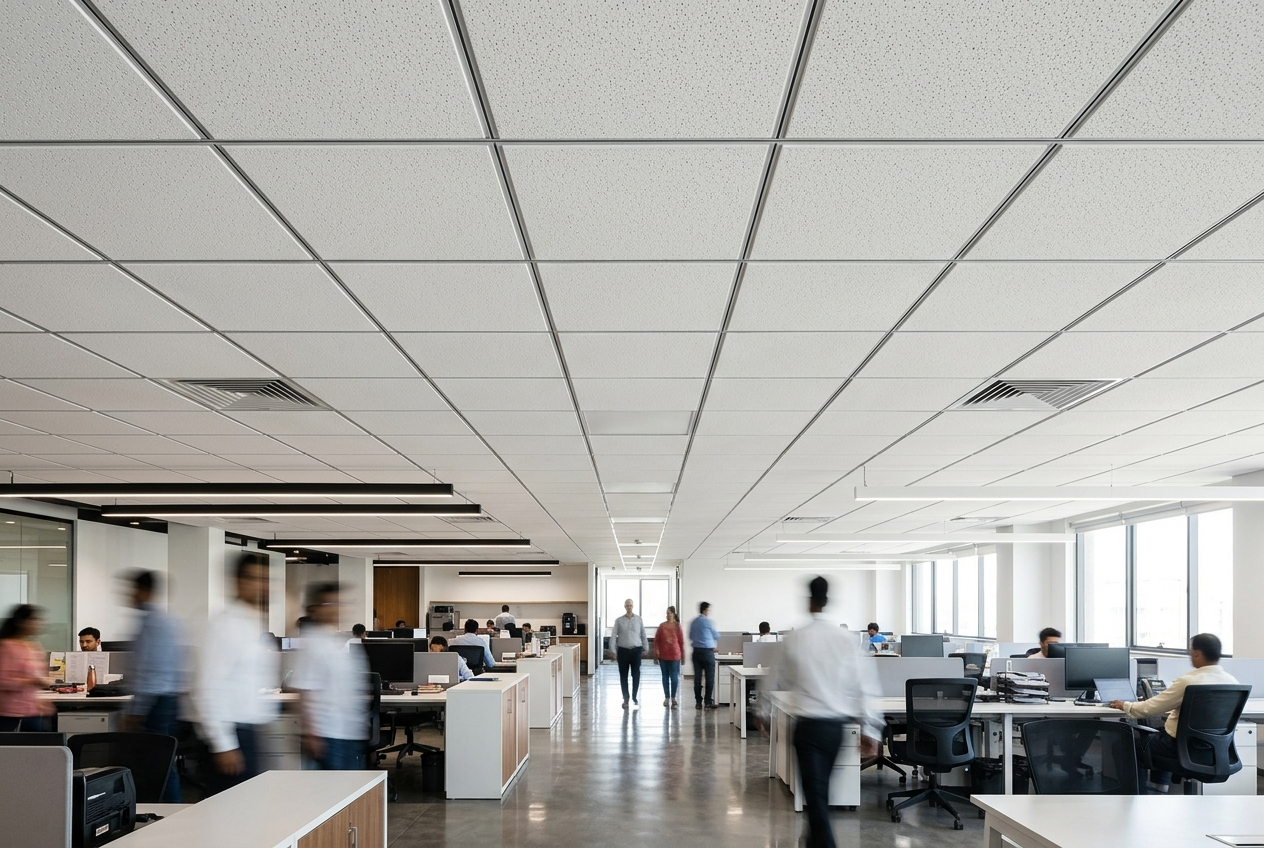
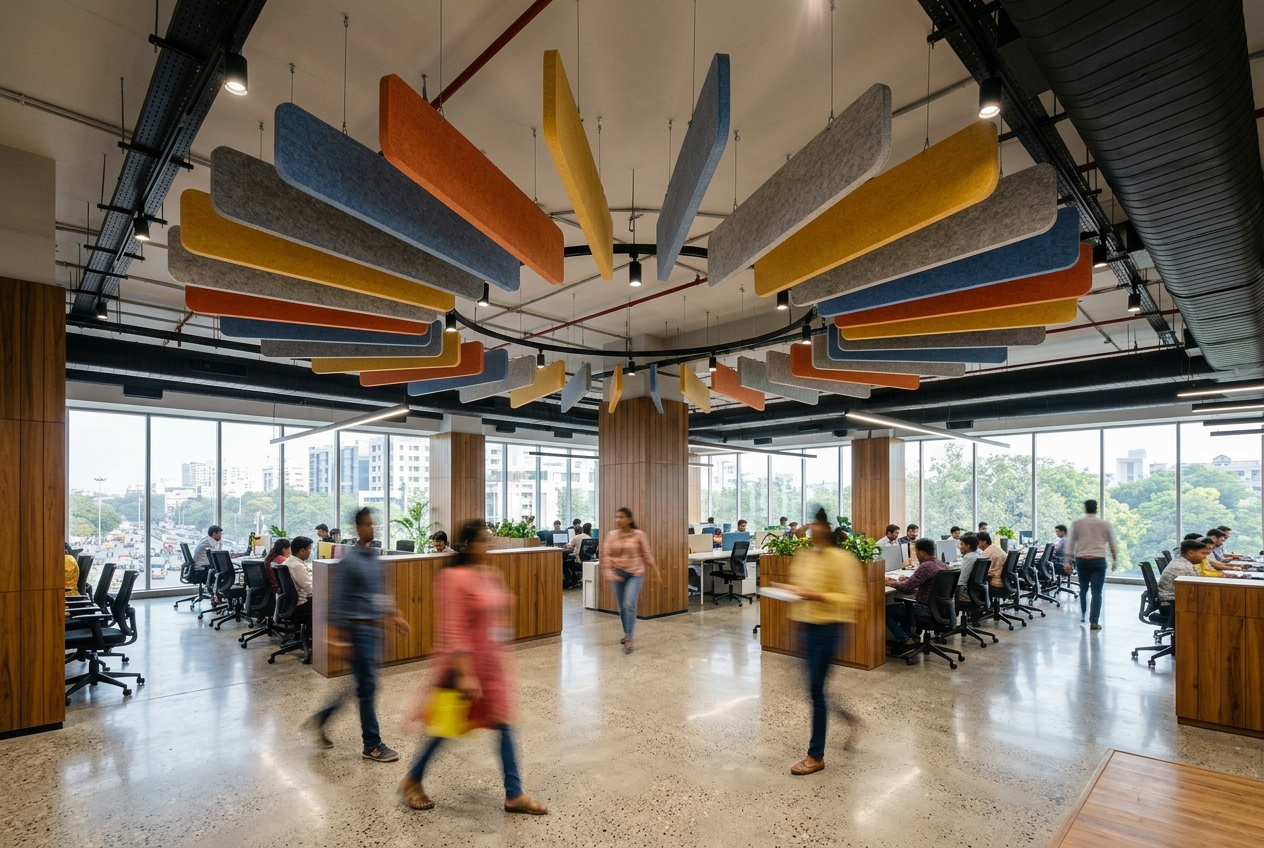
A 200-seat office sits right in that awkward middle zone: too big for a couple of wall panels to fix, but usually too small to justify a full-time acoustic consultant. We’ve walked into more offices at exactly this size than almost any other because it’s the point where open-plan noise complaints start reaching HR and facilities at the same time.
Some of the sites that have shaped how we think about problems at this scale include the CM Dashboard setup inside the Chief Minister’s Office in Gujarat and theatre acoustics projects across multiple states. Different room sizes, same underlying physics, and the same mistake pattern show up in a 200-seat office as they do in a 500-seat auditorium: someone treats acoustics as decoration instead of a specification. Here’s how the noise problem actually breaks down across a typical 200-seat office, and which acoustic panels fits each zone. That kind of pressure teaches you quickly which ceiling decisions are nice to have and which ones can blow up your schedule or budget if you get them wrong. Ceiling systems are one of those decisions that can have a surprisingly big impact on both the look and performance of an office, so it’s worth understanding what to consider before making a choice.
Where the noise actually comes from in a 200-seat office
Open-plan workstation floor (the biggest chunk of seats): This is where most complaints originate. Sound reflects off desks, glass partitions, and a flat ceiling, building up into constant background chatter that raises everyone’s voice a little, which raises the noise a little more, creating a feedback loop.
Meeting and conference rooms: Hard surfaces such as glass walls, whiteboards, and laminate tables cause flutter echo, which makes video calls sound harsh and in-person conversations tiring after 30+ minutes.
Reception and lobby areas: These spaces are usually double-height or have high ceilings, with hard flooring and minimal furniture to absorb sound. Footsteps, phone calls, and conversations all echo more than people expect, even in a relatively small space.
Cabins and manager rooms: Confidential conversations leaking through thin partition walls are an acoustic, not just a privacy, problem. Sound needs to be absorbed at the source before it travels.
Cafeteria/breakout zones: High occupancy, hard flooring for cleaning purposes, and constant chatter combine to make these some of the loudest rooms in the building, even though they’re not workspaces.
General info:
- Made from compressed polyester fibre, often with recycled content, so they are a common choice when sustainability reporting matters.
- Lightweight and rigid enough to be wall-mounted directly without extra framing.
- Available in a wide range of colours, so they can double as a design element rather than just a functional add-on.
- Work well as a first-line treatment for meeting rooms, cabins, and workstation zones where wall space is available.
- Typically available in a standard rectangular format, though they can also be shaped for feature walls.
Where it fits in a 200-seat office: Meeting rooms, cabins, and any wall zone in the open-plan floor where glass or laminate surfaces are causing flutter echo.
If you’re comparing actual products, Amazone By Furnitech’s polyester fibre acoustic panels come in 9 mm and 12 mm thicknesses, with NRC ratings of up to 0.70 and 0.85, respectively. They also come in a genuinely wide range of colours, with 41 shades available in the 9 mm option and 21 in the 12 mm option.
General info:
- Combine a dense acoustic core, usually fibreglass, with a fabric finish, giving them a softer, more premium look.
- The fabric surface is acoustically transparent, meaning it does not block sound absorption despite looking like a soft furnishing.
- Tend to be chosen for spaces where the client wants acoustic treatment to read as interior design rather than acoustic hardware.
- A good option for reception areas and cabins where a warmer, textured finish fits the brand.
Where it fits in a 200-seat office: Reception areas, executive cabins, and any zone where the panels need to blend into a more polished interior scheme rather than stand out as equipment.
Amazone By Furnitech’s fabric-wrapped acoustic panels use a 25 mm fibreglass core with an NRC of up to 0.95. They are finished in 12 shades of jute fabric, giving them a warm, natural texture rather than a flat corporate look.
General info:
- Use the same base material as standard polyester fibre acoustic panels but are shaped using CNC routing into custom geometric patterns, logos, curves, or perforations.
- Turn a functional acoustic requirement into a visible design or branding feature, which matters for offices that want their acoustic spend to also contribute to the interior design.
- Require a finalised, CNC-ready design file from the client or their designer. This is a fabrication service, not an off-the-shelf product.
- Maintain their acoustic performance even after cutting, since the core material does not change.
- Are well suited to feature walls, branded reception areas, or ceiling clouds that need a specific shape.
Where it fits in a 200-seat office: Reception and lobby feature walls, branded meeting rooms, or any spot where the acoustic panels are meant to be looked at, not just heard through.
Amazone By Furnitech’s CNC-Cut PET acoustic panels are cut from the same polyester fibre boards used in their standard panels, are available in over 41 colours, and support fairly involved detailing. This includes logo cutouts, geometric patterns, interlocking modular panel systems, and even integrated cutouts for LED channels or mounting hardware.
General info:
- Suspended acoustic panels that hang below the existing ceiling, absorbing sound before it reflects back down into the room.
- Do not require any modification to existing ceiling grids, ducting, or lighting, which is a real advantage in an occupied office where downtime is expensive.
- Come in multiple shapes, so they can be used for broad coverage or as a visual feature over a specific zone.
- Can be spaced evenly for general noise control or clustered over high-noise zones such as collaboration areas.
Where it fits in a 200-seat office: The open-plan workstation floor. This is usually the single highest-impact acoustic upgrade for the loudest and most complained-about zone in the building.
Amazone By Furnitech’s acoustic ceiling clouds have an NRC of up to 0.95 and come in sizes ranging from 600 mm diameter circles to 2700 x 1200 mm rectangles, with six shape options and two thicknesses, 30 mm and 40 mm. Because they are suspended rather than fixed, they do not interfere with existing grid ceilings or lighting lines.
General info:
- Vertical acoustic panels that hang from the ceiling, absorbing sound from multiple angles rather than just one flat surface.
- Create a visual rhythm across the ceiling, which some offices use deliberately as a design feature.
- Are especially effective under high or exposed ceilings, where sound has more room to build up before hitting a surface.
- Do not take up any wall or floor space, which matters in dense open-plan layouts where walls are already at a premium for storage, whiteboards, or partitions.
- Have a straightforward installation using suspension cables or rods, with no structural changes needed.
Where it fits in a 200-seat office: Open-plan zones with exposed or high ceilings, as well as corridors or walkways where wall-mounted panels are not practical.
Amazone By Furnitech’s acoustic baffles measure 2400 x 300 mm at 30 mm thickness, with an NRC of up to 0.90. They are made from high-density fibreglass wool that targets mid- and high-frequency noise specifically, which happens to be the frequency range where most speech and keyboard or office noise falls.
General info:
- A made-to-order version of ceiling clouds, built around a specific shape, layout, or design brief rather than a standard catalogue size.
- Used when the ceiling needs to do more design work than a standard cloud shape allows, such as branded shapes, irregular room geometry, or a specific visual concept.
- Typically built from fibreglass or polyester fibre, shaped through CNC routing or precise hand-cutting.
- Best suited to reception areas, boardrooms, or any zone where the ceiling treatment is meant to be a statement rather than just a fix.
Where it fits in a 200-seat office: The reception or lobby ceiling, or a boardroom that wants its acoustic treatment to double as a visual centrepiece rather than a retrofit.
Amazone By Furnitech’s custom acoustic ceiling clouds are built from fibreglass and polyester fibre, with roughly 41 colour options and an NRC of up to 0.95, depending on the final design and thickness chosen.
FAQs
1. How much acoustic panel coverage does a 200-seat open-plan office typically need?
There’s no single fixed ratio, but a reasonable starting point is to treat enough ceiling and wall surface area to address the main reflective zones. In the open floor, this usually means treating 25-40% of the ceiling, plus wall treatment in every meeting room and cabin. Rooms with more glass, concrete, or hard flooring generally need more coverage.
2. Should I treat the ceiling or the walls first?
For open-plan floors, the ceiling is usually the priority since it’s the single largest untreated reflective surface. For enclosed rooms like meeting rooms and cabins, wall treatment matters more because sound bounces horizontally between parallel hard walls in a way that ceiling treatment alone won’t fix.
3. What NRC rating should I be targeting for a general office floor vs a boardroom?
Open-plan work areas typically work well with an NRC of 0.55-0.70. Boardrooms, meeting rooms, and any space where speech clarity is critical usually benefit from an NRC closer to 0.85-0.95.
4. Do acoustic ceiling clouds require changes to the existing ceiling grid?
No. Ceiling clouds and baffles are suspended using cables or rods and don’t require modifications to existing grid ceilings, ducting, or lighting lines. This makes them a practical option for occupied offices that can’t afford major downtime.
5. Are custom-shaped or CNC-cut panels worth it for a mid-size office, or overkill?
They’re generally worth it for one or two statement spaces, such as reception or the main boardroom, rather than for the whole floor. Standard panel shapes and sizes are usually more cost-effective for blanket coverage across workstation zones and smaller meeting rooms.
Compare Acoustic Panels for Your 200-Seat Office
For a 200-seat office, acoustic spend usually works best when it is split by zone rather than using one product everywhere. Use ceiling treatment for the open floor, wall acoustic panels for meeting rooms and cabins, and a more design-forward option for reception, where looks matter as much as sound. The most common mistake we see is installing one panel type uniformly across every room, which can under-treat noisy zones and overspend on quieter ones.
For comparing actual specifications, Amazone By Furnitech’s polyester fibre panels, fabric-wrapped panels, CNC-cut PET panels, acoustic ceiling clouds, acoustic baffles, and custom ceiling clouds provide reference points for NRC ratings, sizes, colours, thicknesses and materials. These figures can help when comparing specifications and quotes from different suppliers. Contact us with your floor plan and ceiling details, and our team will recommend a zone-by-zone acoustic panel mix and share a tailored quote.
TL;DR
A 200-seat office needs a zone-by-zone approach, not one panel type everywhere. Use ceiling clouds or baffles over the open-plan floor, where most noise complaints start, aiming for roughly 25-40% ceiling coverage. Put polyester fibre or fabric-wrapped acoustic panels in meeting rooms and cabins and choose CNC-cut PET panels or custom ceiling clouds for reception and boardrooms, where looks matter as much as sound. Ceiling clouds and baffles hang from cables or rods, so they can be installed in an occupied office without changing the existing ceiling grid or lighting.
_ _
Considering acoustic treatment for your space?
Furnitech supplies and installs acoustic panels and ceiling tiles across India.
Call +91-9727092998 or send your requirements.
Related Articles