Ask, ‘Which acoustic solution is best for an auditorium?’ and it is tempting to compare NRC ratings, materials, colours, or panel sizes. That is usually the wrong starting point.
An auditorium is not defined by a single acoustic surface. It is a room where a speaker, performer, microphone, or playback system has to deliver sound to hundreds of listeners while the room itself is constantly reflecting that sound. An acoustic solution that works well on a side wall may not address reflections from a large ceiling. Similarly, a decorative wall panel may improve the acoustics of a particular surface without addressing the overall reverberation of a large hall.
This is why auditorium acoustics often requires more than one type of acoustic solution. Amazone By Furnitech’s project portfolio includes auditorium acoustics at the Gujarat High Court and Gujarat University, as well as an auditorium and gallery at Kevadia Colony and theatre acoustics across several Indian states. For example, the Gujarat High Court auditorium used a combination of mineral fibre ceiling tiles, MDF acoustic panels, perforated gypsum acoustic boards, and galvanized t–grids rather than relying on a single material.
The Better Question: Where Is the Sound Going Wrong?
Before selecting an acoustic solution, identify what the room is doing to the sound.
- If speech from the stage reaches the audience and then keeps reflecting between hard walls, the problem is reverberation.
- If a large ceiling is reflecting sound back into the seating area, the ceiling becomes an important treatment zone.
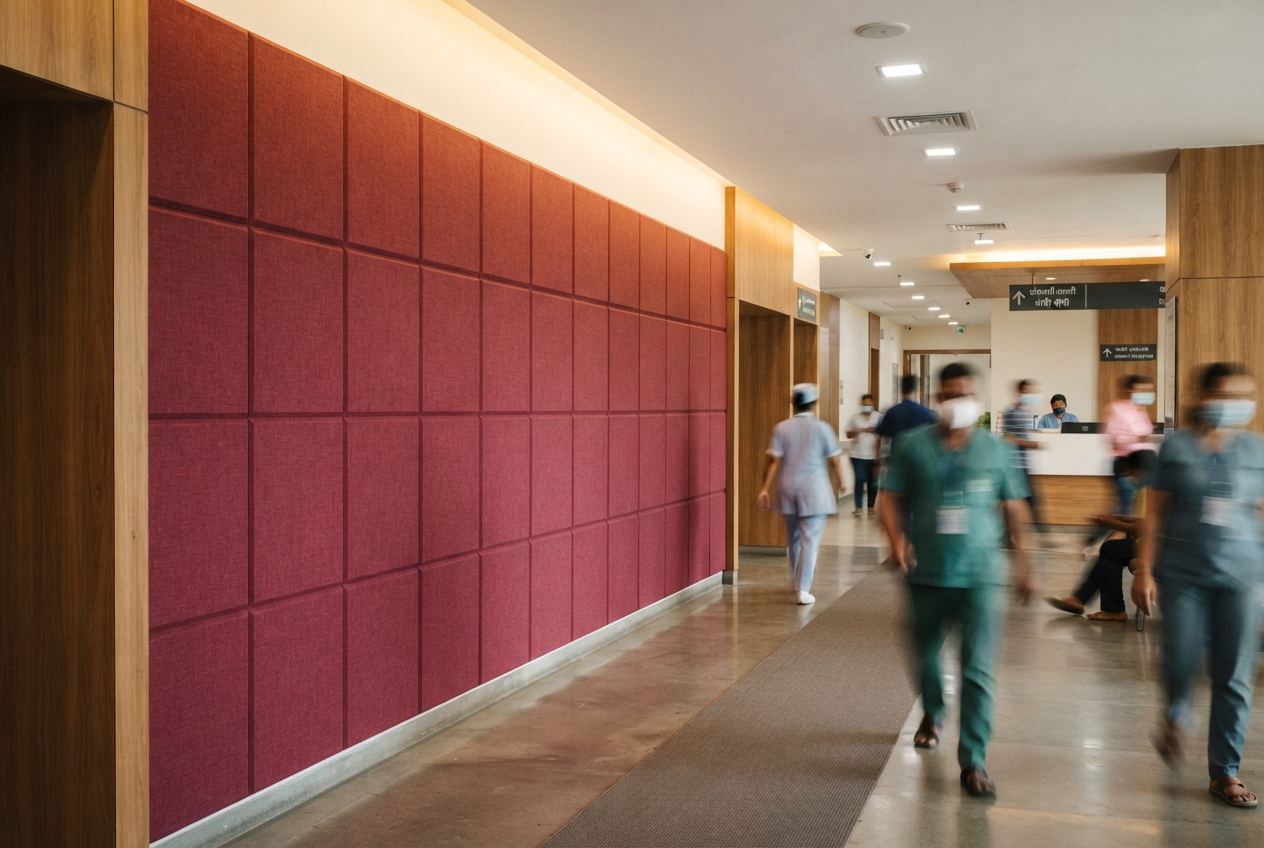
- If side walls are visually prominent and acoustically reflective, an acoustic wall solution can help control those reflections while also becoming part of the interior design.
- If the auditorium requires a continuous, finished ceiling rather than exposed acoustic elements, an integrated perforated system may make more sense.
This way of looking at the room changes the question from ‘Which acoustic solution is best?’ to ‘Which surface needs to do what?’
When the Walls Need to Do More Than Look Good
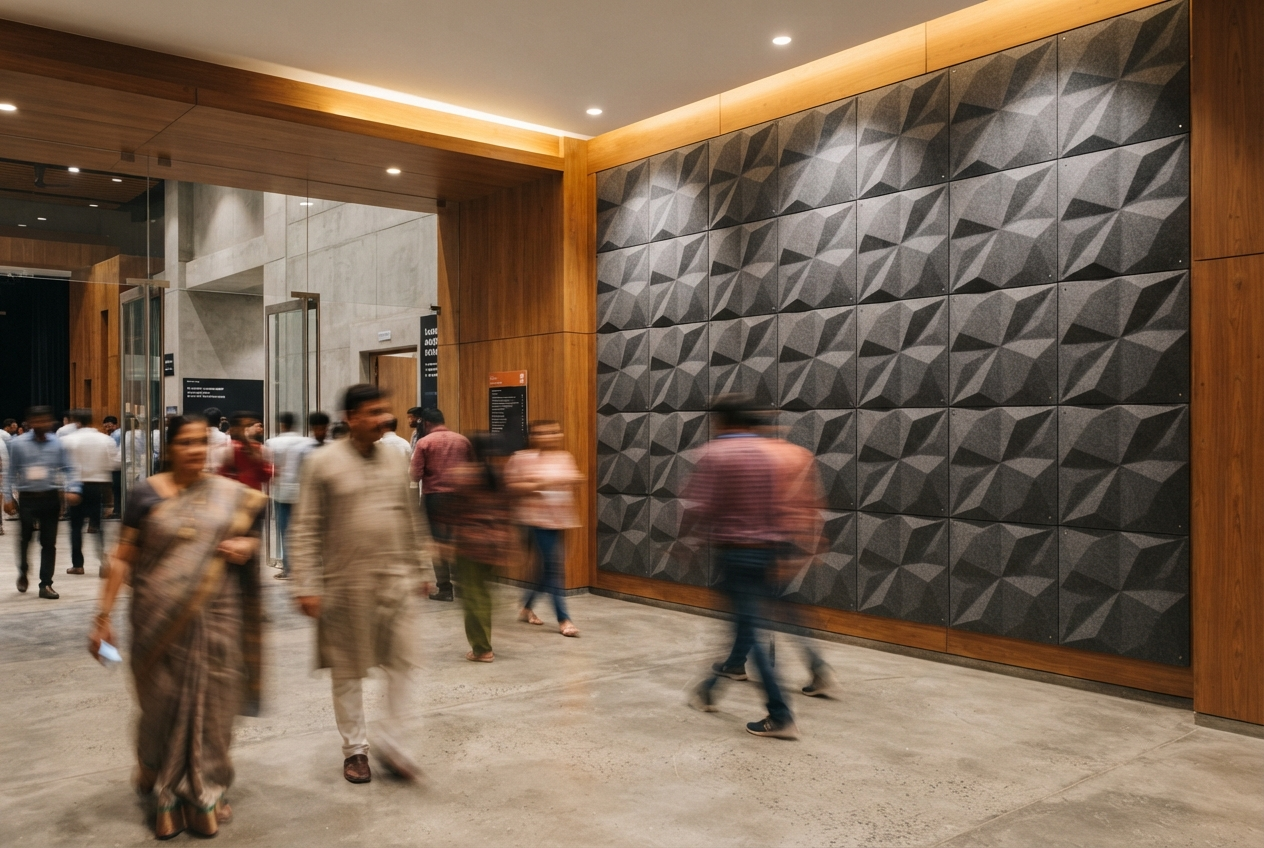
Auditorium walls often occupy large, uninterrupted areas, particularly along the side and rear sections of the hall. Leaving these surfaces completely hard can contribute to strong sound reflections. This is where 3D Acoustic Panels can become useful when the design calls for a decorative wall acoustic solution rather than a conventional flat acoustic surface.
Amazone By Furnitech’s 3D Acoustic Panels are made from PET acoustic material and are available in 2400 x 1200 mm and 400 x 400 mm sizes, with 24 designs, 27 colours, and NRC of up to 0.70. They can be installed on suitable wall surfaces using adhesive, while specific designs, patterns, and shapes can also be customised. For an auditorium, their value goes beyond visual appearance. They allow selected wall areas to become part of the acoustic solution while contributing a stronger architectural identity to the hall.
When the Interior Calls for a Wood-Like Architectural Surface
Some auditoriums need an acoustic solution without making the interior look like a technical installation. For these spaces, MDF Acoustic Panels offer another direction. Their grooved and patterned surfaces can be used on walls or ceilings while providing acoustic absorption.
Amazone By Furnitech’s MDF panels are available in MDF, HDF, and HDMR options, with 16 mm and 18 mm thicknesses, two standard sizes, 10 shades, and NRC of up to 0.70. This makes them particularly relevant when the auditorium design already uses wood tones, linear detailing, or a more architectural wall language. They can become part of the visual composition instead of looking like an add-on acoustic solution.
When the Ceiling Has Too Much Volume to Ignore
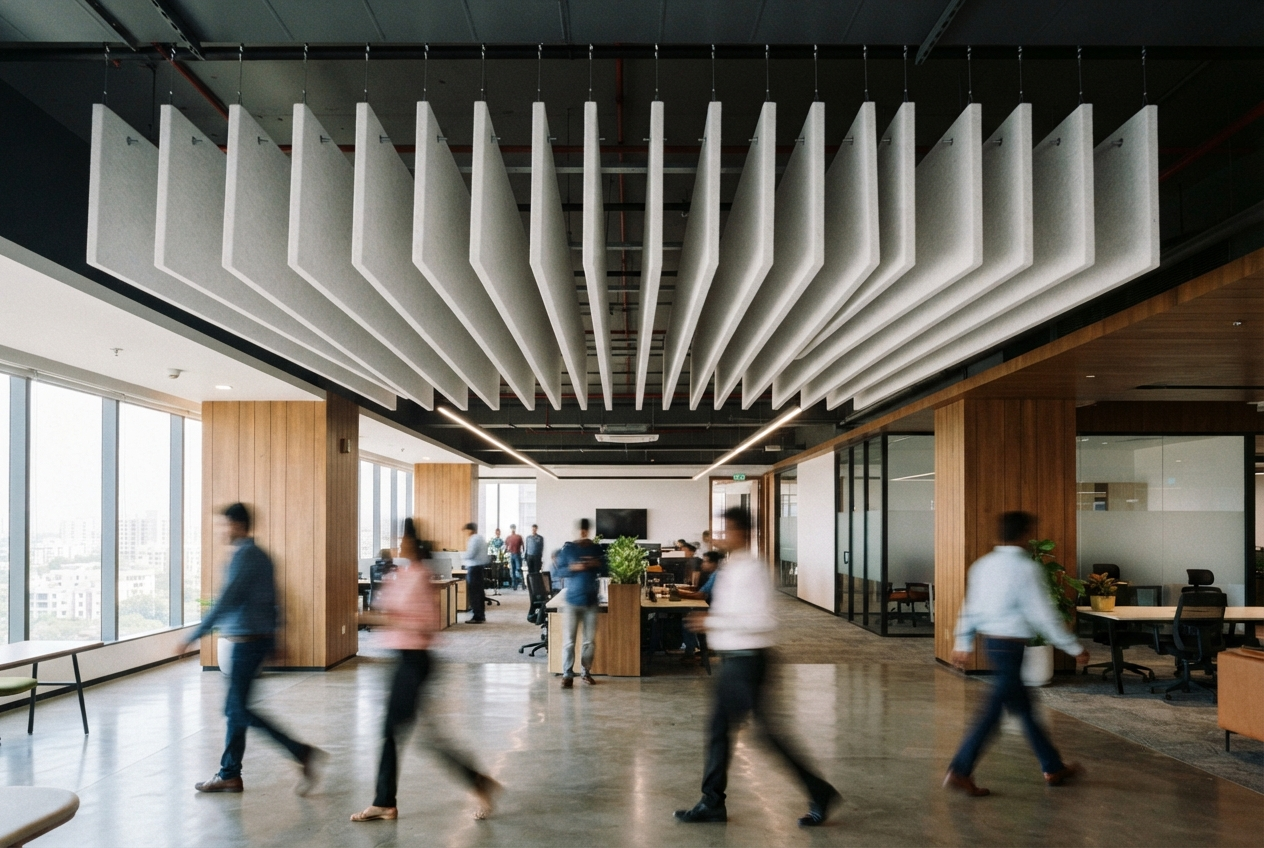
A large auditorium ceiling can represent a substantial reflective surface, particularly where the room has considerable height. This is where acoustic ceiling clouds can offer a different acoustic solution. Rather than covering the entire ceiling, clouds are suspended below it and positioned where additional absorption is useful. This can be valuable when the existing ceiling contains lighting, services, or other architectural elements that make conventional full-ceiling treatment impractical.
Amazone By Furnitech’s Acoustic Ceiling Clouds are available in circular, rectangular, square, hexagonal, wave, and curved forms, with 30 mm and 40 mm thicknesses and NRC up to 0.95. Standard sizes include 600, 900, and 1200 mm diameter options, as well as larger rectangular formats.
For projects with a strong architectural concept, Amazone By Furnitech also offers custom acoustic ceiling clouds that can be shaped around the ceiling plan. Size, shape, thickness, and colour can be customised, with fibreglass and polyester fibre materials and NRC of up to 0.95 depending on the selected design, thickness, and material.
When the Ceiling Needs to Look Like a Ceiling
Not every auditorium should have visible floating acoustic elements. In some projects, the ceiling needs to remain visually continuous and coordinated with lighting, services, and the overall architectural language. In such cases, perforated gypsum acoustic boards can be a practical direction.
Amazone By Furnitech’s Perforated Gypsum Acoustic Boards are 2400 x 1200 mm, 12 mm thick, available in white, and have an NRC of up to 0.60. The perforated surface helps absorb sound, and the boards can be installed on walls or ceilings. The product can also be installed with a cavity and suitable acoustic backing, such as fibre glass wool, to enhance absorption, particularly in larger or more reverberant spaces. This makes them relevant where an acoustic solution needs to be integrated into a more conventional architectural ceiling or wall construction rather than introduced as a separate decorative acoustic solution.
So, Which Acoustic Solution Is Best?
The better choice depends on where an acoustic solution is required and what the architecture allows that surface to do:
- Decorative wall treatment: 3D acoustic panels can combine visual depth with sound absorption.
- Architectural wood-style surfaces: MDF acoustic panels can integrate acoustic treatment with grooved and patterned interiors.
- Large or difficult ceiling volumes: acoustic ceiling clouds can introduce absorption below the existing ceiling.
- Continuous wall or ceiling construction: perforated gypsum acoustic boards can provide an acoustic solution while maintaining a more conventional architectural finish.
The important part is not selecting the product with the biggest number on its specification sheet. It is deciding where absorption is needed, how much surface should be treated, how the room will be used, and how the acoustic solution needs to coexist with lighting, HVAC, sightlines, access, and the architectural design.
A Good Auditorium Should Make the Technology Disappear
The best acoustic solution is not necessarily the product that attracts the most attention. For an audience member, success is much simpler: the speaker is understandable, performances remain engaging, excessive reverberation does not blur the sound, and people can concentrate on what is happening on stage. For architects and contractors, that means an acoustic solution should be selected as part of the auditorium design, not added after the room has already been decided.
Amazone By Furnitech offers multiple acoustic solutions that can be considered according to the surface, architectural requirements, and acoustic objectives, from 3D acoustic panels to MDF panels, perforated gypsum, and suspended ceiling clouds. Its documented auditorium work also demonstrates the use of multiple acoustic solutions within the same project. Contact us to discuss your auditorium’s acoustic requirements and explore suitable panel and ceiling solutions for the space.
TL;DR
The best acoustic solution for an auditorium depends on the room’s size, reflective surfaces, ceiling height, architectural design and acoustic requirements. 3D acoustic panels can add decorative wall absorption, MDF panels offer an architectural finish, acoustic ceiling clouds help manage reflections from large ceiling areas, and perforated gypsum boards provide integrated wall and ceiling treatment. Combining different solutions based on the room’s needs can help control reverberation, improve speech clarity and create a more comfortable listening experience.
_ _
Considering acoustic treatment for your space?
Furnitech supplies and installs acoustic panels and ceiling tiles across India.
Call +91-9727092998 or send your requirements.
Related Articles