‘Just give us the loudest room in the building, and we’ll tell you what’s actually needed.’ That’s usually how these calls start. Nobody asks for NRC 0.90+ acoustic panels on day one. What actually happens is that a client walks us through a room that’s already failing. It could be video calls where nobody can hear the person at the far end of the table, a quiet room that isn’t actually quiet, or an open floor where two teams have stopped scheduling calls at the same time because the overlap is unbearable.
By the time NRC 0.90 gets mentioned, it’s not a preference; it’s the number the room needs to stop being a problem. That’s the range we’ve had to achieve on auditorium work at Gujarat High Court, university buildings at Gujarat University, and theatre acoustics projects across multiple states. These are rooms where pretty good acoustics weren’t the brief; functioning acoustics were.
Which office rooms actually need this much absorption, and why
Not every room in an office needs NRC 0.90+. Most don’t. After more than two decades in the ceiling and acoustic industry, and with over 1,500 corporate partners using Amazone By Furnitech’s acoustic panels and ceilings, we’ve gained experience across a wide range of projects. We’ve seen how acoustic requirements vary across offices, auditoriums, and other commercial spaces. A specific handful of office spaces consistently justify higher absorption, and it’s worth understanding why before choosing a product.
Boardrooms and video-conferencing rooms: The problem isn’t how the room sounds to someone sitting in it; it’s how it sounds to the person on the other end of the call. Hard walls and glass partitions create reflections that microphone pickup amplifies, so a room that feels fine in person can sound genuinely bad on a recording. The fix needs to target wall-level reflections specifically, since that’s where the microphone is picking up the bounce.
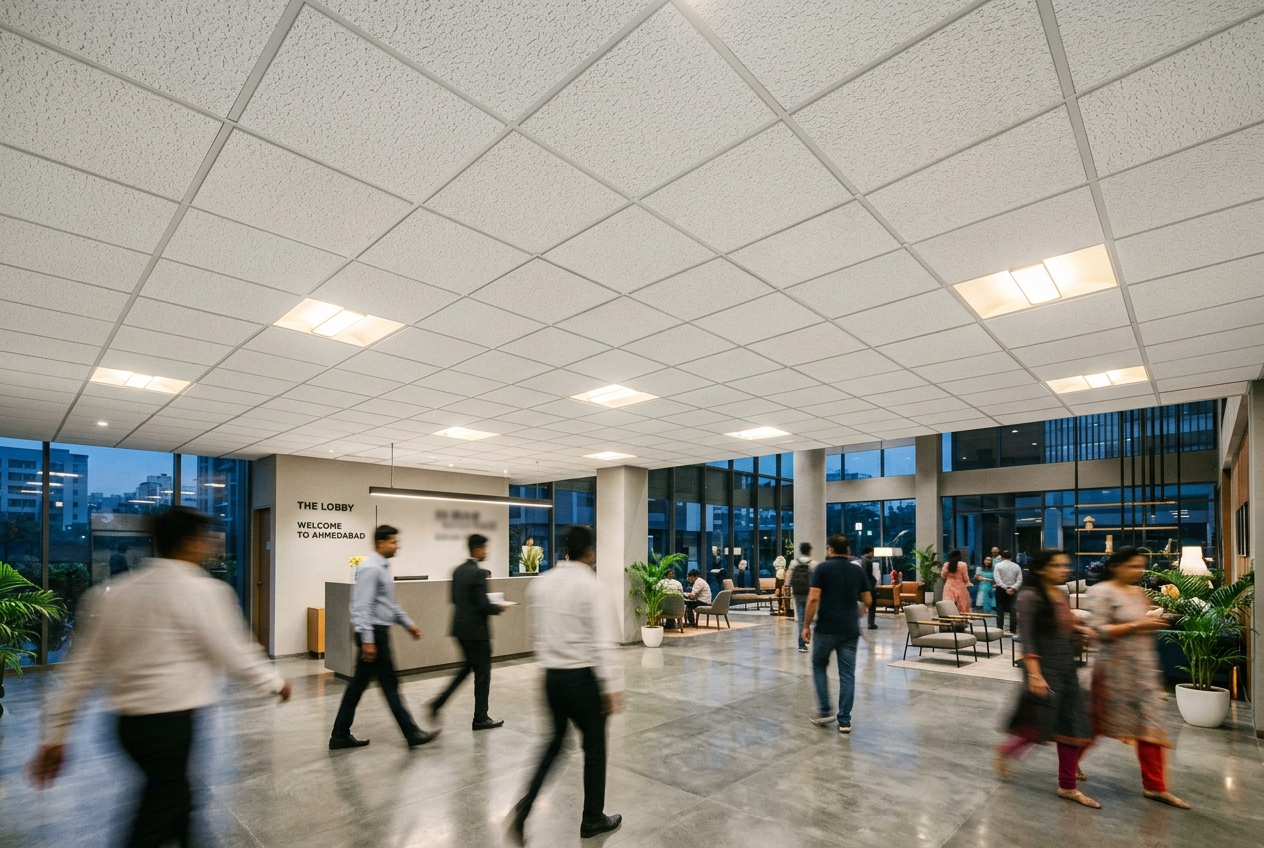
Open-plan floors with high or exposed ceilings: Once a ceiling goes past a certain height, or the structure above is left exposed for an industrial look, sound has more vertical space to travel before it hits a surface. Standard ceiling tiles alone often can’t absorb enough at that scale, and by the time the noise reaches desk level, it’s already loud.
Internal recording, podcast, or media rooms: These are increasingly common in office fit-outs now that internal communications teams produce their own video content. These rooms have zero tolerance for echo because, unlike a conversation, a recording preserves every reflection permanently.
HR, therapy, or confidential 1:1 rooms: The acoustic requirement here isn’t really about echo control. It’s about preventing sound from leaking out and making the room feel calm rather than clinical. High absorption can help reduce sound leakage while also preventing the boxed-in feeling that small, enclosed rooms can have.
Two products consistently show up across these rooms, and which one gets picked usually comes down to whether the problem is on the walls or the ceiling.
The ask, most often: ‘Can we fix the boardroom without making it look like a recording studio?’
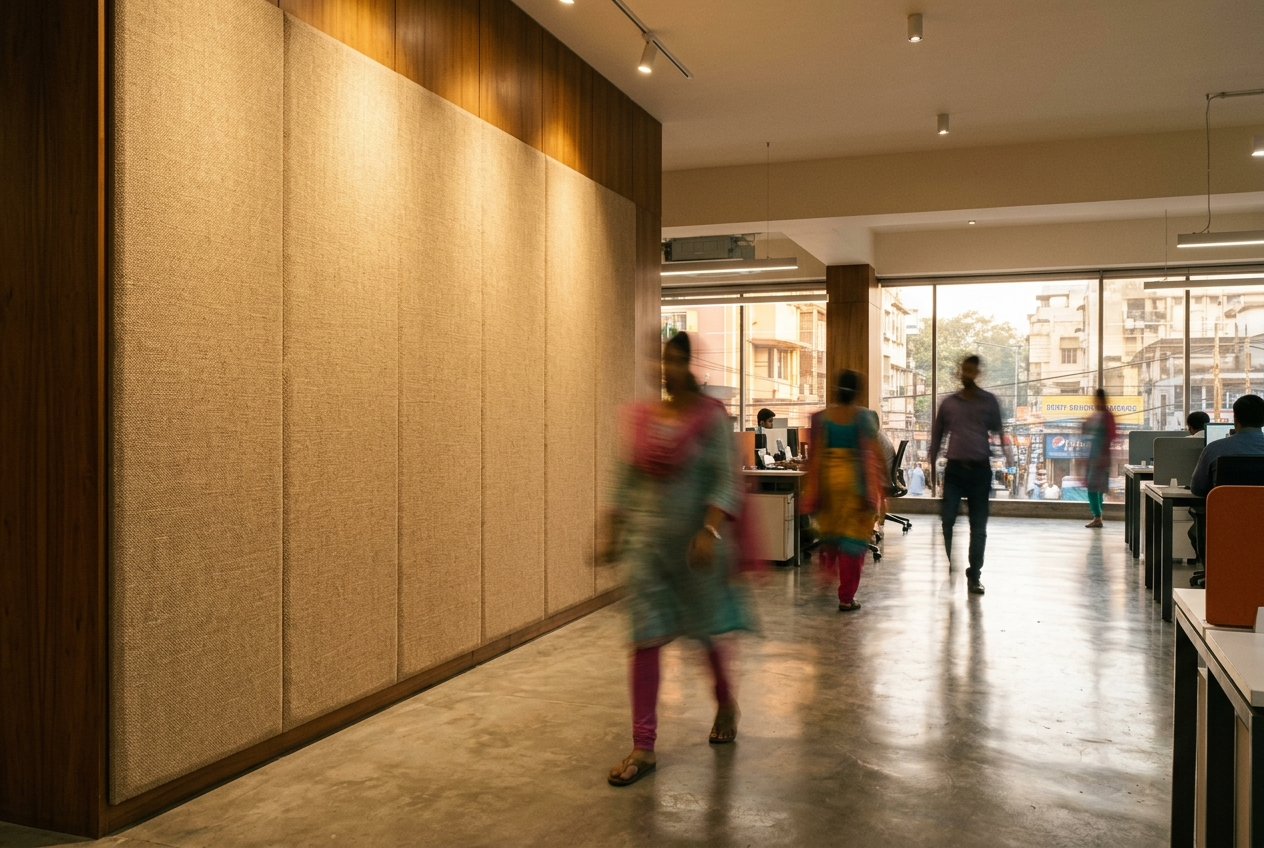
The answer: Wall-mounted acoustic panels with a fibreglass acoustic core, finished in fabric rather than a visibly acoustic surface, so it reads as an interior finish rather than equipment bolted to the wall. Because the fabric is acoustically transparent, the absorption isn’t compromised by the finish. The room gets the performance and the aesthetic without trading one for the other.
Amazone By Furnitech’s fabric-wrapped acoustic panels use a standard 25 mm thickness, high-density fibreglass core rated up to NRC 0.95, with a jute fabric finish available in 12 shades and four different sizes. For a boardroom or confidential-conversation room, acoustic panels go exactly where the problem is: on the reflective wall surfaces causing flutter echo and sound leakage, rather than trying to solve a wall-level problem from the ceiling.
The ask, most often: ‘The open floor is loud, and we can’t touch the ceiling structure. What actually works?’
The answer: Suspended acoustic panels that hang below the existing ceiling rather than replacing it, absorbing sound before it reflects back down into the workstation zone. Since it’s suspended, there’s no need to modify the ceiling grid, ducting, or lighting, which matters in an occupied office where ripping out the ceiling isn’t an option.
Amazone By Furnitech’s acoustic ceiling clouds go up to NRC 0.95 and are available in multiple sizes, six shapes, and two thicknesses. For open-plan floors and exposed-ceiling zones specifically, clouds can be spaced evenly across the whole floor for general noise control or clustered directly over the loudest collaboration zones. That flexibility is something wall panels don’t really offer, since they’re fixed to whatever wall happens to be nearby rather than positioned over the actual source of the noise.
FAQs
1. Is NRC 0.90+ overkill for a normal office, or only for specific rooms?
It’s usually overkill for the general office floor. It matters most in boardrooms, video-call rooms, media and recording rooms, and confidential 1:1 spaces, where speech clarity or sound leakage is the actual functional problem, not just general background comfort.
2. Should I use wall acoustic panels or acoustic ceiling clouds for an open-plan floor?
Acoustic ceiling clouds are usually the better starting point for open floors, since the ceiling is typically the largest untreated reflective surface, and clouds can be positioned directly over the loudest zones. Wall acoustic panels work better in enclosed rooms, where reflections bounce between parallel walls.
3. Does a high NRC rating on the spec sheet guarantee the room will actually sound quiet?
Not on its own. NRC measures a material’s sound absorption, but the real-world result also depends on how much of the room is covered and where the acoustic panels are placed. Under-treating a room with a high-NRC product can still leave it acoustically under-treated.
4. Can acoustic ceiling clouds be installed without modifying the existing ceiling?
Yes. They’re suspended using cables or rigid rods and don’t require changes to grid ceilings, ducting, or lighting lines, which makes them practical for retrofits in occupied offices.
5. What’s the difference in installation effort between fabric-wrapped acoustic panels and acoustic ceiling clouds?
Fabric-wrapped acoustic panels are generally simpler to install, with most being wall-mounted using adhesive systems. Acoustic ceiling clouds require suspension hardware and a little more planning around spacing and height, but neither requires structural changes to the room.
Getting the Room to Actually Hit the Number
An NRC rating on a spec sheet and a room that actually performs at NRC 0.90+ are two different things. Coverage, placement, and room geometry all affect the real-world result, just as much as the material itself. A handful of premium acoustic panels scattered across a large room won’t get you there, even if each panel individually tests at 0.90+. It’s the combination of the right product, in the right zone, with enough coverage, that closes the gap between the specification and what the room actually sounds like once people are sitting in it.
If you’re working through the coverage requirements for a specific room, Amazone By Furnitech’s fabric-wrapped acoustic panels and acoustic ceiling clouds list their NRC ratings, sizes, thicknesses, colours, and material specifications. These can be a useful starting point for comparing options on your shortlist, with wall-mounted acoustic panels suited to boardrooms and enclosed rooms and suspended clouds suited to open floors and exposed ceilings. Contact us to discuss your room’s acoustic requirements and identify suitable acoustic panels or ceiling clouds for your project.
TL;DR
NRC 0.90+ acoustic panels are most useful in office spaces where echo, speech clarity, and noise control directly affect daily work, such as boardrooms, video-conferencing rooms, recording rooms, and confidential meeting spaces. Fabric-wrapped acoustic panels, rated up to NRC 0.95, are suited to wall-level reflections in enclosed rooms, while acoustic ceiling clouds, also rated up to NRC 0.95, help manage noise in open-plan offices and exposed-ceiling areas. However, achieving the desired acoustic performance depends on more than the product rating. Correct placement, sufficient coverage, and room geometry all play an important role in the final result.
_ _
Considering acoustic treatment for your space?
Furnitech supplies and installs acoustic panels and ceiling tiles across India.
Call +91-9727092998 or send your requirements.
Related Articles