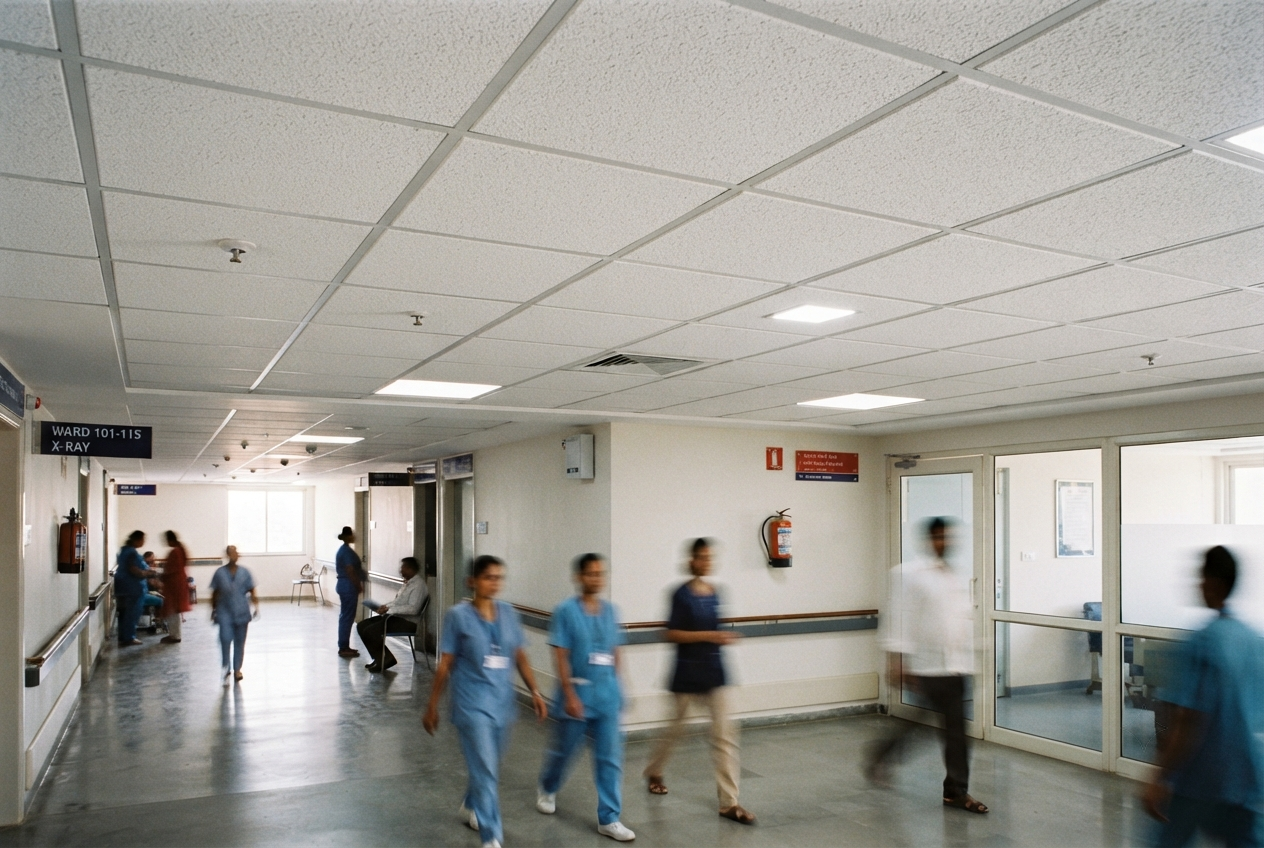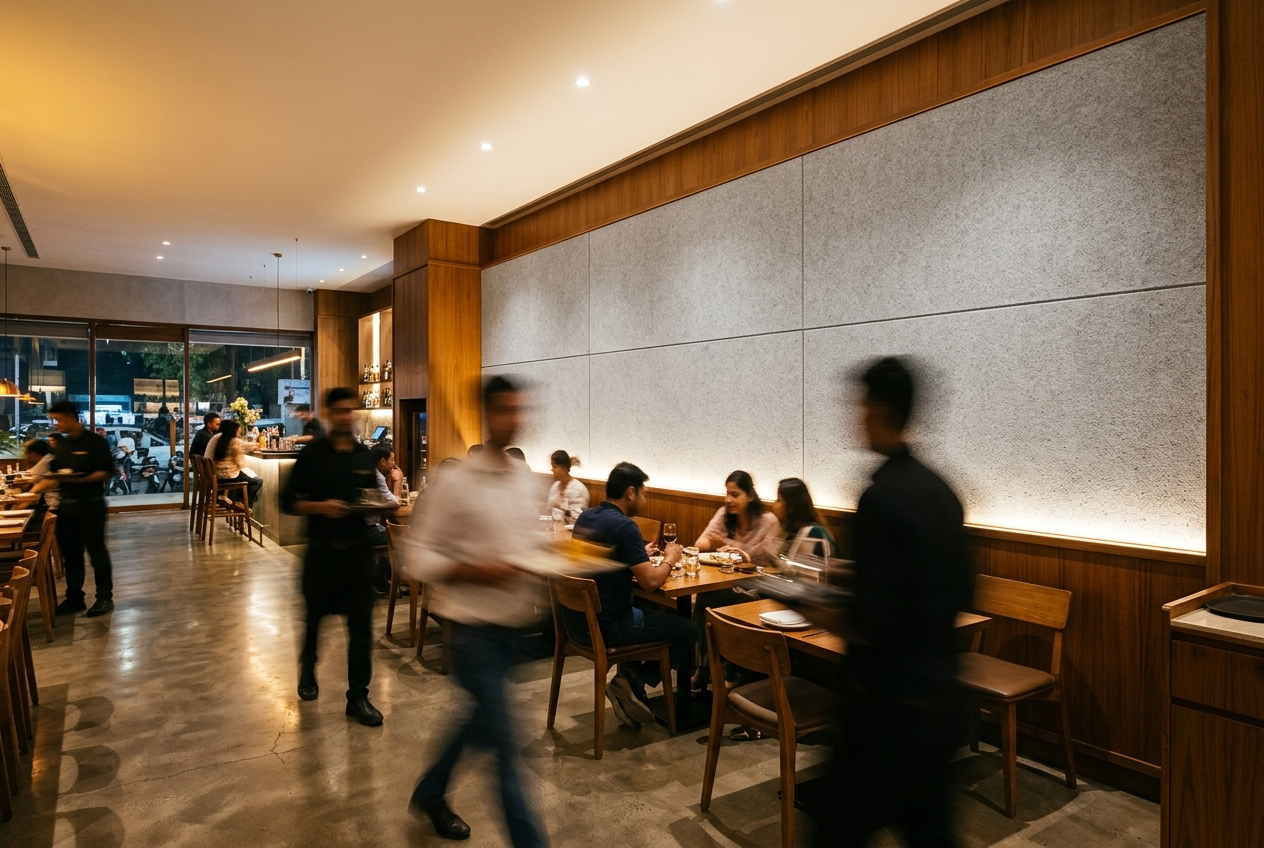

Mineral fibre ceiling tile is the default ceiling tile for many office fit-outs in India, typically installed in a standard T-grid system. However, the specifications of mineral fibre tiles, including thickness, edge profile, surface texture, acoustic performance, fire classification, and moisture resistance, can vary significantly between suppliers. As a result, two tiles sold under the same category may perform very differently after installation.
With nearly two decades of experience across ceiling and acoustic projects in India, and more than 1,500 corporate partners who use Amazone By Furnitech’s acoustic ceilings and panels, we’ve gained experience across a wide range of applications. From that experience, we’ve found that the details behind a product often matter more than the product name itself.
Before ordering, it is worth checking the tile’s actual specifications, relevant test reports, installation requirements, and suitability for the intended space. A ceiling can look identical on the surface while performing very differently in terms of acoustics, fire safety, durability, and moisture resistance.
Thickness
Thickness affects how rigid a tile is and how well it holds its shape over time, especially in AC-heavy office buildings where the ceiling void is exposed to constant temperature cycling. Thinner tiles are lighter and easier to handle during installation, while thicker tiles contain more material to resist sagging under the same temperature fluctuations.
Amazone By Furnitech’s mineral fibre ceiling tiles are available in 12mm, 16mm, 18mm, and 20mm thicknesses. In practice, this means a single project can use a thinner tile in a ceiling void that requires frequent access for wiring or ducting, and a thicker tile across large open floors where long-term rigidity matters more, without having to switch suppliers. The 16mm variant carries SGS and ARAI laboratory certifications for fire and acoustic performance, providing a documented reference point within the range.
Edge profile
Edge profile changes how the ceiling actually looks once installed. A flush edge gives a flatter, more uniform ceiling; a slightly recessed edge adds more shadow definition and makes the grid lines more visible; and a narrower, more concealed grid look tends to appear cleaner and more modern.
Amazone By Furnitech’s mineral fibre ceiling tile range covers all three profiles: Square, Tegular, and Microlook. This means a single office fit-out can use a flush edge across the open floor for a uniform look and switch to a more concealed profile in a reception or boardroom for a cleaner finish. You can still order every tile from the same product line rather than coordinating between two different suppliers’ edge systems.
Texture and finish
Texture affects both appearance and, to a smaller degree, the amount of surface area available for sound absorption compared with a flat finish. A plain or lightly textured finish suits an open floor that should not visually compete with the workstations and fixtures below it. In areas where the ceiling is intended to add visual interest, a more pronounced texture can work well.
Amazone By Furnitech’s mineral fibre ceiling tile range includes Sand, Fissured, Pin-Hole, and Biyo Guard textures, along with clean white and black finishes. This gives a project enough variation to use a subtle finish across the main floor and a more distinct texture or black finish in a reception or feature area. It also allows you to use products from one documented product line rather than mixing textures from different suppliers with different specifications.
Fire rating
For office buildings, this should mean a Class A rating under a recognised standard such as ASTM E84, backed by an actual laboratory-issued certificate rather than a general catalogue claim.
Amazone By Furnitech’s 16mm mineral fibre ceiling tile carries an SGS-tested Class A rating under ASTM E84. This means the certificate can be submitted directly as part of a project’s fire NOC or compliance documentation, rather than requiring separate verification after the tile has already been ordered.
Acoustic performance
NRC measures how much sound a tile absorbs, while STC measures how much sound it blocks between spaces. They are not the same measure, and a tile can perform differently on each. For open-plan office floors, NRC tends to matter more because the goal is to reduce echo across a large space. For tiles installed above meeting rooms or cabins, STC becomes more relevant because the priority shifts to preventing conversations from carrying into adjacent spaces.
Amazone By Furnitech’s 16mm mineral fibre ceiling tile is ARAI-tested to achieve an NRC of up to 0.60 and an STC of 25 dB, which means it can serve both applications reasonably well as a single product. It provides enough sound absorption to reduce echo on an open floor and enough sound isolation to be a workable option above a meeting room, without requiring a separate specialist tile for each use case.
Humidity resistance
Office buildings with heavy AC use, or those in humid coastal cities, expose mineral fibre tiles to more moisture cycling than buildings in dry climates. This is where an untested tile is more likely to sag or discolour over time.
Amazone By Furnitech’s 16 mm mineral fibre ceiling tiles are documented to withstand up to 96% relative humidity without losing their shape. In practice, this means the same tile can be used consistently across a building, including in laboratories, near pantry-adjacent walls, or on basement floors with less airflow, rather than requiring a different humidity-specific product for those particular zones.
Light reflectance and thermal properties
These are easy to overlook but genuinely useful properties. Higher light reflectance bounces more of a room’s lighting back into the space, which can help reduce the amount of artificial lighting a large, high-ceilinged office floor requires. Thermal conductivity is a smaller factor, but a lower value means the tile provides slightly more resistance to heat transfer through the ceiling void.
Amazone By Furnitech’s 16mm mineral fibre ceiling tile is rated at 90.21% light reflectance and 0.055 W/m·K thermal conductivity. The high reflectance can be considered by a lighting designer when assessing lighting requirements for an open floor, while the relatively low thermal conductivity can contribute modestly to reducing heat transfer through the ceiling assembly.
Weight and grid compatibility
Heavier tiles put more load on the T-grid system, so it is worth confirming that a tile’s weight per square metre is suitable for the grid being installed, particularly on larger open floors. Matching the tile size to the grid module also keeps installation straightforward.
Amazone By Furnitech’s mineral fibre ceiling tiles weigh around 3.96 kg/m² and are available in standard module sizes. This means the same tile can be installed in a standard T-grid without requiring a reinforced grid or custom cutting to fit an unusual module size.
The best mineral fibre ceiling tile is not necessarily the one with the longest specification sheet. What matters is how well its thickness, edge profile, finish, acoustic properties, fire performance, and humidity resistance matching the conditions of the space. Checking these details before ordering also helps avoid situations where a tile looks right on paper but creates problems during installation, compliance checks, or long-term use.
For projects where different areas call for different combinations of appearance and performance, Amazone By Furnitech is worth considering. Its mineral fibre ceiling tile range covers multiple thicknesses, edge profiles, textures, and finishes within the same product line. That gives designers and contractors some flexibility to specify different options across an office without introducing several unrelated ceiling systems, while still having tested performance data to refer back to when making the selection. For help selecting mineral fibre ceiling tiles based on your project’s thickness, finish, acoustic requirements, and installation conditions, Contact Us to discuss the options that best suit your space.
TL;DR
Choosing mineral fibre ceiling tiles for office projects requires more than comparing prices or appearance. Check thickness, edge profile, surface texture, fire classification, acoustic performance, humidity resistance, light reflectance, weight, and T-grid compatibility before ordering. Amazone By Furnitech offers mineral fibre ceiling tiles in 12mm, 16mm, 18mm, and 20mm thicknesses, with multiple edge profiles, textures, and finishes to suit different office areas. The 16mm variant also has documented test data for fire safety, acoustics, humidity resistance, and thermal properties, helping designers and contractors make informed decisions based on project requirements.
_ _
Considering acoustic treatment for your space?
Furnitech supplies and installs acoustic panels and ceiling tiles across India.
Call +91-9727092998 or send your requirements.
Related Articles